Hawking Women’s Rights

Considering the amount of uninformed commentary that has been proliferating on Pakistan, readers might want to check out Tanqeed, an important new initiative started by a group of progressive Pakistani academics, writers and journalists. The trigger was a typically obtuse ‘debate’ on New York Times about the recent assassination attempt on a school-girl in Swat. In response Tanqeed (which means ‘criticism’) asked 6 Pakistani writers to present a less ideologically skewed take on the same event (and its broader context). You can find the result here. The following is my contribution:

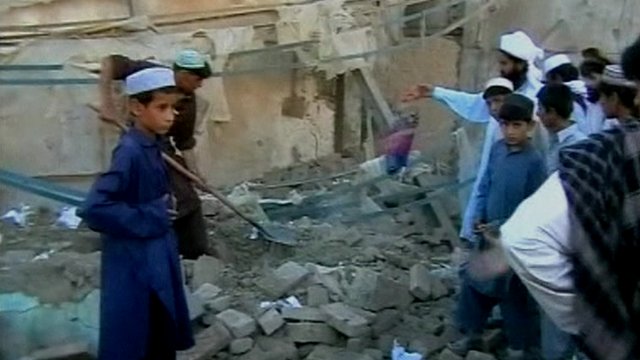
Ten year old Nadia, whose family was incinerated in a drone strike.

For advocacy to be successful, it has to come from a place of empathy rather than superiority. Many of the most vocal advocates of women’s rights in Pakistan today are also known for their sanguine views on the “war on terror.” It is, therefore, doubtful that their new self-image as the deliverers of women from patriarchal tyranny will gain much purchase among the sufferers.

Women have doubtless borne the brunt of the dislocation and insecurity occasioned by the “war on terror.” But, to treat women’s rights in isolation from the general malaise merely serves to put the concern under a pall of suspicion. Women’s rights have been long used as a pretext for imperial aggression. Far from bringing relief, their invocation by the apologists for war merely helps obscurantist criminals, like the TTP, elevate misogyny into an anti-imperial expression.

The situation in Pakistan’s troubled northwest is no doubt ugly. From the indiscriminate violence of the Taliban, the gratuitous butchery of sectarian criminals, the bombing of girls’schools, the targeting of children, to the threats against the media, it is a predicament that is begging for a visionary political solution.
Continue reading “Hawking Women’s Rights”

Bruce Cumings: The Korean War, A History

Bruce Cumings, Chairman of the Department of History at the University of Chicago and author of The Korean War: A History, joins Dean Lawrence R. Velvel on Books of Our Time.

Continue reading “Bruce Cumings: The Korean War, A History”

The Archbishop, Oedipus, and the Golden Ass

The British Labour Party is in the process of rehabilitating Tony Blair. In my latest for Al Jazeera, I follow Archbishop Desmond Tutu’s shot across the bow with one of my own, presenting irrefutable evidence of exactly what Blair knew before he joined Bush’s war against Iraq.

It is a fact that by early 2003, British intelligence had established that Iraq had no weapons of mass destruction or a weapons programme. In several secret meetings in Amman with Iraqi intelligence chief Tahir Jalil al-Habbush, the head of MI6 for the Middle East Michael Shipster had already received detailed reports on the absence of Iraq’s weapons.

This story was confirmed by former MI6 chief Richard Dearlove to Pulitzer-prize winning journalist Ron Suskind who recounts it in considerable detail in his book The Way of the World. According to Dearlove, the meetings happened with the full knowledge of Bush, Cheney, George Tenet and Tony Blair. After the war, Suskind reveals, Habbush was resettled by the CIA and paid $5 million in hush-money to prevent him from undermining the official narrative.

The second claim – that Saddam had to be removed because he was a murderous dictator – would be less incredible if the person making it were not Tony Blair. Blair’s affinity for tyrants is well-documented. His cozy relations with Muammar Gaddafi are well-known; and it has now emerged that at the time Blair was contemplating war on Iraq, he was also considering a knighthood for Syria’s Bashar al-Assad.

You can read the rest here.

Drones: the west’s new terror campaign

by Clive Stafford Smith

Living Under Drones, a new report from Stanford and New York universities, was a difficult piece of fieldwork – I was with the law students in Peshawar as they tried to interview victims of the CIA’s drone war. But it has made an important contribution to the drone debate by identifying the innocent victims of the CIA’s reign of terror: the entire civilian population of Waziristan (roughly 800,000 people).

Until now, the most heated dispute has revolved around how many drone victims in the Pakistan border region are dangerous extremists, and how many children, women or men with no connection to any terrorist group. I have been to the region, and have a strong opinion on this point – but until the area is opened up to media inspection, or the CIA releases the tapes of each hellfire missile strike, the controversy will rage on.

Continue reading “Drones: the west’s new terror campaign”

Living Under Drones

An important new report from the Stanford and New York University law schools finds drone use has caused widespread post-tramatic stress disorder and an overall breakdown of functional society in North Waziristan. In addition, the report finds the use of a “double tap” procedure, in which a drone strikes once and strikes again not long after, has led to deaths of rescuers and medical professionals. Follow the conversation #UnderDrones

Don’t miss Glenn Greenwald’s commentary on the report.

America’s Dangerous Game

This documentary about US intervention in Yemen is a few months old but still just as relevant.

This film reveals the full scale of Washington’s covert war in Yemen and asks: Is the US creating more enemies than it can capture or kill?

World Have Your Say: Syria

From the BBC World Service’s World Have Your Say. Robin Yassin-Kassab of PULSE joins other commentators to bring you the latest developments.

Hiroshima

8:15 am tomorrow will be 67 years since the bombing of Hiroshima. To mark the occasion we are publishing the classic piece by John Hersey which was rated by a hundred US editors and journalists as the greatest work of 20th century journalism. [you’ll have to scroll down to p.5 to start reading].


Continue reading “Hiroshima”

The Drone Morality

Here’s part three of Alternate Focus’s The Drone Wars trilogy. (Also see Part 1 and Part 2)

Who bears responsibly for lethal action when weapons are fully automated? Can a machine have a code of ethics? While their accuracy might, in theory, minimize innocent deaths, drones also enable illegal political assassinations, and by keeping US troops out of harm’s way they also make war easier. A serious debate on these topics is long overdue.