Syria Speaks on Tour

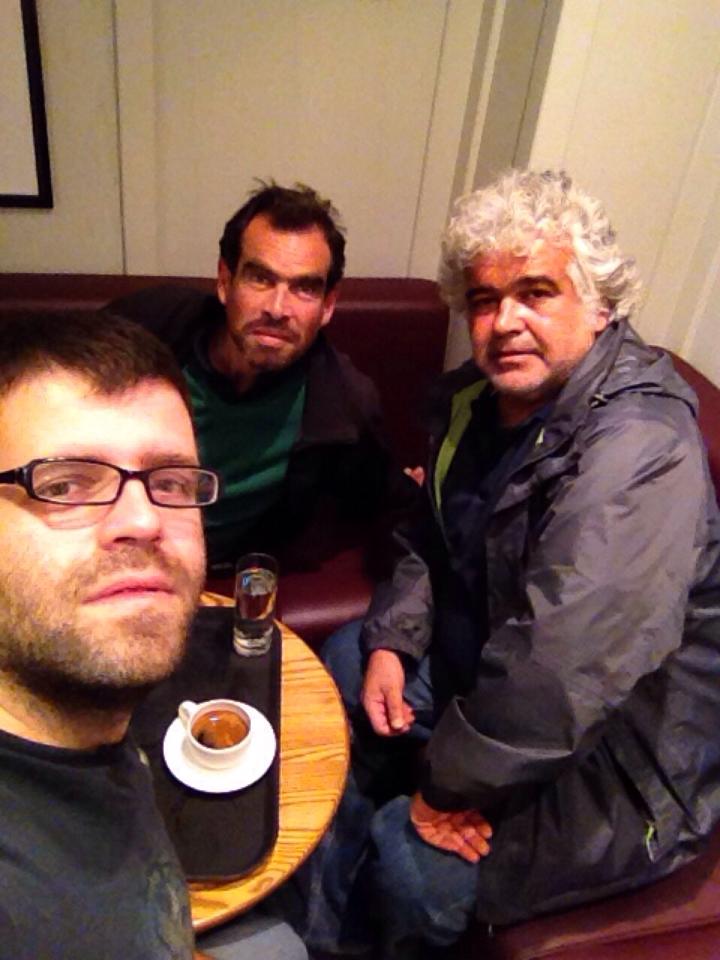
left to right: Khalil, me and Khaled. photo by Khalil.

This was published at the National

For a week in June, Syrian writers and artists toured England, giving readings and workshops to promote “Syria Speaks: Art and Culture From the Frontline”, a book reflecting the country’s new revolutionary culture. British-Syrian novelist Robin Yassin-Kassab describes the experience.

*

In Bradford we met a woman who had tried as hard as she could to forget she was Syrian. We didn’t discover her original trauma, but we heard its symptoms over a British-Pakistani curry. She hadn’t spoken Arabic for years, and never told anyone where she was from. Once a policeman detained her for an hour because she refused to tell him her origin.

In Bristol, on the other hand, we met a little old woman who, with her red hair and flowery dress, we might have mistaken for English. But she was a Damascene, and she wept when I read a description of her city. Afterwards she came to introduce herself. “I’ve lived in England for thirty years, and I didn’t realise until the revolution that I had a fear barrier inside. Then I noticed I’d never talked about Syria. I’d tried not to even think about it. But those brave youths gave me courage; they gave me back my identity and my freedom.”

So the Syrian revolution is alive and well in Bristol if not in Bradford, for this is where the revolution happens first, before the guns and the political calculations, before even the demonstrations – in individual hearts, in the form of new thoughts and newly unfettered words. Syria was once known as a ‘kingdom of silence’ in which public discourse was irretrievably devalued by enforced lip-service to the regime and its propaganda pieties. As a result, many Syrians describe their first protest as an ecstatic event, a kind of rebirth. In “Syria Speaks”, Ossama Mohammed’s story “The Thieves’s Market” concerns a woman who attends the state’s official demonstrations, until her friend is murdered for participating in an oppositional one. “I grew up,” she says, “came of age, abandoned someone and was abandoned, on a march that finished yesterday.” When that coerced march ended and a thousand new ones began, Syrians found unprecedented liberation simply by expressing honest opinions in the presence of their neighbours, by breaking the barriers of fear.

Continue reading “Syria Speaks on Tour”

Egypt’s Invisible Protesters, One Year After the Coup

by Mohamad Elmasry

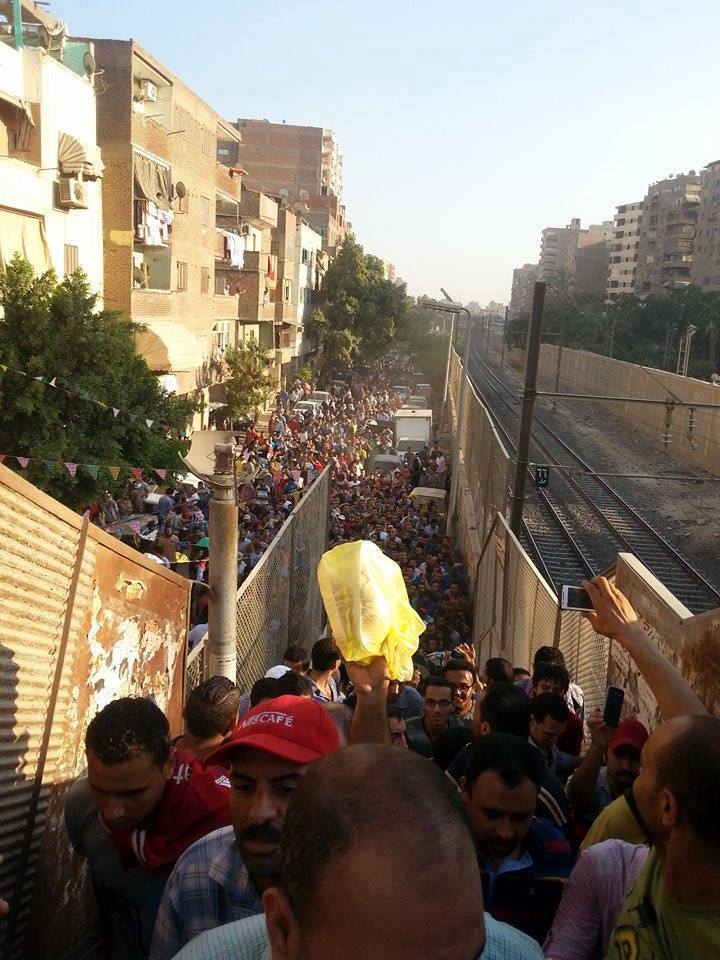
Egypt-coup-anniversary-protestDuring an interview about Egypt with a major Western media outlet three weeks ago, I mentioned the anti-coup protest movement in the country and its relevance as an oppositional force in Egypt’s post-coup political order. The Washington-based journalist who was interviewing me wondered about my assertion, telling me that, according to his knowledge, the protests were small, infrequent and insignificant.

Much Western media coverage of Egypt has failed to offer up the kind of context, nuance, and balance necessary to give news audiences a full sense of the debate and contestation inside the country. Coverage of Egypt’s mass death sentences, jailing of journalists, and human rights abuses notwithstanding, western reportage has, at least on some issues, surrendered to the Egyptian military’s narrative. In particular, many western media outlets seem to have adopted the Egyptian regime’s account that ongoing protests are small and not representative of a significant trend. Western media outlets have largely ignored the anti-coup protest movement that has continued unabated for 365 consecutive days.

Continue reading “Egypt’s Invisible Protesters, One Year After the Coup”

Arena:The 50 Year Argument The New York Review of Books

Martin Scorsese’s documentary film charting literary, political and cultural history as per the New York Review of Books, America’s leading journal of ideas since 1963.

Collective Punishment and the Value of Israeli vs. Palestinian Lives

The following post was written by my colleague and friend Mohamad Elmasry, a Visiting Scholar at the University of Denver’s Center for Middle East Studies whose MA thesis examined American newspaper coverage of death in the Israel-Palestine conflict.

In the aftermath of the tragic killings of three Israeli teenagers, Gaza has been bombed (yet again). More than 30 targets were hit last evening. Israel is good at collective punishment. We know this.

The murder of the three Israeli teens is quite awful. What is also awful is that these three kids will get more news coverage than the hundreds of Palestinian kids killed by Israel in the last several years. Numerous academic research studies all say the same thing: western reportage favors and humanizes the Israeli perspective, while delegitimizing and condemning the Palestinian perspective. The research also shows that Israeli deaths are covered more prominently than Palestinian deaths. For western media, Israeli lives are worth more than Palestinian lives. It’s that simple, really.

Palestinians do not have a military, and — after having been robbed of their land, slaughtered, and kicked out of their homes in 1948 — have been illegally occupied for nearly half a century. For many years, the US and Israel have been virtually the only countries in the world to vote against the UN resolution for “peaceful settlement of the question of Palestine,” which would require Israel to end its illegal occupation. The vote is usually something like 160 to 5 (with the Marshall Islands and Micronesia always voting with the US. and Israel, and the rest of the world voting in the other direction). In November 2012, the vote was 163 to 6. Israel and the US have also systematically obstructed peace negotiations, as has been meticulously documented by Norman Finkelstein and other leading scholars.

The occupation is utterly brutal (one need only consult any of the countless independent eyewitness accounts, or, alternatively, the human rights reports). Palestinians can do nothing without the permission of the Israeli Defense Forces, are not allowed freedom of movement, do not have control over their own resources, and have to put up with the regular home demolitions that make room for illegal Israeli settlements. Over the years, many thousands of Palestinians have been killed — including more than 1,300 children between 2000 and 2011 alone — and many thousands more imprisoned while defending themselves against IDF atrocities.

We Americans give Israel several billion dollars per year in aid. Most of us (Americans) do not know the first thing about the conflict and are too consumed with our busy lives (i.e. sporting events, television shows, movies, etc.) to give a damn what our government does with our tax dollars. To add insult to injury, our national media reportage of the conflict is dreadful, and, occasionally balanced reporting notwithstanding, overwhelmingly projects Palestinians as the aggressors and Israelis as the victims. Many studies have confirmed this basic finding. See the studies cited below, among numerous others.

REFERENCES

Ackerman, S., (2001). “Al-Aqsa Intifada and the U.S. Media.”Journal of Palestine Studies, v30 i2 p61.

Dunsky, M., (2001). “Missing: The Bias Implicit in the Absent.” Arab Studies Quarterly, v23 i3 p1.

Elmasry M. H., (2009) “Death in the Middle East: An Analysis of How the New York Times and Chicago Tribune framed killings in the second Palestinian Intifada.” Journal of Middle East Media 5(1).

Friel, H. & Falk, R. (2007). Israel-Palestine On Record: How the New York Times Misreports Conflict in the Middle East. London-New York: Verso.

Ross, S. D. (2003). “Framing of the Palestinian-Israeli conflict in thirteen months of New York Times editorials surrounding the attack of September 11, 2001.” Conflict & Communication online, vol. 2, No. 2.

Viser, M. (2003). “Attempted Objectivity: An Analysis of the New York Times and Ha’aretz and Their Portrayals of the Palestinian-Israeli Conflict.Harvard International Journal of Press/Politics, Vol. 8 Issue 4, p114.


Mohamad Elmasry is a Visiting Scholar at the Center for Middle East Studies at the University of Denver and an incoming Assistant Professor in the Department of Communications at the University of North Alabama. Previously he was Assistant Professor and Graduate Director in the Department of Journalism and Mass Communication at The American University in Cairo (AUC). His work has appeared in the Journal of Middle East Media, the International Communication Gazette, the Journal of Arab and Muslim Media Research, International Journal of Communication, Global Media Journal, Political Violence @ a Glance, Al Jazeera English, openDemocracy, The Immanent Frame and Jadaliyya, among other publications.
Voices from North Waziristan

Mahvish Ahmad of the indispensable Tanqeed interviews refugees in Bannu, Khyber Pakhtunkhwa, displaced from North Waziristan after the launch of the Pakistani Army’s Operation Zarb-e-Azb. Note that these voices go unheard in the Pakistani media and the nationalist and liberal intelligentsia has been cheering on this “war on terror”.

Beware the Game of Shadows in Syria

I am a signatory to this letter published by the Guardian.

'Hamza Bakour' by Khalil Younes
‘Hamza Bakour’ by Khalil Younes

As supporters of the Syrian people’s struggle for freedom and democracy, we are concerned by the British government’s decision to re-establish diplomatic relations with Iran in response to the crisis in Iraq (Shortcuts, G2, Iran, 18 June).

There is a grave danger that the Iranian government will see this as a licence to extend its already substantial intervention in Syria in support of its client – the Assad regime – which could not have survived this long without Iranian support.

Thousands of troops from the Iranian Revolutionary Guard and the Basij militia are actively fighting in Syria on the regime’s side, as are Iran’s proxies, Hezbollah and the Iraqi Shia militias. To ally with Iran in order to combat Isis is deeply ironic, since there is considerable evidence that the Syrian regime has been colluding with Isis: Assad’s air force bombs civilians, schools, markets and hospitals without mercy but declined to attack Isis’s massive headquarters in Raqqa until the Iraq crisis erupted.

The Syrian regime has been playing a game of shadows in which this covert collusion with the growth of Isis has been used to undermine the democratic opposition and strengthen its own claim to be a bulwark against “terrorism”. To accept Iran – and by implication Bashar al-Assad – as allies in the fight against Isis is to fall for this deception.


Peter Tatchell, human rights campaigner, Haytham Alhmawi, director of Rethink Rebuild Society, Reem Al-Assil, activist, Adam Barnett, journalist, James Bloodworth, editor of Left Foot Forward, Mark Boothroyd, International Socialist Network, Sasha Crow, founder of Collateral Repair Project for Iraqi and Syrian Refugees, Naomi Foyle, writer and coordinator of British Writers in Support of Palestine, Christine Gilmore, Leeds Friends of Syria, Bronwen Griffiths, writer and activist, Juliette Harkin, associate tutor, University of East Anglia, Robin Yassin Kassab, author and co-editor of Critical Muslim, Tehmina Kazi, human rights activist, Maryam Namazie, Fitnah – Movement for Women’s Liberation and Equal Rights Now – organisation against women’s discrimination in Iran, Fariborz Pooya, Worker-communist party of Iran UK, Mary Rizzo, activist, translator and blogger, Christopher Roche, Bath Solidarity, Naame Shaam campaign group http://www.naameshaam.org, Brian Slocock, political scientist and blogger on Syria, David St Vincent, contributing writer and editor, National Geographic Books, Luke Staunton, Merseyside Syria Solidarity Movement – UK Continue reading “Beware the Game of Shadows in Syria”

Newsnight: What makes ISIS tick in Iraq and Syria?

Pulse editor Robin Yassin-Kassab on the BBC’s Newsnight show discussing ISIS in Iraq and Syria.

Time to Act: End Sexual Violence as War Weapon and End Impunity to Indian Armed Forces in Kashmir

As the world looks to the Global Summit on Ending Sexual Violence in Conflict as a ‘pioneering’ movement, we must speak against rape as a weapon of war in Kashmir, and foreground the survivors whose suffering you have neglected throughout the two-year high profile global campaign.

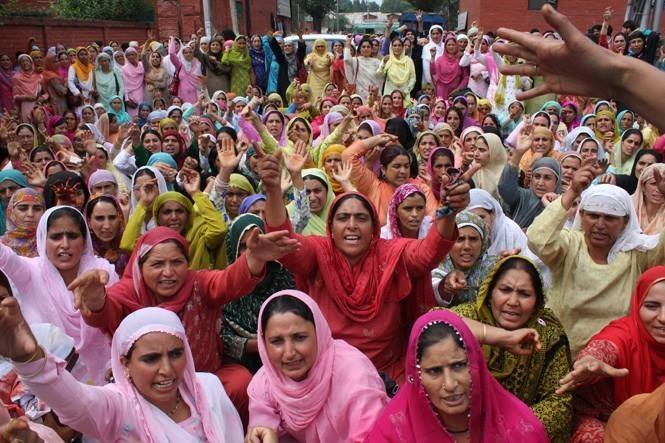
Women protesting in the Press Enclave, Lal Chowk, Srinagar, against the double rape and murder of Shaheed Aasiya and Shaheed Nilofar, from Shopian, by the Indian Occupation Army. 2009  Photo Credit: Bilal Bahadur
Women protesting in the Press Enclave, Lal Chowk, Srinagar, against the double rape and murder of Shaheed Aasiya and Shaheed Neelofar, from Shopian, by the Indian Occupation Army. 2009
Photo Credit: Bilal Bahadur

Rt Hon William Hague MP
Secretary of State for Foreign and Commonwealth Affairs
Foreign & Commonwealth Office, UK

12 June, 2014

Time to Act: End Sexual Violence as War Weapon and End Impunity to Indian Armed Forces in Kashmir

Dear Foreign Secretary,

As the world looks to the Global Summit on Ending Sexual Violence in Conflict as a ‘pioneering’ movement, we must speak against rape as a weapon of war in Kashmir, and foreground the survivors whose suffering you have neglected throughout the two-year high profile global campaign.

We are writing to ask you to support an independent international investigation into the rapes and sexual violence that continue to take place in Kashmir since 1989 as a weapon of war. Crimes of sexual violence and sexual torture against Kashmiris have been extensively documented by international human rights organisations such as Human Rights Watch, Amnesty International, and Médecins Sans Frontière (Doctors Without Borders). According to one such report, “Rape in Kashmir: A Crime of War” (by Asia Watch of HRW and Physicians for Human Rights), Indian Armed Forces have used rape in Kashmir as a weapon of war to punish, intimidate, coerce, humiliate and degrade Kashmiri women and men. The Indian State grants its military forces occupying Kashmir legal impunity so that they cannot be prosecuted for rape and other violent crimes including murder. It is time for the international community to break its long and unconscionable silence over rapes in the internationally recognized disputed region of Kashmir.

Continue reading “Time to Act: End Sexual Violence as War Weapon and End Impunity to Indian Armed Forces in Kashmir”