I haven’t been writing about Syria at my previous pace. The time is not right.
This is a time for Syrian internet activists, those still surviving, to send us their videos. It’s a time for gathering evidence – although no more evidence is needed.
It’s a time for reporters to write, for committed foreign journalists to smuggle themselves inside and tell the tale. (You could call the murdered journalists martyrs, because they chose to go to a place where they knew they might die, and they did so for the sake of the truth.)
People who have specific human stories to tell should tell them. I hear the occasional story, and I might relay some of them; but I am not there. I am observing from Scotland.
This time is the beginning of a long process of creative mulling for those who will eventually produce novels and films concerned with the tragedy.
Most of all it’s a time in which people scream and suffer and die, a time to wait for the next explosion, or the next kick at the door, or for the return of the rapists, or for the next shriek of pain and humiliation from the neighbouring cell. It’s a time for burying children at night, hastily, in silence. And the suffering continues with glacial inevitability. Fate doesn’t seem to plan an end to it, not yet.
Returning last week from an instructive three weeks in Pakistan, I was detained briefly at Islamabad’s chaotic airport after an X-ray machine showed two highly suspicious music CDs and a USB memory stick in my check- in bag.
The music was of Mehdi Hassan, my favorite singer in South Asia, and the USB was part of a PR packet given to me by a Bangkok hotelier. It didn’t matter. For nearly three hours, two men in shalwar kameez — members of one of Pakistan’s intelligence agencies — supervised customs and immigration officials, and even the staff of my Middle Eastern airline, through an extensive scrutiny of my bags and the many visas in my passport.
These plainclothed, thuggish-looking men seemed to confirm the popular Western stereotype of Pakistan’s “deep state,” a vast subterranean network of soldiers, spies, and militants-for- hire that actually runs the country while the state fails to provide health care and education to a largely poor and illiterate population of nearly 190 million. Continue reading “Pakistan’s Unplanned Revolution Rewrites Its Future”
Once again, we encourage readers to tune in to this excellent program produced by the Tax Justice Network. Hosted by Naomi Fowler, each 15 minute podcast follows the latest news relating to tax evasion, tax avoidance and the shadow banking system. The show will feature discussions with experts in the field to help analyse the top stories each month.
In this month’s episode Taxcast looks at Amazon’s tax affairs, the global tax cut race to the bottom, India tackling tax havens and the miners in Zambia who pay more tax than the multi-national mining company.
This is a very significant moment in American television history. Over a year back Bob Simon of CBS’s 60 Minutes had provided first glimpses to an American mainstream audience of the Palestinian lives being disrupted by Israeli occupation. He now returns to the Holy Land to debunk Israeli claims (made most recently by Israeli ambassador Michael Oren) about the thriving Christian presence in the historic lands. If you can ignore Simon’s statements about the security allegedly being provided by the wall, you’ll find the last couple of minutes, where he makes the generally composed Michael Oren squirm by confronting him over his attempts to suppress the 60 minutes investigation, quite satisfying. You can measure the significance of this segment from the fact that Israeli prime minister Benjamin Netanyahu himself got involved in attempts to pressure CBS into abandoning the investigation; it has since been described by Israeli officials as a ‘strategic terror attack‘, and ADL has issued an official condemnation.
Meanwhile, our friends at Jewish Voices for Peace have launched a campaign to thank 60 Minutes for its hard-hitting coverage. We’d encourage all readers to take a few minutes to sign their petition.
I have never had the patience for long-winded novels, and much less for memoirs, but I am glad I persuaded myself to read Imran Khan’s Pakistan: A Personal History. Now that Tehreek-e-Insaaf , the political party founded and led by Imran Khan, gathers momentum – after many years in the political wilderness – and may yet grow to challenge the established political parties in the next elections, it is time to take a closer look at the man who leads this party, and promises to restore justice and dignity to Pakistan’s long-suffering but mostly passive population.
Once I had gotten past the Prologue – which I thought did not belong at the beginning of the book – Khan’s narrative never lost its power to sustain my interest. The book takes the reader through many unexpected shifts in the protagonist’s life – from cricket to charity work, from charity work to politics, from the life of a celebrity to a life of piety, from disdain for Islam to a deepening respect for its richness and depth, from contempt (a colonial legacy common to Pakistan’s elites) for ordinary Pakistanis to a growing concern for their tormented lives, from wilting shyness before audiences to a determination to face the glare of public life, from growing anxiety about Pakistan’s problems to an unshakable resolve to do something about them; etc. In short, the book takes the reader through the life of an extraordinary man, at first fully immersed in the privileges of his class and his cricket celebrity but slowly turning inwards, questioning the colonial mindset of his own privileged class, angry at the limitless corruption of Pakistan’s rulers, and, finally, reaching resolution in his commitment to take Pakistan back from its corrupt elites. A politician with Imran Khan’s record would be rare in Western ‘democracies.’ In a country like Pakistan, mired for decades in the corruption of rapacious elites, he is an anomaly – an outlier. Should the Pakistanis embrace Imran Khan, should they give him the chance to pick and lead the nation’s political team, this could be a game-changer for their country.
In a departure from the usual Fighting Words format, American author Norman Mailer sits down for an in-depth discussion of “hip.” Mailer, a self-proclaimed philosopher of hip, teaches host Nathan Cohen about the differences between hips and squares, and discovers the true meaning of hip as the two men chain-smoke their way through this wonderful 1960 interview. Be there or be square.
The following is an excerpt from the brilliant new take-down of famed French “philosopher” Bernard Henri-Lévy by Jade Lindgaard and Xavier de la Porte. Titled The Impostor: BHL in Wonderland, the book is part of the recently inaugurated Verso Counterblasts series. The excerpt was published at Al Jazeera.
On June 5, 2011, nearly three months into the war against the Gaddafi regime, the Libyan rebel forces issued a corrective communiqué referring to Bernard-Henri Lévy. It said that the National Transitional Council (NTC), the political body representing the insurgents fighting the Tripoli regime, “vehemently rejects what has been reported in some media as Mr Bernard Lévy’s comments on the future relationship between Libya and the Israelis”. The communiqué continued: “The NTC is surprised by Mr Lévy’s comments,” and – an intriguing detail – “Mr Lévy was received as a special envoy from the president of France, and relations with Israel were never discussed.”
What was going on? The event had passed unnoticed at first, but three days earlier, Agence France Presse (AFP) had come up with a considerable scoop if turned out to be authentic. A real breakthrough in the history of relations between Israel and the Arab countries: the NTC was apparently prepared to recognise the state of Israel and maintain “normal relations” with it. That was the “verbal message” that Bernard-Henri Lévy had come to deliver to the Israeli prime minister, Binyamin Netanyahu, on behalf of the Libyan Council.
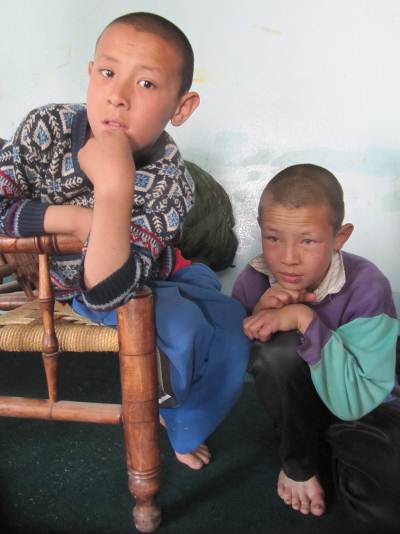
Two Afghan youth taking refuge together with the Afghan Peace Volunteers
Last weekend, in Kabul, Afghan Peace Volunteer friends huddled in the back room of their simple home. With a digital camera, glimpses and sounds of their experiences were captured, as warfare erupted three blocks away.
The fighting has subdued, but the video gives us a glimpse into chronic anxieties among civilians throughout Afghanistan. Later, we learned more: Ghulam awakens suddenly, well after midnight, and begins to pace through a room of sleeping people, screaming. Ali suddenly tears up, after an evening meal, and leaves the room to sit outside. Staring at the sky and the moon, he finds solace. Yet another puzzles over what brings people to the point of loaning themselves to possibly kill or be killed, over issues so easily manipulated by politicians.
I asked our friend, Hakim, who mentors the Afghan Peace Volunteers, if ordinary Afghans are aware that the U.S. has an estimated 400 or more Forward Operating Bases across Afghanistan and that it is planning to construct what will become the world’s largest U.S. Embassy, in Kabul. Hakim thinks young people across Kabul are well aware of this. “Do they know,” I asked, “that the U.S. Air Force has hired 60,000 – 70,000 analysts to study information collected through drone surveillance? The film footage amounts to the equivalent of 58,000 full length feature films. The Rand Corporation says that 100,000 analysts are needed to understand ‘patterns of life’ in Afghanistan.”
Hakim’s response was quick and cutting: “Ghulam would ask the analysts a question they can’t answer with their drone surveillance, a question that has much to do with their business, ‘terror’: “You mean, you don’t understand why I screamed?”

 Returning last week from an instructive three weeks in
 I have never had the patience for long-winded novels, and much less for memoirs, but I am glad I persuaded myself to read Imran Khan’s Pakistan: A Personal History. Now that Tehreek-e-Insaaf , the political party founded and led by Imran Khan, gathers momentum – after many years in the political wilderness – and may yet grow to challenge the established political parties in the next elections, it is time to take a closer look at the man who leads this party, and promises to restore justice and dignity to Pakistan’s long-suffering but mostly passive population.