These images speak for themselves.
This is Egypt: Footage from November 19 – 22
These images speak for themselves.
These images speak for themselves.
This review appeared in the Guardian.
The Arabian Nights (or the Thousand and One Nights, or the Arabian Nights Entertainments – there are so many versions) constitute, in Marina Warner’s words, “a polyvocal anthology of world myths, fables and fairytales.” The antecedents of these Arab-Islamic texts are Quranic, Biblical, Indian, Persian, Mesopotamian, Greek, Turkish and Egyptian. In them, oral and written traditions, poetry and prose, demotic folk tales and courtly high culture mutate and interpenetrate. In their long lifetime the Nights have influenced, amongst many others, Flaubert, Wilde, Marquez, Mahfouz, Elias Khoury, Douglas Fairbanks and the Ballets Russes.
The frame story, in which Shahrazad saves her life by telling King Shahryar tall tales, is only one such ransom. More than simple entertainment, then: throughout these stories within stories, and stories about stories, and stories metamorphosing like viruses, endlessly generative, narrative even claims for itself the power to defer death.
The Syrian regime’s blanket ban on journalist access has some carefully selected exceptions. Robert Fisk, for instance, who seems to be compensating for the naive anti-Syrian and pro-March 14th line in his reporting of Lebanon over the last years by treating the statements of Syrian regime figures – professional liar Boutheina Shaaban is one – with great naivety. At least he didn’t apply the ‘glorious’ epithet to her which he used to describe Walid Jumblatt’s wife. Fisk’s book on Lebanon “Pity the Nation” is a classic, his account of the massacres at Sabra and Shatila remain fresh in the mind (the blood-footed flies clambering over his notebook), and for many years he was one of the very few English-language journalists with some real knowledge of the Middle East. Sadly, his knowledge doesn’t extend to a working familiarity with Arabic. In several recent articles he has informed us that that the slogan of the Ba‘ath Party – umma arabiya wahda zat risala khalida – means ‘the mother of the Arab nation.’ In fact it means ‘one Arab nation with an eternal message’. Fisk is confusing ‘um’ – mother – with ‘umma’ – nation. It’s a rather disastrous mistake. Someone ought to tell him about it.
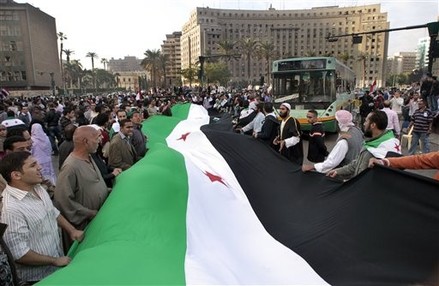
Jihan Hafiz reports that dozens killed as Egyptians demand a civilian government.
Fresh from his scrimmage with the Murdoch press, Steve Coogan, creator of the comedy classic ‘I’m Alan Partridge’, takes on the casual racism of the BBC’s Top Gear. (via The Guardian)

As a huge fan of Top Gear, I normally regard the presenters’ brand of irreverence as a part of the rough and tumble that goes with having a sense of humour. I’ve been on the show three times and had a go at their celebrity-lap challenge, and I would love to receive a fourth invite. But I think that’s unlikely once they have read this. If, however, it makes the Lads question their behaviour for a second – ambitious, I know – it will be worth it.
I normally remain below the parapet when these frenetic arguments about comedy and taste break out. But this time, I’ve had enough of the regular defence you tend to hear – the tired line that it’s “just a laugh”, a bit of “harmless fun”.
Some of the Lads’ comments again, in case you missed them. “Mexican cars are just going to be lazy, feckless, flatulent, overweight, leaning against a fence asleep looking at a cactus, with a blanket with a hole in the middle on as a coat” (Richard Hammond). Mexican food is “sick with cheese on it” (James May).
Jeremy Clarkson added to the mirth by suggesting that the Mexican ambassador (a certain Eduardo Medina-Mora Icaza) would be so busy sleeping he wouldn’t register any outrage. (He wasn’t and he did.)
OK, guys, I’ve got some great ideas for your next show. Jeremy, why not have James describe some kosher food as looking like “sick with cheese on it”? No? Thought not. Even better, why not describe some Islamic fundamentalists as lazy and feckless?
Maher Arar, who was rendered to Syria by the CIA and tortured by the regime on behalf the United States, speaks about the conflict in Syria.
In this episode of Slavery: A 21st Century Evil, Al Jazeera’s Rageh Omaar investigates slavery that is passed down from father to son, mother to daughter.
The Israeli blockade may have taken a heavy toll on Gazans, but this film reveals life and hope among the devastation.
by Kathy Kelly and Hakim
“You can’t listen only to leaders,” Hakim tells them. “We must put our ears close to the hearts of ordinary people and listen to them.” Hakim is often poetic, but he’s also a trained physician, prone toward assembling data and seeking careful diagnosis.
Rising early this morning, he prepared for today’s presentation by collecting statistics about government responses, in various parts of the world, to massive manifestations of public opinion. As expected, the short survey showed that leaders aren’t listening well to ordinary people, that ‘national interests’ routinely overrule the people’s interests:
72% of Australians want their troops to be withdrawn from Afghanistan.
But Prime Minister Julia Gillard insists that Australian troops will remain “till the end of the decade, at least.”
63% of Americans oppose the Afghan war.
But the US is about to sign a US-Afghan Strategic Partnership Agreement that will allow joint military bases in Afghanistan beyond 2024.
The amazingly talented Canadian-Palestinian spoken word poet, Rafeef Ziadah, answers.

