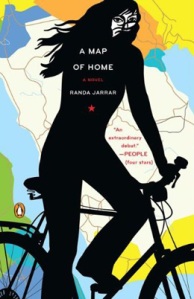
 This review was also published in the Electronic Intifada.
Randa Jarrar’s “A Map of Home” is a beautifully achieved coming of age novel which follows a clever girl through a war, a domestic battlefield, and repeated forced migrations. For our heroine, these events are aspects of the normal everyday stuff (because everything’s normal when it happens to you), like school, friends, family, and shopping. Despite the geographical and cultural particularities of the story, the themes – of awakening sexually, of learning how to love a parent yet firmly say no, and of struggling for independence and a place in the world – are universal, and the book will appeal to all but the most easily shocked readers.
At the novel’s centre is a family. The father, Waheed, is a Palestinian from Jenin exiled to a string of temporary residences. Resentful of his failure to develop a career as a poet, he projects his ambition onto his daughter, about whom Waheed is convincingly self-conflicted: he wants her to be a famous professor, but doesn’t want her to study away from home.
 By Joseph Shansky
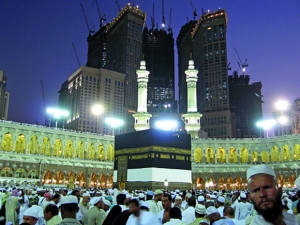 The contemporary religious revival is a complex business. In the same period that Muslim societies, in their weakness, seem to have re-embraced Islam, America, in its strength, has re-embraced Christianity. Western Europe remains avowedly secular. Despite the contradictions within the West, mainstream Orientalism holds that all cultures are developing towards the universal (or, more specifically, globalised) model of secular modernity and the market. The Muslim world experiences backwardness to the extent that it resists secularisation.


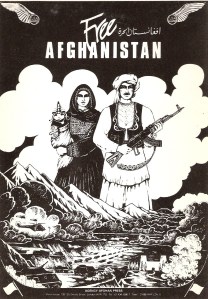 A British artist made these impressive propaganda posters during the Afghan war against the Soviet occupation. They were also printed as postcards. The picture to the right was sent out as a christmas card by Agency Afghan Press in the UK, prompting London’s Evening Standard to wonder, jokingly, if the three figures represented Joseph, Mary and Jesus. The picture to the left was made for Gulbedeen Hekmatyar’s Hizb-i-Islami, which then had a London office. The pictures raised no horrified eyebrows in the UK – of course not: the Afghan people and the Thatcher and Reagan administrations were all on the same side, for freedom, against godless Soviet communism interfering with a traditional culture. Today, however, Hekmatyar is fighting the NATO occupation of his country, and were a British artist to dare paint an Afghan mujahid, with Qur’an in one hand and kalashnikov in the other, standing on an American flag, underneath a calligraphed ‘Allahu Akbar’, he would quite probably be charged under anti-terror legislation.
 P U L S E