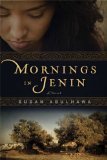
Mornings in Jenin

This review was published in today’s Times.

According to the Zionist story, Palestine before the state of Israel was ‘a land without a people awaiting a people without a land.’ Writers from Mark Twain to Leon Uris, as well as Hollywood studios and certain church pulpits, retell the tale. But Palestinians, in the West at least, lack a popular counter-narrative. Palestinians are reported on, met only on the news.

Perhaps this is changing. As the land disappears from under their feet Palestinians have been investing in culture, and an explosion of Palestinian talent is becoming visible in the West, in films, hip-hop, poetry and novels. And now Susan Abulhawa’s “Mornings in Jenin” is the first English language novel to fully express the human dimension of the Palestinian tragedy.

The story begins with the Abulheja family at home in the village of Ein Hod near Haifa, marrying, squabbling, trading, and harvesting the olives. It’s a touching and sometimes funny portrait of rural life with hints of the city (notably the Jerusalem-based Perlsteins, refugees from German anti-Semitism) and the Beduin tribes.

Then comes the Nakba, or Catastrophe, of 1948. Driven from their shelled village, the family suffers loss, separation, and humiliation, ending up in a camp in Jenin where “the refugees rose from their agitation to the realisation that they were slowly being erased from the world.” By now we care very much about the key characters, and through them we experience “that year without end”, the interminably drawn out Nakba which stretches through some of the bloodier signposts of Palestinian history – the Naksa or Disaster of 1967, the Lebanese refugee camp massacres, until the 2002 Jenin massacre.

Continue reading “Mornings in Jenin”

Israeli kidnapped on Lebanese border

Ok, so relax. It’s not true. I mean, if that had really happened, we would know about it, right? It would be all over the 24hr news, analysts would be wondering what it meant for the region, and whoever was responsible for snatching the civilian would be condemned as carrying out a gross provocation. In the event that the Israeli citizen was quickly released, we would all breathe a sigh of relief.

So let’s be glad that nothing like this has happened.

Israel allegedly snatched Rabih Zahra from an area along the Lebanese border with Israel on Sunday.

According to the source, Zahra’s arrest represents a violation of UN Security Council Resolution 1701, which ended Israel’s 2006 war on Lebanon…

A joint Lebanese army and UN team inspected the area from which Zahra was taken and announced he was arrested on Lebanese territory.

Zahra claimed that Israeli soldiers had beaten him and asked him about the activities of the Lebanese Shiite Movement, Hezbollah, in southern Lebanon.

A Eurocentric Problem

M. Shahid Alam

Cartographic violence

He who knows himself and others
Here will also see,
That the East and West, like brothers,
Parted ne’er shall be.

Goethe[1]

In no other major civilization do self-regard, self-congratulation and denigration of the ‘Other’ run as deep, nor have these tendencies infected as many aspects of their thinking, laws, and policy, as they have in Western Europe and its overseas extensions.[2] These tendencies reached their apogee during the nineteenth century, retreated briefly after World War II, but have been staging a come back since the end of the Cold War.

For several decades now, critics have studied these Western tendencies under the rubric of Eurocentrism, a complex of ideas, attitudes, and policies, which treat Europe — when it is convenient — as a geographical, racial and cultural unity, but places Western Europe and its overseas extensions at the center of world history since 1000 CE.[3]

Unlike the garden variety of ethnocentrism, Eurocentrism emerged as an ideological project — shaped by Europe’s intellectual elites — in the service of Europe’s rising expansionist states, starting in the sixteenth century. It makes sweeping claims of European superiority in all spheres of civilization. In this worldview, only Europeans have created history over the past three thousand years, beginning with the ancient Greeks. In various accounts, this centrality is ascribed to race, culture, religion and geography.

Continue reading “A Eurocentric Problem”

The Only Democracy in the Middle East: 5.2.2010

Israeli army hits hard against children and saplings in Nebi Salah:

Continue reading “The Only Democracy in the Middle East: 5.2.2010”

Ethan Bronner’s Conflict With Impartiality

by Alison Weir

Ethan Bronner, New York Times Jerusalem Bureau chief

Ethan Bronner is the New York Times Jerusalem bureau chief. As such, he is the editor responsible for all the news coming out of Israel-Palestine. It is his job to decide what gets reported and what doesn’t; what goes in a story and what gets cut.

To a considerable degree, he determines what readers of arguably the nation’s most influential newspaper learn about Israel and its adversaries, and, especially, what they don’t.

His son just joined the Israeli army.

According to New York Times ethics guidelines, such a situation would be expected to cause significant concern. In these guidelines the Timesrepeatedly emphasizes the importance of impartiality.

This is considered so critical that the Times devotes considerable attention to “conflict of interest” (also called “conflict with impartiality”) problems, situations in which personal interest might cause a journalist to intentionally or unconsciously slant a story.

Continue reading “Ethan Bronner’s Conflict With Impartiality”

Is One Iraqi’s Self-Hatred Newsworthy?

Crusaders in Iraq?

M. Shahid Alam

An Arab-American of Lebanese descent, fluent in Arabic, Anthony Shadid was one of a handful of unembedded Western journalists reporting from Iraq during the US invasion in 2003. At the time, he was The Washington Post’s correspondent for Islamic Affairs in the Middle East.

His dispatches from Iraq were about Iraqis, about the destruction visited upon them by a war whose architects claimed that they were bringing democracy to that country. He reported the destruction and mayhem caused by this war by letting the Iraqis speak for themselves: and they spoke of their pain, their anguish, their perplexity and their anger.

For his honest reporting, for a job well done, Anthony Shadid received some of the highest accolades of his profession. In 2004 he received the Michael Kelly Award and the Pulitzer Prize for international reporting. Other honors followed, all well-deserved. He had won his spurs for reporting, not cheerleading, neither praising nor denouncing the United States. He was reporting for The Washington Post, a neoconservative newspaper.

On Jan 29, I noticed for the first time a report in The New York Times that carried Anthony Shadid’s byline. Was this a promotion? It was written from Halaichiya, a remote village in the southern tip of Iraq, untouched by the war. The village has never seen Americans before, neither troops nor diplomats.

Continue reading “Is One Iraqi’s Self-Hatred Newsworthy?”

America’s new right: Racist and proud of it

When I read The Washington Post’s report on the opening of the far-right wing’s Tea Party convention in Nashville, I was taken aback by the remarks of former Republican Congressman and white nationalist Tom Tancredo. While racism undeniably persists in driving a good deal of the American political agenda, the degree to which Tancredo and his ilk in the increasingly mainstream right-wing can be overt and blatant in their bigotry is remarkable and worrying. Here’s what I mean:

On Thursday night, giving the opening address, former U.S. representative Tom Tancredo (Colo.), who ran for the 2008 Republican presidential nomination as an anti-immigration candidate, railed against Obama and “the cult of multiculturalism.” Americans could be “boiled to death in a cauldron of the nanny state,” he said. “People who couldn’t even spell the word ‘vote,’ or say it in English, put a committed socialist ideologue in the White House.”

When Tancredo said, “His name is Barack Hussein Obama,” the audience booed loudly.

MSNBC’s Rachel Maddow recaps:

Canada’s pandering to Israel

By Ian Williams (MEI)

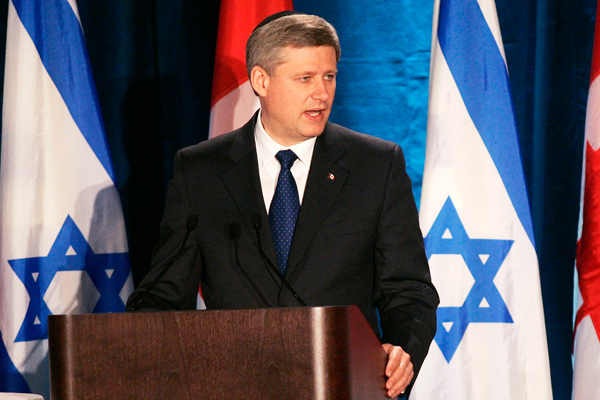
In January, Canada stopped contributing to the United Nations Relief and Works Agency (UNRWA). It is the latest in a series of decisions that have seen Ottawa ‘out-Israeling’ Washington. It had previously stopped funding KAIROS (Canadian Ecumenical Justice Initiatives), an NGO that had been supporting human rights groups in Israel and the Occupied Territories. In each case, the government of Stephen Harper seemed to be responding to, or rather pandering to, rabidly pro-Israeli Jewish groups in Canada. Israel itself has certainly never encouraged an end to the funding of UNRWA, an institution that for decades has, in effect, been paying some of the bills for the occupation.

Although camouflaged internationally by a similar drift in British and Australian policy, Ottawa has moved far from its own earlier positions, and possibly farther than either London or Canberra. Indeed, the Obama administration’s muted criticisms of Israeli policy sound relatively ferocious compared with Canada’s gestures towards the administration of Binyamin Netanyahu.

Once upon a time, Canada was a paragon of international virtue: supportive of the UN and happily putting distance between itself and its southern neighbour on the Middle East. Then came Stephen Harper. Ottawa did not join the Iraq war, but that was more a function of strong Canadian public opinion and Harper’s parlous electoral position than any considered choice.

Continue reading “Canada’s pandering to Israel”

Remember Zinn by Organizing

by Ralph Nader

There are several memorial services and events being planned for Howard Zinn whom The New York Times called a “historian, shipyard worker, civil rights activist and World War II bombardier, when he passed away at age 87 late last month.”

His legion of friends, students, admirers and colleagues will be out in force reminding the country about his impact as a civic leader, motivational teacher, author of the ever more popular book A People’s History of the United States, and all around fine, compassionate, and level-headed human being.

Judging by similar gatherings for remembering other progressive activists and writers, the encomiums for Professor Zinn, who taught at Spelman College in the late fifties and early sixties (two of his students were Marian Wright Edelman and Alice Walker) and at Boston University until 1988, will be heartfelt, wide-ranging and inspiringly anecdotal.

Receptions will follow and those in attendance will return to their homes, hoping that what Howard Zinn spoke and wrote and how he acted will serve as an example for those who follow his public philosophy of being and doing.

Continue reading “Remember Zinn by Organizing”

BRICUP’s Open Letter to Elton John

BRICUP‘s excellent letter is worth posting. You can send your own messages to Elton John at

Playing for the prison wardens?

editor@eltonjohn.com

Dear Elton John

Like much of the world, we think you’re a good bloke. You came out when it was difficult; you admitted your addictions were stronger than you were; you’ve poured money into AIDS research. Oh, and then there’s the music – not bad at all.

But we’re struggling to understand why you’re playing in Israel on June 17. You may say you’re not a political person, but does an army dropping white phosphorus on a school building full of children demand a political response? Does walling a million and a half people up in a ghetto and then pounding that ghetto to rubble require a political response from us, or a human one?

We think it needs a human response, and we think that by choosing to play in Tel Aviv you’re denying this. You’re behaving as if playing in Israel is morally neutral – but how can it be? How can the cruelties Israel practises against the Palestinians – fundamentally because the Palestinians are there, on Palestinian land, and Israel wants them to go – be morally neutral?

Continue reading “BRICUP’s Open Letter to Elton John”