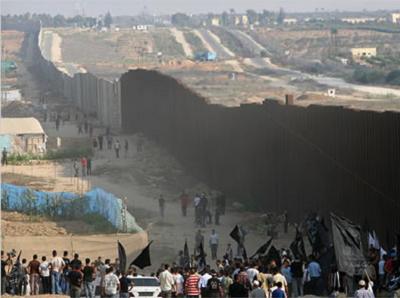
 As expected, the Egyptian client regime allowed only a token number of Gaza Freedom Marchers to enter the besieged prison territory. Roughly 1400 activists from 43 countries were forced to remain in Cairo, where they managed to demonstrate outside various embassies and in the central Tahrir Square. Egyptian police turned out in huge numbers to harass the protestors and, most crucially, to stop Egyptians from coming into contact with them. (Ali Abunimah has been blogging on events in Cairo). The Freedom Marchers chanted ‘ash-sha’ab al-misri ma’ana – The Egyptian People Support Us’, a slogan which is undoubtedly true. The Egyptian regime, meanwhile, with the help of American military engineers, is building a metal wall across the frontier with Gaza which will reach deep underground and cut off the tunnels which are Gaza’s only lifeline. The corrupt Azhar Mosque authorities have declared this crime to be compatible with Islamic law.
The Gaza Freedom Marchers approved today an important declaration aimed at accelerating the global campaign for Boycott, Divestment and Sanctions (BDS) against Israeli Apartheid. The Cairo Declaration deserves the widest possible circulation.
Cairo Declaration
January 1, 2010We, international delegates meeting in Cairo during the Gaza Freedom March 2009 in collective response to an initiative from the South African delegation, state:
Continue reading “The Cairo Declaration to End Israeli Apartheid”

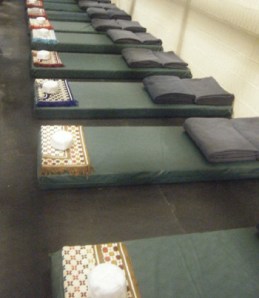 In a notification filed on December 30th in a U.S. District Court for the District of Columbia, the Justice Department has announced that in addition to shifting prisoners from Bagram to a newly built facility nearby, the Pentagon also intends to demolish the original facility at Bagram. According to the notification, the Department of Defense will shift prisoners to the new facility by January 19th. Shortly thereafter, plans to demolish the Bagram facility will be put into effect.
 P U L S E