US wavers on Middle East

Barack Obama, who even today was lecturing Iran in the obnoxious school-masterly tone which American presidents feel obliged to adopt in their declamations, once again turns a blind eye when the violence is pepetrated by a friendly despot.

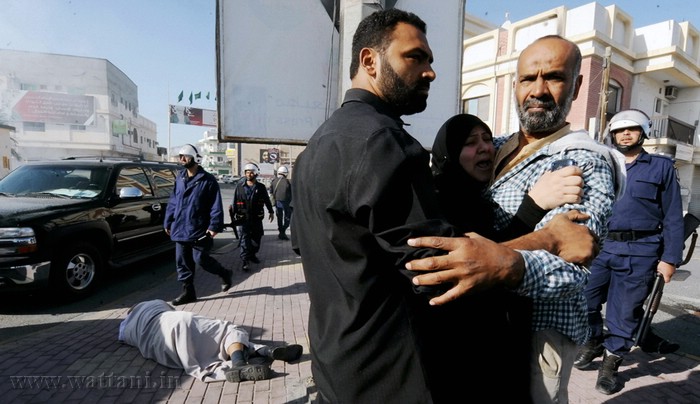
The US and president Barack Obama continue to waver in their position regarding the unrest sweeping through the Middle East. The country says it will not dictate events in the region. But Obama has criticised the Iranian government’s violent response to protests there, while at the same time maintaining a more neutral tone with Bahrain. Many find the US’s response disappointing, and some feel the White House will only react strongly to those governments it does not have a stake in.

Al Jazeera’s Patty Culhane reports.

And this is the kind of violence that is being wrought by this ‘reliable ally.’
Social networks, social revolution

Al Jazeera Empire: Youtube, Facebook and Twitter have become the new weapons of mass mobilisation. Are social networks triggering social revolution? And where will the next domino fall?

“Diplomatic Immunity” or Murder with Impunity? And Who’s a Diplomat Anyway?

triple murders, a suicide, and the unraveling of a spy and a covert war…

by Huma Dar

On Thursday, 27th of January, 2011, while the world was busy watching — or ignoring, as the case might be — the inspiring Egyptian Revolution, in broad daylight, in a very busy part of Lahore (Pakistan), in front of hundreds of eye-witnesses, American contractor, Raymond Davis, murders two or by some accounts even three people: Muhammad Faheem (aka Faheem Shamshad?) (age 26), Faizan Haider (age 22), and Ibad-ur-Rehman.  Davis shoots the former two, who had allegedly threatened to rob him, from within his locked car, with seven bullets — each bullet expertly and fatally finding its mark.  The windshield shows the piercing trajectory of the fatal bullets, but otherwise remains miraculously unshattered.  Davis, then, emerges calmly from his well-equipped car (see descriptions below), shoots Faizan from the back while Faizan was running away (how “dangerous” is that?! does the excuse of “self-defence” hold when one of the victims was running away?), takes photographs and videos of both his victims with his cellphone, gets back into his car, and drives off unruffled, to flee the scene.  Faizan Haider was still alive — he expired later in the hospital.  What an act of “responsibility” from a “diplomat” of the self-ascribed global policeman!
Continue reading ““Diplomatic Immunity” or Murder with Impunity? And Who’s a Diplomat Anyway?”

The Autumn of the Patriarch

Brother Leader

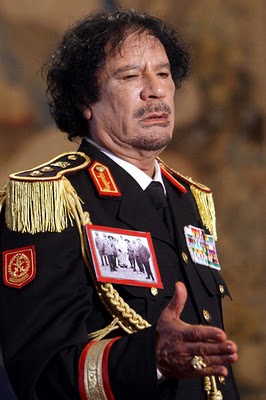
Muammar al-Qaddafi is neither a president nor a king (although he did call himself ‘King of Kings’ at one Arab summit). No, what he is, as well as Colonel, is the Brother Leader, and the Guide of the First of September Great Revolution of the Socialist People’s Libyan Arab State-of-the-Masses (he invented the Arabic word jamahiriyya for the last chunk). I’ll refer to him here as Qaddafi.

Qaddafi is famous for grandstanding – his female bodyguards, his tent, his flamboyant dress. In interviews he growls and flicks his hands. At Arab League meetings he puts his feet on the desk, smokes cigarettes, gets into shouting matches, dramatically swans out. Sometimes he says things worth saying, and he’s often provided a laugh for Arabs who don’t live in Libya.

Qaddafi thinks he’s a lady-killing revolutionary of Guevara proportions and a tyrant of the stature of Mao; hence his Green Book (not to forget his fiction). At the same time, he thinks the people, not he, are in control of Libya’s destiny. And perhaps – we can hope after Tunisia and Egypt – he’s right.

Ideologically he’s swung from Arabism to Islamic socialism to pan-Africanism, but it’s all been hot air. His hosting of a diversity of ‘revolutionary’ groups, including religious cults, reinforced the impression that he was either stupid or insane.

Continue reading “The Autumn of the Patriarch”

America’s Wars in the Muslim World

Nir Rosen is the finest frontline reporter the US has produced in decades. He has just resigned from his position at the New York University after he came under fire from Israel lobby attack-dog Jeffrey Goldberg for making light of the recent attacks on CBS propagandist Lara Logan (comments for which he has since apologized). Following is a talk he gave recently at LSE about his new book Aftermath. (Also, don’t miss Ali Gharib’s excellent profile on Rosen.)

Bahrain Rising

On the tiny island state of Bahrain an intelligent, highly politicised Shia majority is ruled by an actively sectarian Sunni ‘king’ and his mercenary police force. To ensure minimum fraternisation, and to shrink the Shia majority, Sunni Arabs from such countries as Syria, Jordan and Yemen are awarded citizenship after loyal service in the police.

Bahrain was known to Sumerians as Dilmun, a possible location for the Garden of Eden. Today it’s known to Americans as the home of the Fifth Fleet, one of the more essential bases for guarding the Gulf. It’s linked by causeway to Saudi Arabia, which provides it with security and thousands of drunk young men on Thursday nights. It is likely that Saudi Arabia would intervene if Bahrain went the way of Egypt.

Unlike other Gulf countries, Bahrain has always been notable for its angry mass demonstrations against assaults on Iraq, Lebanon and Palestine. Not surprising, then, that February 14th’s Day of Anger attracted a wide section of Bahraini society, including Sunnis. There’s nothing sectarian about the protestors’ democratic demands – one of their chants is Not Sunni Not Shii Just Bahraini – but we can expect sectarian mobilisation by the regime and Saudi-owned media if protests continue, as they doubtless will. The Bahraini people will be described as an unwitting front for Shii-Persian assault. For this reason, the Iranian leadership would do well to remain silent as events unfurl (Iran’s comments on the Tunisian and Egyptian revolutions, after all, have been inaccurate and propagandistic.)

Continue reading “Bahrain Rising”

Can anyone at the US State department spell ‘Irony’?

From the State Department’s 14 February 2011 daily press briefing.

MR. CROWLEY: Well, that – what has guided us throughout the last three months and guides us in terms of how we focus on Iran is the core principles – the Secretary mentioned them again today – of restraint from violence, respect for universal rights, and political and social reform. There is a – it is hypocrisy that Iran says one thing in the context of Egypt but refuses to put its own words into action in its own country.

QUESTION: How about other countries – Bahrain, Yemen, or Algeria, or Jordan? Why you are not talking about those countries and you are condemning what is happening in Iran?

MR. CROWLEY: Well, actually, in the other countries there is greater respect for the rights of the citizens.

14 February 2011

Hossam el-Hamalawy on The Workers and The Military

Egypt’s revolution could go in any direction in the months and years to come. It could end up in a tame army-supervised semi-democracy under the presidency of Amr Moussa, with the army running foreign policy. More likely, the result will be far more interesting than that.

The Supreme Military Council has decided not to lift the state of emergency. The core of the old system remains in place. And Communique Number Five calls for an end to industrial action. But oil and gas workers continue to strike, as well as transport, textiles and media workers. More significantly, workers are refusing the authority of Mubarak-era union officials, and are organising to represent themselves. Another instance of spreading revolutionary fervour: state TV workers chased the head of the news department out of the building.

Writing for Jadaliyya, Egyptian blogger Hossam el-Hamalawy examines the role of the working class in the revolution. He concludes: “We have to take Tahrir to the factories now. As the revolution proceeds an inevitable class polarization is to happen. We have to be vigilant. We shouldn’t stop here.”

Continue reading “Hossam el-Hamalawy on The Workers and The Military”