There is a context to London’s riots that can’t be ignored

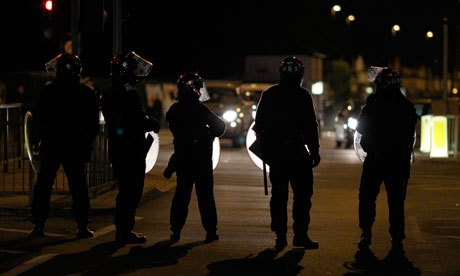
Police in riot gear in Enfield, north London, on Sunday night (Photo: Stefan Wermuth/Reuters)

Nina Power, senior lecturer in philosophy at Roehampton University, writes in The Guardian:

Those condemning the events of the past couple of nights in north London and elsewhere would do well to take a step back and consider the bigger picture: a country in which the richest 10% are now 100 times better off than the poorest, where consumerism predicated on personal debt has been pushed for years as the solution to a faltering economy, and where, according to the OECD, social mobility is worse than any other developed country.

As Richard Wilkinson and Kate Pickett point out in The Spirit Level: Why Equality is Better for Everyone, phenomena usually described as “social problems” (crime, ill-health, imprisonment rates, mental illness) are far more common in unequal societies than ones with better economic distribution and less gap between the richest and the poorest. Decades of individualism, competition and state-encouraged selfishness – combined with a systematic crushing of unions and the ever-increasing criminalisation of dissent – have made Britain one of the most unequal countries in the developed world.

Continue reading “There is a context to London’s riots that can’t be ignored”

Does Nick Clegg bear responsibility for the London riots?

Who would have known that Nick Clegg was such a prophet? Long before he joined the Tories in a governing coalition he had predicted that ill-conceived austerity measures could lead people to riot. But if he was so certain, woudln’t that suggest that he triggered the riots by furnishing the circumstances under which he predicted they would happen?

Does Your Congressperson Represent You – or Israel?

by Medea Benjamin

US lawmakers jostle for the Israeli Prime Minister's blessing.

In this time of economic austerity, when jobs are being slashed and Americans are fearful about their future, the Congressional recess is the time for our elected representatives to be home in their districts, reaching out to their constituents and servicing the people they are paid to represent. Instead, this August one out of every five representatives will be taking a junket to Israel, compliments of an affiliate of the Israel lobby AIPAC (American Israel Public Affairs Committee) but still clocked in on the taxpayer’s dime.

Americans who have lost their jobs and seen their life savings evaporate because Congress can’t seem to get it together deserve an explanation of how this crisis will be solved. Following the recent debt debacle, the public is hungry for information about the mysterious 12-person “super committee” that will slash over one trillion dollars from the federal budget. But instead of opening their doors to their constituents, 81 members of Congress will be getting briefings from Israeli government officials, touring historic religious sites, and perhaps “seeking a salty dip in the Dead Sea.” Representative Steny Hoyer, who is leading the Democratic delegation, said he is pleased members of Congress have this opportunity “to gain a deeper understanding of the issues involved in increasing stability in the region.” One has to wonder whether our elected officials are more concerned about the stability of Israel or the well-being of American families.

Continue reading “Does Your Congressperson Represent You – or Israel?”

‘Israel protests silent on occupation issue’

Israeli-American writer Joseph Dana speaks to Al Jazeera from Tel Aviv about the current protests in Israel:

Kama Sutra for Palestinian Intellectuals — Or, How to Love Mahmoud Darwish

by Amal Amireh

The new Syrian TV drama “In the Presence of Absence,” about the life of the poet Mahmoud Darwish, is giving some Palestinians an ulcer this Ramadan season. The series is being broadcast on several Arab satellite channels, including the Palestinian one. Some objected to the series before it was made because they thought those who were undertaking the project are doing it for profit and are not being faithful to the memory of Palestine’s national poet. Their effort to stop it didn’t pan out and now they are watching in horror as they see their beloved poet miscast, misrepresented, and twisted out of shape. The actor-criminal is one Firas Ibrahim that everyone seems to love to hate. Believe me, voodoo dolls of him will sell like hot qatayef in Rmallah.
They are lamenting that this great poet is being sacrificed on the altar of egos and art-for-profit. They are in a panic that the legacy of Darwish is in danger and that he is being mutilated for an audience that does not know much about him. Some of those objecting to this drama knew Darwish personally: they are friends, disciples, and colleagues. Some are readers who love the man for the poetry he wrote. I feel their pain!

But instead of using the occasion of a bad TV drama to celebrate the Darwish they love, to educate people about his poetry, to write articles that critique the drama they don’t approve of, I’m sad to report that two thousand Palestinian intellectuals are demanding taking the offensive drama off the air.  They have even demonstrated in front of Palestine TV to that effect. In other words, they are calling for censorship. Their love for Darwish seems to have obscured their vision.*

Continue reading “Kama Sutra for Palestinian Intellectuals — Or, How to Love Mahmoud Darwish”

Resistance Regime?

One of my favourite chants from the Syrian uprising is the powerful and cleanly apparent illi yuqtil sha‘abu kha’in, or ‘he who kills his people is a traitor.’ It’s cleanly apparent to me at least – but not to everybody. Some kneejerk ‘leftists’ (a rapidly diminishing number) still hold that the Syrian regime is a nationalist, resistance regime, a necessary bulwark against Zionism, and that therefore it must be protected from its unruly subjects; that in fact it’s the unruly subjects, rather than those who murder them, who are the traitors.

Very sadly, Shia Islamists – Lebanon’s Hizbullah, the sectarian parties in power in Baghdad, and Iran – have repeated the same argument, not because they believe it but for tedious clannish reasons. Syrians aren’t very surprised by the Iraqi or Iranian positions; it’s Hizbullah’s betrayal which sticks in the craw. After all, until Hassan Nasrallah began propagandising on behalf of the regime’s repression, Syrians of all sects supported and admired Hizbullah. During Israel’s 2006 assault they welcomed southern Lebanese refugees into their homes. Indeed, the regime’s alliance with Hizbullah can in large part be credited to the Syrian people; the alliance was one of the regime’s only real sources of popularity. The Asad clique needed Hizbullah’s resistance flag to cover its own nationalist nakedness.

Sectarianism is the old curse of the mashreq, exacerbated in modern times by Sykes-Picot, minority dictatorships, Zionist meddling, and the invasion of Iraq. Lebanon’s political system, indeed the whole idea of Lebanon, is as sectarian as can be. Lebanese Sunnis and Christians are every bit as sectarian as Lebanese Shia, and usually worse. So perhaps Nasrallah can’t help himself. But whatever his excuse he is thoroughly wrong, strategically as well as morally, and his wrongness is public and blatant. Whether or not the Syrian regime falls, Nasrallah’s current position will do more damage to Hizbullah’s ability to fight Zionism, to carry the aspirations of Arabs and Muslims, than any number of Israeli assassinations and bombing runs.

Continue reading “Resistance Regime?”

In Cuba, the revolution continues, softly, as times change

The great Australian journalist and documentary filmmaker John Pilger writes from Cuba:

On my first day in Cuba, in 1967, I waited in a bus queue that was really a conga line. Ahead of me were two large, funny females resplendent in frills of blinding yellow; one of them had an especially long bongo under her arm. When the bus arrived, painted in Cuba’s colours for its inaugural service, they announced that the gringo had not long arrived from London and was therefore personally responsible for this breach in the American blockade. It was an honour I could not refuse.

The bus was a Leyland, made in Lancashire, one of 400 shipped to Cuba in defiance of Washington, which had declared war on the revolution of Fidel Castro. With the Internationale and Love Me Do played to a bongo beat – the Beatles having been “admitted to the Revolution” – we lurched through Havana’s crooked streets. Such a fond memory now accompanies me on my return to Cuba; yet looking back at what I wrote then, I find I used the word “melancholy” more than once. For all the natural warmth of Cubans, the hardship of their imposed isolation left smiles diminished and eyes averted once the music had stopped.

Beyond the nationalised American department stores – the windows empty except for electric fires from China of which Cubans had no need – and the flickering necklace of lights of an almost deserted port, there was the silhouette of an American spy ship, USS Oxford, policing Cuba’s punishment. In 1968, the revolution added its own folly by summarily banning all small businesses, including the paladares, Havana’s lively bars and restaurants. The Soviet era had begun.

Continue reading “In Cuba, the revolution continues, softly, as times change”

Eduardo Galeano: Keeping the Gods Inside

Eduardo Galeano shares insight into how activists can “keep the Gods inside.” Clip found after the jump.

Continue reading “Eduardo Galeano: Keeping the Gods Inside”

Tahrir Envy: An Anti-Occupation Activist’s First Thoughts on the Tent Protests in Israel

Tahrir Envy in Rabin Square

Almost a month in, Tahrir-envy in Israel is now at what seems to be its peak. 150,000 people took the streets last Sunday, at what must have been the biggest protests here since the protests against the “disengagement” from Gaza. For months now, a public whisper was spread through the mainstream media; why don’t the Israelis take the streets?

“Where are the masses? With its lack of ideology and values, the phenomenon of postmodernism is one reason why downtrodden Israelis choose not to rise up and free themselves of latter-day bondage. Revolution Square is empty.”

Continue reading “Tahrir Envy: An Anti-Occupation Activist’s First Thoughts on the Tent Protests in Israel”

Hama Hallucinated

picture by Reuters

Here’s an extract from my novel The Road From Damascus, in which the dying Ba’athist Mustafa Traifi hallucinates the Hama massacre of 1982. Back then the regime really was fighting an armed group – the Syrian Muslim Brotherhood. I don’t much like my writing of four years ago, but the passage is rustling in my mind today for obvious reasons.

What’s time to a corpse? From the moment of its death, time becomes a foreign territory, a land stranger and more distant with every minute, every decade, until soon there’s nobody left to put a face to the corpse’s name, to the name of the dust, and soon the letters of its name have sunk into the graveslab’s grain, and the stone itself is broken or buried or dug up. And the land which was once a graveyard is overgrown, or shifted, or levelled. And the planet itself dead, by fire or ice, and nobody at all anywhere to know. No consciousness. As if nothing had ever been.

Unless there is Grace watching and waiting for our helplessness.

There is no permanence for a corpse, not even for corpse dust. Or corpse mud, in this country. All this graveyard sentiment. You may as well shoot it into outer space. Into the stars.

Mustafa Traifi is dreaming intermittent dreams of war. He sees the city of Hama from above and within. Sees the black basalt and white marble stripes. The mosque and the cathedral. The thin red earth. The tell of human remains, bones upon bones. The Orontes River rushing red with the blood of Tammuz, the blood of Dumuzi, the dying and rising shepherd god. The maidens weeping on the river banks.

Life is precarious. This place is thirty kilometers from the desert. The river raised by waterwheels feeds a capillary network of irrigation and sewage channels, and agricultural land in the city’s heart. Traffic is organised by the nuclei of marketplaces (Mustafa sees from above, like the planes) where there are householders and merchants and peasant women in red-embroidered dresses and tall men of the hinterland wearing cloaks and kuffiyehs, and mounds of wheat and corn, and olives and oranges from the hill orchards, and complaining oxen and fat-tailed sheep. Where there is dust in the endless process of becoming mud and then again dust.

Continue reading “Hama Hallucinated”