Killing Activists in Honduras

 
Walter Trochez

By Joseph Shansky

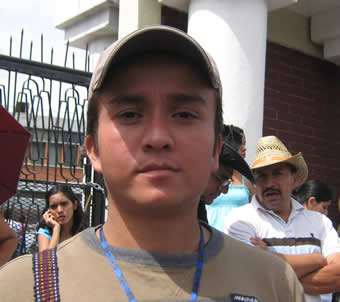
“As a revolutionary I will be today, tomorrow and forever on the front lines of my people, all the while knowing that I may lose my life.” – Walter Trochez, 25, murdered in Tegucigalpa on 12/13/09

The bodies of slain activists are piling up in Honduras. While it’s being kept quiet in most Honduran and international media, the rage is building among a dedicated network of friends spreading the word quickly with the tragic announcement of each compañero/a.

Now that the world heard from mainstream news outlets such as the New York Times of a “clean and fair” election on Nov. 29 (orchestrated by the US-supported junta currently in power), the violence has increased even faster than feared.

The specific targets of these killings have been those perceived as the biggest threats to the coup establishment. The bravest, and thus the most vulnerable: Members of the Popular Resistance against the coup. Their friends and family. People who provide the Resistance with food and shelter. Teachers, students, and ordinary citizens who simply recognize the fallacy of an un-elected regime taking over their country. All associated with the Resistance have faced constant and growing repercussions for their courage in protesting the coup. With the international community given the green light by the US that democratic order has returned via elections, it’s open season for violent forces in Honduras working to tear apart the political unity of the Resistance Front against the coup.

Continue reading “Killing Activists in Honduras”

In the Guardian, Palestinians ‘Claim’ While Israelis ‘Count’

Halim writes in over the Guardian’s blatantly biased language in its coverage a week ago:

It is the second time in 2 days that the UK Guardian and its correspondent Ian Black have repeated the same claim without proof.  They say:

“Palestinians claim 1,400 were killed, mostly civilians; Israel counted 1,166 dead, the majority of them combatants.”

“Palestinians claim 1,400 people, mostly civilians, were killed in the three-week offensive. Israel counted 1,166 dead, the majority combatants. Israel insists it acted in self-defence against Hamas rocket attacks from Gaza.”

How can it be that the Palestinians only claim but Israel counts? Where is the proof of this “counting”? Please EMAIL ian.black@guardian.co.uk and ian.cobain@guardian.co.uk and ask them this.

Note: Ian Black’s son reportedly serves in the Israeli military. Readers might want to ask Guardian editors if this is true, and if it does not constitute a conflict of interest.

Continue reading “In the Guardian, Palestinians ‘Claim’ While Israelis ‘Count’”

Foreign Policy shoots back on Global Thinkers

Foreign Policy editor Joshua Keating is generous in referring to PULSE’s 20 Top Global Thinkers of 2009 list as ‘a welcome addition to the conversation‘. FP has certainly ignited a debate around its choices in its inaugural global thinkers list.

Keating misses our point, however, in part because he misreads our argument. It is clear from our post that we are referring specifically to the incongruity of having individuals such as Dick Cheney, General Petraeus, Larry Summers, Thomas Friedman, Bernard-Henri Lévy, Ayaan Hirsi Ali, Salam Fayyad, The Kagans and Ahmed Rashid on a list of thinkers.  We surmised that it may have to do with the fact that the main thrust of their work aligns with the US military and economic agenda worldwide. We could not have been referring to FP’s entire list, since, as Keating correctly notes, several of our choices overlap with FP’s, and there are others on the list that we actually respect and admire.

Continue reading “Foreign Policy shoots back on Global Thinkers”

PULSE: 20 Top Global Thinkers of 2009

On 30 November 2009 Foreign Policy magazine published its ‘Top 100 Global Thinkers’ list. We were naturally skeptical since the selection included Dick Cheney, General Petraeus, Larry Summers, Thomas Friedman, Bernard-Henri Lévy, David Kilcullen, Ayaan Hirsi Ali, Salam Fayyad, The Kagan Family (yes, all of them) and Ahmed Rashid among others.  We don’t consider any of these people thinkers, let alone having global significance, and we couldn’t help but notice that the main thrust of all their work aligns with the global military and economic agenda of the US government. In response we asked twelve of our writers and editors to nominate their Top 20 global thinkers of 2009.  Our criteria included choosing those who inspire critical thinking, as well as those who have been able to buck received wisdom and shape public debate.  Always agreeing with their statements and positions was not a requisite, but in all cases our selections involved nominating those who have spurred people to challenge or enhance their own thinking in different ways.  The following is our unranked list.

Update: See Foreign Policy’s response, our rejoinder, and our reflections on the debate. (Also see our 20 Top Global Media Figures of 2009)

Arundhati Roy

The top nominee when it came to number of votes among PULSE contributors, Indian writer and activist Arundhati Roy is as much known for her non-fictional political work as she is for her award-winning fiction. She is a spokesperson of the alter-globalization movement and a critic of hegemonial US foreign policy, as well as vocal on behalf of the anti-nuclear and environmental movements both in India and abroad. She is also a staunch critic of the repressive Indian policies in Kashmir. Most recently a contributor to We Are One: A Celebration of Tribal Peoples (October 2009), Roy continues to be passionately engaged and eloquently outspoken in building a social movement towards developing alternatives. Her latest book is Listening to Grasshoppers: Field Notes on Democracy.

Continue reading “PULSE: 20 Top Global Thinkers of 2009”

Mahmood Mamdani: State Formation and Conflict

Mahmood Mamdani on state formation and conflict in Sudan. This lecture is a couple of years old (from 2007), but highly informative.

Utopia as Alibi: Said, Barenboim and the Divan Orchestra

by Raymond Deane

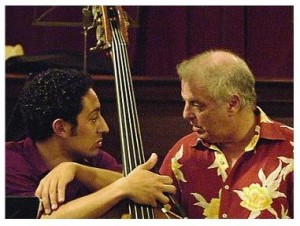
As a classical musician involved in pro-Palestinian activism, I frequently encounter the assumption that I am an unconditional admirer of the West-Eastern Divan Orchestra (WEDO). My reservations on this score tend to produce shocked disapproval: How could I not enthuse about such an idealistic project, particularly since it was co-founded by the late Edward Said, a figure for whom I have frequently expressed respect and admiration?

In truth, I have always been a little wary of Said’s veneration for the eighteenth/nineteenth century canon of European classical music. I look in vain in his writings on the subject[1] for a historical and political contextualisation of music comparable of that to which he so perceptively subjected literature in his indispensable Culture and Imperialism.[2]

In his 2002 speech accepting the Principe de Asturias Prize, Said claimed that he and his friend the Israeli pianist and conductor Daniel Barenboim founded the WEDO “for humanistic rather than political reasons”. This surprising dualism implies that music belongs to a utopian sphere somehow removed from the dialectical hurly-burly of hegemony and resistance.

The paradoxes of Said’s position have been ably dissected by the British musicologist Rachel Beckles Willson.[3] She quotes her colleague Ben Etherington’s critique of Said’s tendency “to assert the intrinsic value of Western elite music without really exploring how that tradition escapes mediation.” Paraphrasing Said’s critique of literary scholars in his Humanism and Democratic Criticism[4] she convincingly claims that he “omitted to make ‘a radical examination of the ideology of the [musical performance] field itself.’” (Willson’s chain brackets).

Continue reading “Utopia as Alibi: Said, Barenboim and the Divan Orchestra”

ON PRESIDENTS AND PRECEDENTS: IMPLICATIONS OF THE HONDURAN COUP

By Joseph Shansky

First published in Upside Down World, 10 December 2009

President Obama was elected partly because of his promise to a large Hispanic constituency to give both new attention and new respect to Latin America. Judging from the US role in the military coup in Honduras, he must think that one of the two is enough.

For those who closely followed the coup and its aftermath, a tiny fear sat in the back of our minds. Eventually it was confirmed. As the State Department position shifted from condemning to condoning the illegal government, the outline of a bigger picture became clear. If this violent takeover were really to be approved by the US, it would mark a frightening new focus on the region.

In late June, Honduran President Manuel Zelaya was kidnapped by the military and forced out of the country. For the next five months, an illegitimate government, headed by Congressional leader Roberto Micheletti, suppressed the outrage of many Honduran citizens against this regime through a number of violent means including murder, torture, and detention of citizens.

Throughout this time, the US response to these allegations was silence.

Continue reading “ON PRESIDENTS AND PRECEDENTS: IMPLICATIONS OF THE HONDURAN COUP”

What does courage look like?

Student protester Majid Tavakoli was arrested on December 7, 2009.

While the majority of mainstream news media’s focus on Iran has returned to the debate over who has the right to control the country’s nuclear energy ambitions, Iranian students continue to risk their lives while protesting for their human and civil rights.  Hundreds of Iranian men and women have been arrested and interrogated since the recent Iranian presidential election, and claims of torture and abuse of detainees continue to surface.

On December 7 Majid Tavakoli, a student at Amir Kabir University in Tehran, was reportedly violently arrested after giving a speech at one among several protests that were held around the country on Iran’s Student’s Day, or 16 Azar.  16 Azar commemorates the murder of 3 Iranian student protesters who were shot and killed by Mohammad Reza Pahlavi’s military during a large protest that occurred in 1953 against US Vice President Richard Nixon’s visit to the country in support of the Shah’s government.  Earlier that year the popular and democratically elected government of Mohammad Mosaddeq was overthrown by a CIA/MI6 sponsored coup which restored the Shah to power.  The brutal and corrupt Iranian monarchy maintained control of the country until the revolution of 1979.

It has been reported that Tavakoli had already been imprisoned before for his activism, and that he was tortured during his detention.  Tavakoli was well aware of the risks involved in giving his impassioned speech, but contended that it was the “duty” of all students to make their voices heard despite the heavy air of fear and paranoia weighing upon them in solidarity with the protesters that have been imprisoned and tortured, as well as those who have been killed during the ongoing wave of protests which hit Iran following the 2009 election.  Early on in his speech Tavakoli states:

Today is 16 Azar.  It is our day.  It is the day of students…

Continue reading “What does courage look like?”

What the US Elite Really Thinks About Israel

Senator William Fulbright had first called the US Congress an Israeli Occupied Territory

Our friend Jeffrey Blankfort on the surprising results of CFR survey — surprising, to the extent that it goes against the lefitst conventional wisdom which has accorded Israel the status of a ‘strategic asset’; much less so, however, when it comes to revealing the level ignorance about the situation in Pakistan. For background, also see Blankfort’s rejoinder to Joseph Massad’s fatuous attack on John Mearsheimer and Stephen Walt.

The Council on Foreign Relations is always near the top of the Left’s list of bogeymen that stand accused of pulling the strings of US foreign policy. It is right up there with the Bilderberg Group and the Trilateral Commission, right? Wrong. If that was the case,  those arguing that US support for Israel is based on it being a “strategic asset”  will have a hard time explaining a Pew Research Center survey on America’s Place in the World, taken of 642 CFR members between October 2 and November 16. The Pew poll  not only reveals that the overwhelming majority, two-thirds of the members of this elite foreign policy institution, believes that the United States has gone overboard in favoring Israel, it doesn’t consider Israel to have have much importance to the US in the first place.

Continue reading “What the US Elite Really Thinks About Israel”

Loach and Laverty Support Aminatou Haidar

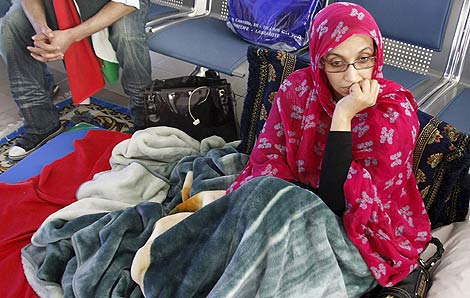
Aminatou Haidar is known as the “Sahrawi Gandhi”

Scottish writer Paul Laverty and British director Ken Loach issued a joint statement on December 1st (commemorating the anniversary of Rosa Park’s refusal to give up her bus seat for a white passenger) in support of Western Saharan human rights activist Aminatou Haidar.  Haidar is in the third week of a hunger strike after being deported against her will by Moroccan authorities occupying her homeland.  You can watch Democracy Now!’s coverage of Haidar’s plight here.

Statement concerning Sahrawi human right’s activist Aminatou Haidar 

Haidar’s boarding card and Rosa Parks’s seat

On the 1st December 1955, in Montgommery, Alabama,  Rosa Parks refused to obey a bus driver and give up her seat to a white passenger.  On Friday the 13th of November 2009 Aminatou Haidar refused to fill out her boarding card as instructed by the authorities in Laayoun (where she lives)  in Morocco controlled Western Sahara.  

Continue reading “Loach and Laverty Support Aminatou Haidar”