Al Jazeera’s Hoda Abdel Hamid reports on the ongoing battle for Libya.
Author: alannahpriestley
Who Will Survive in the End
By Nafissa Assed
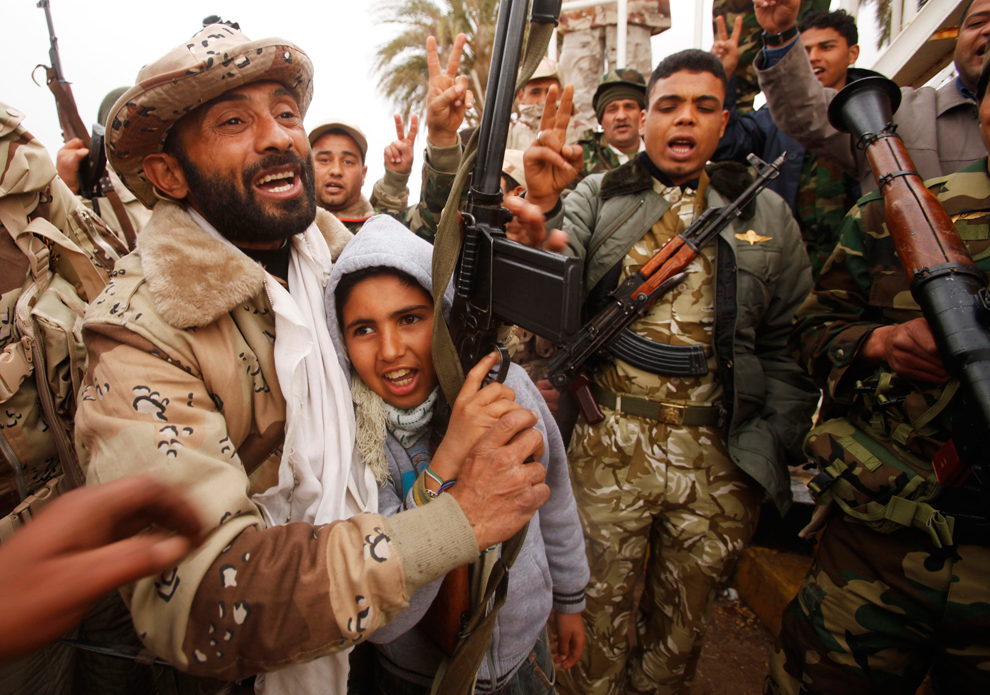
As the 17th February commemorates the memory of the fallen victims of the Abu Salim prison massacre, when over 1200 prisoners were brutally executed, the 7th April is also known as one of those days that witnessed some of the worst abuses of human rights in Libyan history. On 7th April 1976, Qaddafi ordered the persecution and public execution of Libyan university students who were suspected of opposing the regime. The same month of the same year also commemorates Qaddafi’s physical liquidation campaign against Libyan dissidents inside and outside Libya.
Today I called a family member in Libya and she told me that the living conditions and the level of terror in Tripoli are indescribable. People go to the gas stations, wait for hours, and when their turn comes, they may be unlucky and find none left. There is no money in banks anymore. Every time she goes to the bank, they keep telling her the same thing: that there is no money. People barely go out, and what’s worse is that there are many elderly and babies who must receive weekly treatment in clinics. The critical living conditions of Tripoli are disrupting its economic life gravely, as Malta stopped a fuel ship on its way to west Libya, preventing it from making its delivery in accordance with the UN blockade.
The Arab Awakening
The End of a Dictator. An excellent Al Jazeera documentary about the fall of Hosni Mubarak.
Driven by its youth, Egypt’s revolution embraced all sectors of society. As the fear barrier was broken, destinies were transformed by the tumultuous events. This film offers an examination of the demise of the Mubarak regime through the eyes of people whose lives were, until now, defined by it.
Israel’s new assault on Gaza

The densely populated Gaza enclave is once again under Israeli aerial attack. Five people have been killed and over 30 injured already. Max Blumenthal calls the assault ‘Operation Goldstone,’ since Israel seems to be taking encouragement from the Judge’s partial retraction of his earlier report. Over at the Electronic Intifada Rami Almeghari reports:
As Palestinians were preparing for their weekend this Thursday afternoon, all of a sudden barrages of Israeli artillery fire and air raids by warplanes struck several regions of the Gaza Strip. Five Palestinians were killed and about thirty more injured.
Israeli shells struck farm land, homes, a mosque and an ambulance, and the injured were evacuated to al-Shifa hospital in Gaza City, Kamal Adwan hospital in northern Gaza and the Abu Yousif al-Najjar hospital in southern Gaza…
Sources at the al-Shifa hospital in Gaza City said that they received six injuries earlier this afternoon; among them were two women and several children.
Lion of the Desert
Link TV profiles the great Libyan revolutionary Omar al-Mukhtar.
Crossfire
A Daily Show classic: Colbert and Carell debate the Iraq war.
Rape in the US military
There were 19,000 in the year 2010 alone according to the Pentagon. Congresswoman Jackie Speier speaks out. (Also see Democracy Now’s coverage of rape in the ranks)
Ecuador expels U.S. ambassador

The following press release is from the Center for Economic and Policy Research (CEPR). Mark Weisbrot is co-writer with Tariq Ali of the Oliver Stone film “South of the Border“.
A declaration by the Ecuadorian government that U.S. Ambassador Heather Hodges is “persona non grata” and must leave Ecuador as soon as possible should not come as a surprise, Mark Weisbrot, Co-Director of the Center for Economic and Policy Research, said today. Weisbrot noted that the expulsion follows recent troubling revelations in cables released by Wikileaks that describe U.S. government co-ordination with Colombia over a public relations strategy to attempt to link Ecuadorian President Rafael Correa to the Colombian guerrillas the FARC.
“The Obama Administration doesn’t seem to know how to have normal diplomatic relations with democratic, left-of-center governments in the hemisphere,” Weisbrot said. He noted that there was a trend – well documented through U.S. government cables, funding disclosures, and other information – of attempts to undermine governments in Bolivia, Brazil, Honduras, Venezuela, and other countries.
Continue reading “Ecuador expels U.S. ambassador”
23 Things They Don’t Tell You About Capitalism
In the latest issue of Vanity Fair, Joseph Stiglitz writes:
The upper 1 percent of Americans are now taking in nearly a quarter of the nation’s income every year. In terms of wealth rather than income, the top 1 percent control 40 percent. Their lot in life has improved considerably. Twenty-five years ago, the corresponding figures were 12 percent and 33 percent. One response might be to celebrate the ingenuity and drive that brought good fortune to these people, and to contend that a rising tide lifts all boats. That response would be misguided. While the top 1 percent have seen their incomes rise 18 percent over the past decade, those in the middle have actually seen their incomes fall. For men with only high-school degrees, the decline has been precipitous—12 percent in the last quarter-century alone. All the growth in recent decades—and more—has gone to those at the top. In terms of income equality, America lags behind any country in the old, ossified Europe that President George W. Bush used to deride. Among our closest counterparts are Russia with its oligarchs and Iran. While many of the old centers of inequality in Latin America, such as Brazil, have been striving in recent years, rather successfully, to improve the plight of the poor and reduce gaps in income, America has allowed inequality to grow. […]
The top 1 percent have the best houses, the best educations, the best doctors, and the best lifestyles, but there is one thing that money doesn’t seem to have bought: an understanding that their fate is bound up with how the other 99 percent live. Throughout history, this is something that the top 1 percent eventually do learn. Too late.
One of the reasons this state of affairs obtains, argues Ha-Joon Chang, is because of the chimera of a ‘free market.’
Continue reading “23 Things They Don’t Tell You About Capitalism”
 P U L S E