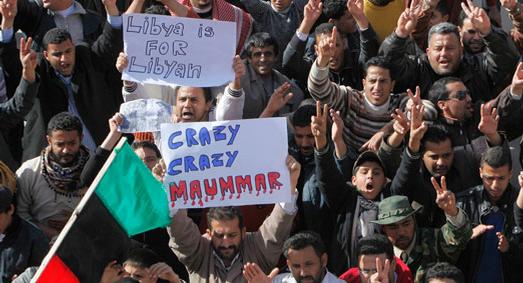
Who are the Libyan revolutionaries?

Jihan Hafiz of the Real News on the Libyan revolutionaries. (Also see Part 2)

Recently returned from Bengazi, Hafiz reports on rebel fighters, supporters and early stages of the Libyan uprising.

James Bays of Al Jazeera reports from the frontline:

Jon Lee Anderson of the New Yorker, who wrote the acclaimed biography of Che Guevara, also spent some time with the rebels. Here’s an excerpt:

During weeks of reporting in Benghazi and along the chaotic, shifting front line, I’ve spent a great deal of time with these volunteers. The hard core of the fighters has been the shabab—the young people whose protests in mid-February sparked the uprising. They range from street toughs to university students (many in computer science, engineering, or medicine), and have been joined by unemployed hipsters and middle-aged mechanics, merchants, and storekeepers. There is a contingent of workers for foreign companies: oil and maritime engineers, construction supervisors, translators. There are former soldiers, their gunstocks painted red, green, and black—the suddenly ubiquitous colors of the pre-Qaddafi Libyan flag.
Continue reading “Who are the Libyan revolutionaries?”

Militarism, Mutilation, and Minerals: Understanding the Occupation of Afghanistan

Below is a short film from Cultures of Resistance, featuring renowned Afghan activist, former parliamentarian, and feminist Malalai Joya, among others.

The introduction to the film from the Cultures website:

By mid-2010, the war in Afghanistan had arguably passed Vietnam as the longest war in the history of the United States. At the war’s outset many U.S. citizens supported the invasion as a means of holding responsible those who orchestrated the attack on the World Trade Center. However, as time has passed and more American troops and Afghan civilians die, the U.S. government has struggled to maintain popular support by emphasizing other justifications for continuing the costly occupation. One of the most controversial concerns is the plight of women. Many commentators, some of them Afghan women, argue that the presence of coalition forces in their country has allowed them to be more active in politics and civil society. But not all women agree, and many find the country just as dangerous as ever. Furthermore, some believe that, in reality, the U.S. is far more concerned with the nearly $1 trillion worth of untapped mineral deposits that the U.S. discovered in June 2010. This short film allows women in Afghanistan to give voice to their reasons for opposing an ongoing occupation, and it features an interview with renowned Afghan feminist Malalai Joya.

Continue reading “Militarism, Mutilation, and Minerals: Understanding the Occupation of Afghanistan”

‘Israel’s Five Star Occupation: Get Europe To Pay’: Ali Abunimah and David Cronin on Israeli Apartheid

As David Cronin also puts it in the second clip (over the fold), “The European Union is chastising Israel with one side of its mouth, and kissing Israel with the other.” This London talk by Ali Abunimah and David Cronin was chaired by Oxford academic Dr Karma Nabulsi and hosted by Palestine Solidarity Campaign and KCL Action Palestine.

Ali Abunimah

Continue reading “‘Israel’s Five Star Occupation: Get Europe To Pay’: Ali Abunimah and David Cronin on Israeli Apartheid”

Bad Luck, Worse Luck, Concrete Steps

by Nafissa Assed

We all know that the western intervention in Libya is problematic, but it also remains the right decision that saved a countless number of innocent Libyans from Qaddafi’s brutal bombing and mercenaries. As the American writer Cormac MacCarthy says: “You never know what worse luck your bad luck has saved you from.”

Unfortunately, it took the UN Security Council over a month to finally authorize the necessary measures and impose a no-fly zone over Libya to protect civilians. At that time Qaddafi’s viciousness had grown, with bombings, tanks, high-caliber guns, helicopter shootings and callous mercenaries. Human rights monitors found that Qaddafi’s forces are using dozens of landmines on the outskirts of Ajdabiya.

Now air power is useful up to the point that it can dislocate Qaddafi’s logistics and stop the movement of his forces across the huge desert spaces between Libya’s cities, but it cannot take and hold ground, and that also is something that Libyans do not wish to happen. They do not want foreign ground troops.

Continue reading “Bad Luck, Worse Luck, Concrete Steps”

Report from Land Occupations in Post-Coup Honduras

Jesse Freeston reports for The Real News Network on the land conflict in the Lower Aguan region of Honduras, the continued killing of campesinos, and general repression by the regime of Pepe Lobo.

Battle for Benghazi: the first shots

New footage has emerged from the first moments of the uprising in Libya, showing gunmen – who appear to be Gaddafi loyalists – shooting unarmed protesters dead.

With armed men dragging people from Benghazi’s mosque, others were left to die on the streets.

Al Jazeera’s Sue Turton reports from the city.

The Enduring Palestine Land Day

by Brenda Heard

For nearly three decades the Palestinian people had been brutalised and belittled.  Then on 30 March 1976 they took a collective stand.  They were not the nomadic nuisance denounced by the Western Israeli Alliance.  They were a people with the same inalienable rights as any people.  And they would determine their own fate.

They held a general strike and demonstrated against the recently announced intention of the Israeli forces to further snuff out Arab viability in the Galilee region.  But the Israeli armed forces would not tolerate what they viewed as insubordination; they turned their weapons on the protestors, killing six outright, injuring dozens and arresting those who persisted in raising their voices.   The Western Israeli media quickly put down the fatal day as an outbreak of rioting Arabs.  But the estimated 400,000 Palestinian people who had participated in the strike knew better.

Continue reading “The Enduring Palestine Land Day”

BDS flash mob at Grand Central Station, NYC (Updated)

Boycott Israel group posts silent video after YouTube removes original

How Europe’s universities aid the Israeli occupation

by David Cronin

One of the most enjoyable things that has happened since I wrote a book on Israel’s relations with Europe is that I have been asked to speak at various universities. So when an invitation appeared in my email inbox to visit King’s College London (KCL), I immediately accepted. Big mistake.

The request came from the International Center for the Study of Radicalisation (ICSR), a partnership between King’s College and the Interdisciplinary Center (IDC) in Herzliya, Israel. I only became aware of the partnership one day before I was scheduled to address an ICSR seminar in January. Following a hasty consultation with some friends in the Palestine solidarity movement, I withdrew from the event, informing the organisers that I fully supported the campaign to boycott Israeli goods and institutions.

Set up in 2008, the ICSR boasts on its website that it is “the first initiative of this kind in which Arab and Israeli academic institutions can work together”. This appears to be a reference to how the Jordan Institute of Diplomacy is also involved in its research on political violence. However, the participation of an academic body from an Arab state does not exonerate the ICSR for embracing the Herzliya centre, which has long tried to cloak Israeli apartheid with intellectual gravitas.

Each year the IDC hosts the Herzliya security conference, attracting Israel’s political, military and business elite, as well as illustrious foreign guests. Speakers at this conference can spout racist invective without fear of being challenged; in 2003, Yitzhak Ravid, a senior researcher with Israel’s weapons development authority Rafael called for coercive measures to curb the birth-rate among Palestinians. “The delivery rooms in Soroka Hospital in Be’ersheba have turned into a factory for the production of a backward population,” he said, alluding to an area with a considerable number of Bedouin inhabitants.

Continue reading “How Europe’s universities aid the Israeli occupation”

Shoe thrower targets Iraq’s PM

The great Muntadhr Al Zaydi is alive and kicking.

Protests have also been taking place in Iraq – as demonstrators there call for sweeping reforms. In their midst is Muntadhr Al Zaydi, the man known internationally for throwing a shoe at former US president George Bush.

He had to stay away from his country for months after serving jail time, but he is now back on the streets of Baghdad. He is on a mission that is again putting him at odds with authorities.

Al Jazeera’s Rawya Rageh explains.