Ours Are The Streets

This review was written for the Guardian.

Here’s another suicide bomber novel. We’ve had Amis and Updike’s uninformed attempts, plus variations on the theme from Sebastian Faulks. This time, though not of Muslim background, our author is a British-Asian and he does have some important insights on the anguished inbetweenness suffered by so many second-generation immigrants, which in some rare cases may constitute part of the psychological background to political radicalisation.

As a study of migrants, the frustrated ambition of the first generation and the generalised alienation of the second (from the ‘home country’ as much as from ‘home’) – this could as well be titled ‘Ours Are Not The Streets’ – the novel is very successful.

People of a variety of backgrounds will recognise the complex allegiances of Imtiaz, the chief protagonist, who “felt fine rooting for Liverpool, in a quiet way, but not England” and who finds himself “defending Muslims against whites and whites against Muslims.” Everybody will appreciate Suhota’s deft treatment of the generation gap. Imtiaz’s repeated ‘why can’t you be normal?’ is a common adolescent interrogation, but one which becomes more acute in an immigrant household. Suhota is very good at dramatising children’s rankling shame at their migrant parents’ submission to humiliation. Imtiaz’s father’s silence as a passenger pisses in the back of his cab, or when a member of a hen party demands he grope her breasts, and Imtiaz’s squirming response to the silence, are excrutiatingly well written.

Imtiaz is really very British. He stands up to his parents and marries Becka, his pregnant white girlfriend, who happily converts to Islam and moves into the family home. They have a daughter, Noor. Imtiaz, not assimilated but reasonably comfortably integrated, seems to have it all.
Continue reading “Ours Are The Streets”

The Murder of Salmaan Taseer

Salmaan Taseer, governer of Pakistan’s Punjab province, has been shot dead by one of his own security detail for the supposed crime of defending Aasia Bibi, a Christian woman threatened with execution under Pakistan’s blasphemy law. The law was introduced by the British and given extra teeth by military dictator Zia ul-Haq, and is commonly used for the pursuit of grudges against the weak. The most disturbing aspect of Taseer’s murder is that both puritanical Deobandi and traditionalist ‘Sufi’ Barelvi religious leaderships have expressed support for it. Many Pakistanis are lionising Taseer’s murderer. For decades sections of Pakistan’s ruling elite have peddled religio-nationalist chauvinism as a stop-gap substitute for social justice. The result is today’s ugly combination of elite and mob rule. I reviewed a book by Taseer’s son here. Below, novelist Mohammed Hanif reports from Karachi:

Minutes after the murder of the governor of Pakistan’s Punjab province Salmaan Taseer I saw a veteran Urdu columnist on a news channel. He was being what, in breaking news jargon, is called a “presenter’s friend”. “It is sad of course that this has happened but . . .”

Continue reading “The Murder of Salmaan Taseer”

Inspiration from Tunisia

The anti-regime protests spread across Tunisia involve trades unionists, the unemployed, lawyers, journalists and students. The people chant against “the killers of the people, the flayers of the people.” Their slogans include “Tunisia is the people, not the government,” “We’ll solve the police crisis, we’ll solve the Tunisian crisis,” and (I think – the sound isn’t clear) “Work, Freedom, National solidarity.” The first film shows a Tunisian town continuing to fearlessly demonstrate despite tear gas and truncheon attacks. (A maths teacher has been shot dead by police during the protests). The second (over the fold) shows a demonstration in the capital. Arabic speakers can follow this link to al-Jazeera’s round-up of the most recent developments.

Continue reading “Inspiration from Tunisia”

The Tunisian Intifada

The dictatorship of Zine el-Abdine Ben Ali, a Western client, is in serious trouble. A full-scale intifada is raging. It began in Sidi Bouzid as a protest against unemployment, corruption and police brutality. Then it spread to Sousse, Sfax, Meknassi, and the capital, inflated by long-simmering resentment at Tunisia’s lack of civil liberties. Because Ben Ali is a client, and because Tunisia is a mass tourism destination, the Western mainstream is leaving this largely alone. But here’s Nesrine Malik in the Guardian, and al-Jazeera (see below) is doing well. In the context of a horrific upsurge of nihilistic sectarianism in the Arab world, it is to be hoped that the Tunisian revolution will grow and develop, and teach a lesson to the Arabs in real, not illusory, action towards change.

Horror and Hope

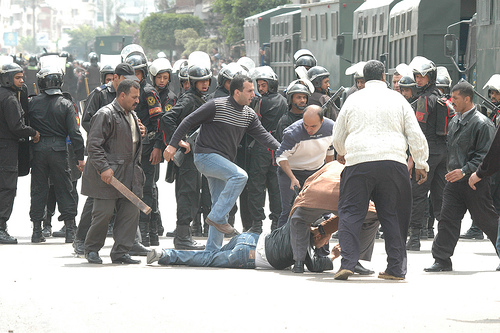
Egyptian police break a Copt's leg. Photo by Nasser Nouri

It currently seems there is a real danger of the Middle East losing its millenia-old diversity. Iraq’s post-invasion civil war separated the country’s Shia and Sunni communities, driving millions into exile. Pro-Western Arab regimes continue to spew vicious anti-Shia propaganda, which is heard by important sections of society. Now Wahhabi-nihilists have declared open season on Iraq’s ancient Christian community. Palestine was cleansed of its natives in 1947/48 and transformed into a Jewish ethno-state. Zionism and a new Muslim chauvinism have reduced the Christian proportion of the West Bank from 15% in 1950 to 2% today. And the New Year brought news of an appalling attack on Egyptian Copts, an increasingly oppressed and alienated community.

Informed observers will know that there is nothing essential or ‘ages-old’ about the emerging sectarian chaos. Sectarianism had receded almost to irrelevance amongst the generations of Arabs that believed they were on their way to true independence. Foreign partitions and occupations did a large part to crush that dream. Totalitarianism and economic and educational failures (often the policies of foreign-backed regimes) did the rest. In Egypt’s case, the Mubarak regime has dealt with its Islamist challenge in two ways: politically, it has rigged elections ever more blatantly and persecuted its visible opponents; socially, it has given way to the most retrograde desires of Islamism (forbidding the construction of churches, banning books) and done its best to whip up petty chauvinism over the most ridiculous of pretexes (for instance the mutual football hooliganism of Egyptian and Algerian fans).

Continue reading “Horror and Hope”

Wrong Target for a Pretend Philosopher

French Zionist and celebrity Islamophobe Bernard-Henri Levy recently accused Susan Abulhawa’s novel Mornings in Jenin of contributing to anti-Semitism. Levy picked the wrong target. Abulhawa has already proved herself more than a match for the ranting Alan Dershowitz. In the Huffington Post she responds to Levy’s anti-Semitism charge: “This word — with its profound gravity of marginalization, humiliation, dispossession, oppression, and ultimately, genocide of human beings for no other reason but their religion — is so irresponsibly used by the likes of Levy that it truly besmirches the memory of those who were murdered in death camps solely for being Jewish.” Then she reminds us that “the people who today are being marginalized, humiliated, dispossessed, and oppressed for the sole reason of their religion are Palestinian Christians and Muslims.

The entire, excellent rejoinder to Levy’s attempt at intimidation is over the fold. Meanwhile, if you haven’t yet bought a copy of Abulhawa’s wonderful novel, do so.
Continue reading “Wrong Target for a Pretend Philosopher”

The Awakening According to Antonius

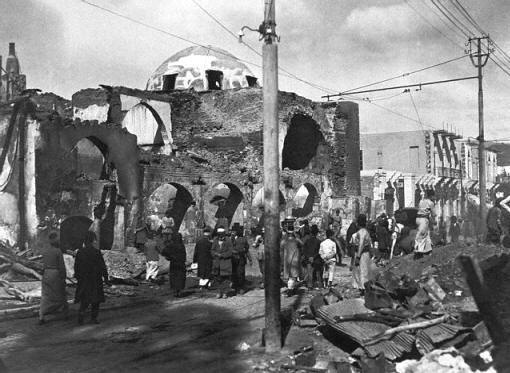
Damascus after French Bombardment, 1925.

Originally published at the Muslim Institute.

I never managed to finish T.E. Lawrence’s vastly overrated “Seven Pillars of Wisdom”. It’s a poorly written, narrowly partial and self-dramatising account of the Arab Revolt against Turkish rule during World War One, as poor a rendering of history as one would expect from Lawrence, with his poor Arabic, poor knowledge of the Arab nationalist movement, and his strange belief that he could pass as an Arab, despite his blond hair and stumbling speech. I got as far as his description of the Syrians as “an ape-like race.”

A far, far better book on early Arab nationalism is George Antonius’s “The Arab Awakening,” which covers the period from Muhammad Ali’s brief unification of Egypt and Syria in the 1830s to the struggle for Palestine in the 1930s.

Continue reading “The Awakening According to Antonius”

Coffee With Hezbollah

Here’s a strange and sparkly, jumpy and tightly-packed little book by PULSE’s own Belen Fernandez, in which our heroines (Belen and the photographer Amelia Opalinska) hitch-hike through Lebanon and Syria a few weeks after the war of summer 2006, consuming far more caffeine than is good for them.

Beyond Gonzo, it doesn’t pretend to be journalism at all. Instead it recounts a fairly lunatic, fairly random sight-seeing tour towards ‘the dark force’ Hezbollah. The setting, of course, is an Israeli-devastated landscape, and the ‘dark force’ tag, like all the book’s other appropriations of mendacious political language, is ironic. “Coffee with Hebollah” is, as Norman Finkelstein writes in his recommendation, “simultaneously serious and silly.” It’s also quick witted and very well informed, sensitive to the discourses and stereotypes of Lebanon’s 18 sects, the country’s tortured history, as well as the fantastic representations of Lebanon that have emerged from Israeli and Western power centres. This makes the book a new kind of journalism as well as a parody of the mainstream version.

The satire is harsh, and nobody escapes the treatment, including the author. The absurdity of the material is pointed up further by the mock-formal language of negotiation and diplomatic report in which encounters are narrated, the supposedly transparent language of perfect sense. So, for instance, labelling somebody by sect is described as conducting  an “exhaustive religio-spatial analysis.” Such phrasing mirrors the pompous pretensions of the thinking it describes. There is also a great deal of translation comedy, natural territory for irony, which lies in gaps, in the distance between reality and representation.

Continue reading “Coffee With Hezbollah”

An Animal of Colossal Proportions

This review first appeared at the new Muslim Institute website (worth watching)..

These days it seems that almost everyone sees the apocalypse bearing down. This is the age of Kali Yag and the oncoming rapture, the arrival of the triumphant Mehdi, of catastrophic climate change and resource shortage. This is the age in which Beduin compete to build the taller towers, in which fog appears above cities as a sign of their evil.

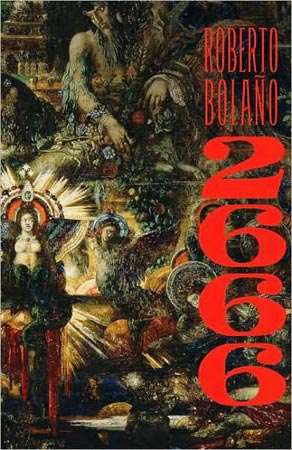
2666’ is a vast apocalypse-in-motion novel set in the 1990s. It was written by a poet who turned to novel writing in his forties only in order to support his young family. He died at 50.

Roberto Bolano wrote ‘2666’ in five books. Before he died he asked that each book be published separately, because he believed that would leave more cash for his loved ones. His publishers decided to ignore this directive, for each book feeds thematically and by plot tangent into the others. The novel has a cumulative, total effect.

The first book – effortlessly cosmopolitan, densely detailed, persistently digressive – centres on a menage a trois between three European academics who also share an obsession with a reclusive German writer called Archimboldi. When a British-Pakistani cab driver expresses his outrage at the academics’ unorthodox relationship, the two men of the trio beat him to a pulp. Afterwards, “they were convinced that it was the Pakistani who was the real reactionary and misogynist, the violent one, the intolerant and offensive one, that the Pakistani had asked for it a thousand times over.” Almost in passing, the episode diagnoses a very contemporary European disease, but also contributes to some of the novel’s central themes, of violence, anonymity, senselessness and the failure of imagination.

Continue reading “An Animal of Colossal Proportions”