A Struggler in Context

An edited version of this review appeared at the Electronic Intifada.

“From afar,” writes Ramzy Baroud (founder of the indispensable Palestine Chronicle), “Gaza’s reality, like that of all of Palestine, is often presented without cohesion, without proper context; accounts of real life in Gaza are marred with tired assumptions and misrepresentations that deprive the depicted humans of their names, identities and very dignity.”

Baroud’s “My Father was a Freedom Fighter” is an antidote to the media’s decontextualisation and dehumanisation of Palestinians. It’s also an instant classic, one of the very best books to have examined the Palestinian tragedy.

As the title suggests, Baroud relates the life of his father, Mohammed Baroud. Each step in the story is located in a larger familial, social, economic and political context, one distinguished by eyewitness accounts and made concrete by an almost encyclopedic wealth of detail. But neither the book’s detail nor its deep reflection conflict with its compulsive readability. It’s quite an achievement.

Continue reading “A Struggler in Context”

The Spinning Wheel

This review was written for the Palestine Chronicle.

This is not what you expect: an accomplished and self-reflective work of history enclosed within a layer of war reportage – in comic book form. But Joe Sacco’s “Footnotes in Gaza” is just that, an unusually effective treatment of Palestinian history which may appeal to people who would never read a ‘normal book’ on the subject. The writing, however, is at least as good as you’d expect from a high quality prose work. Here, for instance, is page nine: “History can do without its footnotes. Footnotes are inessential at best; at worst they trip up the greater narrative. From time to time, as bolder, more streamlined editions appear, history shakes off some footnotes altogether. And you can see why… History has its hands full. It can’t help producing pages by the hour, by the minute. History chokes on fresh episodes and swallows whatever old ones it can.”

The pictures – aerial shots, action shots, urban still lifes, crafted but realist character studies – work as hard as the words. Sacco depicts fear, humiliation and anger very well indeed, and often achieves far more with one picture than he could in an entire newspaper column. The cranes at work on a Jerusalem skyline are worth a paragraph or two of background. So is the fact that almost every Palestinian male has a cigarette in his mouth. And when dealing with historical process – the changing shape of the camps, for example – the pictures are more than useful.

Continue reading “The Spinning Wheel”

Defamation and Binary Idiocy

by Ali Farzat

To summarise: I have been smeared by a Scottish newspaper. Most of the words they attribute to me I did indeed say, but they have decontextualised and selected to such an extent that they make me say things I do not believe – for instance that September 11th was a good thing, or that the Taliban should take over Afghanistan. What follows is a rather long description of meeting the man from the gutter press, which I hope will set the record a little straighter. Yesterday, meanwhile, 33 civilians were killed by NATO bombs in Afghanistan.

I was doorstepped the other morning. A young man wearing a suit and an apologetic manner wanted to ask some questions on behalf of the Scottish Mail on Sunday.

What? Stumbling down the stairs in my thermal underwear, wild-haired and bestubbled, I dream for a passing moment that I’ve become as important to the world as Tiger Woods or Amy Winehouse. Perhaps even now press vermin are going through my rubbish bin. Perhaps paparazzi are crowding the front garden.

Alas, our aspiring hack, young Oliver Tree (for so he called himself), hasn’t yet graduated to the tabloid heights, and neither have I. It soon becomes clear that his mission is much more mundane, is indeed the everyday grind of papers like the Mail: to create outrage where there was none before, to smear, misrepresent and decontextualise, in order to strangle the possibility of real debate.

Continue reading “Defamation and Binary Idiocy”

Mughniyeh Martyred

Imad Mughniyeh

It’s two years now since the assassination of top Hizbullah operative Imad Mughniyeh in Damascus. Hizbullah is still promising retaliation ‘at a time of its choosing’. Meanwhile, Israel’s assassinations of resistance figures continue – most recently Hamas’s Mahmoud al-Mabhouh was murdered in Dubai. The Emirati regime has taken no retaliatory action. I wrote the following in the immediate aftermath of Mughniyeh’s killing.

In this post I will jettison my chances of ever being granted an American visa (update: I have since been granted an American visa), by committing imperially-defined thought crime and supporting the strategy, if not all the tactics, of the martyred resistance leader Imad Mughniyeh. In today’s sad world you can be demonised, even prosecuted, for refusing to sing the ideological chorus with Israel (specifically Danny Yatom) that assassinations of resistance fighters represent “a great achievement for the free world in its fight against terror.” But I believe it is important not to be cowed by such hypocrisy and intimidation.

Continue reading “Mughniyeh Martyred”

Myth-Making

We often project our current political concerns backwards in time in order to justify ourselves. I say ‘we’ because everyone does it. Nazi Germany invented a mythical blonde Aryan people who had always been kept down by lesser breeds. The Hindu nationalists in India imagine that Hinduism has always been a centralised doctrine rather than a conglomerate of texts and local traditions, and describe Muslim, Buddhist, Christian, Sikh, Jain and animist influences on Indian history as foreign intrusions. Black nationalists in the Americas depict ancient Africa as a continent not of hunter-gatherers and subsistence farmers but as a wonderland of kings and queens, gold and silk, science and monumental architecture. To our current cost, Zionists and the neo-cons have been able to reactivate old Orientalist myths in the West, myths in which the entirety of Arab and Islamic history has involved the slaughter and oppression of Christians, Jews, Hindus, women, gays, intellectuals .. and so on.

Such retrospective mythmaking frequently goes to the most absurd extremes in young nations conscious of their weakness or of a need for redefinition (America may be one of these). Probably for that reason it is particularly evident in the Middle East.

Many Muslims go beyond adherence to those concepts and taboos that are necessary for religious belief and idolise or demonise historical figures who have nothing to do with the divine revelation. For many Sunnis, the first caliphs were ‘rightly guided’ saints who could do no wrong. During their reign there was no crime, poverty or injustice in the realm of Islam. For many Shia, the same men (apart from Ali) were decadent criminals. These secular figures were not deities or prophets but human beings working in specific contexts, with all the good and bad and moral ambiguity that implies, but Muslims frequently hold religious positions on their worth. The same applies even to later worldly figures like Haroon ar-Rasheed (saint or criminal) and Salahuddeen al-Ayubbi (likewise; as well as Kurdish traitor and hero of Arabism).

Continue reading “Myth-Making”

The Zanj Revolt

Working in intolerably humid conditions clearing the salt marshes of southern Mesopotamia, fed on a poor diet of dates and semolina, frequently racially abused, the ‘Zanj’ – east African slaves in 9th Century Iraq – rose in their hundreds of thousands in a revolt which lasted for 15 years. They conquered large parts of Iraq, Iran and Bahrain, held the city of Basra for a decade, established their own capital, and even minted their own currency.

As labour intensive activities such as mining and plantation agriculture had expanded in the Muslim empires, so the slave trade had developed, especially the commerce in African slaves. Simultaneously, cultural justifications for the enslavement of Africans multiplied, with many classical writers depicting blacks as slow-witted and bestial. One writer who did not rehearse the stereotype was Jahiz of Basra, himself perhaps of African origin, who wrote:

Everybody agrees that there is no people on earth in whom generosity is as universally well developed as the Zanj. These people have a natural talent for dancing to the rhythm of the tambourine, without needing to learn it. There are no better singers anywhere in the world, no people more polished and eloquent, and no people less given to insulting language. No other nation can surpass them in bodily strength and physical toughness. They are courageous, energetic, and generous, which are the virtues of nobility, and also good-tempered and with little propensity to evil. They are always cheerful, smiling, and devoid of malice, which is a sign of noble character.”

Continue reading “The Zanj Revolt”

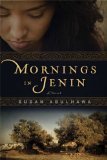
Mornings in Jenin

This review was published in today’s Times.
According to the Zionist story, Palestine before the state of Israel was ‘a land without a people awaiting a people without a land.’ Writers from Mark Twain to Leon Uris, as well as Hollywood studios and certain church pulpits, retell the tale. But Palestinians, in the West at least, lack a popular counter-narrative. Palestinians are reported on, met only on the news.

Perhaps this is changing. As the land disappears from under their feet Palestinians have been investing in culture, and an explosion of Palestinian talent is becoming visible in the West, in films, hip-hop, poetry and novels. And now Susan Abulhawa’s “Mornings in Jenin” is the first English language novel to fully express the human dimension of the Palestinian tragedy.

The story begins with the Abulheja family at home in the village of Ein Hod near Haifa, marrying, squabbling, trading, and harvesting the olives. It’s a touching and sometimes funny portrait of rural life with hints of the city (notably the Jerusalem-based Perlsteins, refugees from German anti-Semitism) and the Beduin tribes.

Then comes the Nakba, or Catastrophe, of 1948. Driven from their shelled village, the family suffers loss, separation, and humiliation, ending up in a camp in Jenin where “the refugees rose from their agitation to the realisation that they were slowly being erased from the world.” By now we care very much about the key characters, and through them we experience “that year without end”, the interminably drawn out Nakba which stretches through some of the bloodier signposts of Palestinian history – the Naksa or Disaster of 1967, the Lebanese refugee camp massacres, until the 2002 Jenin massacre.

Continue reading “Mornings in Jenin”

BRICUP’s Open Letter to Elton John

BRICUP‘s excellent letter is worth posting. You can send your own messages to Elton John at

Playing for the prison wardens?

editor@eltonjohn.com

Dear Elton John

Like much of the world, we think you’re a good bloke. You came out when it was difficult; you admitted your addictions were stronger than you were; you’ve poured money into AIDS research. Oh, and then there’s the music – not bad at all.

But we’re struggling to understand why you’re playing in Israel on June 17. You may say you’re not a political person, but does an army dropping white phosphorus on a school building full of children demand a political response? Does walling a million and a half people up in a ghetto and then pounding that ghetto to rubble require a political response from us, or a human one?

We think it needs a human response, and we think that by choosing to play in Tel Aviv you’re denying this. You’re behaving as if playing in Israel is morally neutral – but how can it be? How can the cruelties Israel practises against the Palestinians – fundamentally because the Palestinians are there, on Palestinian land, and Israel wants them to go – be morally neutral?

Continue reading “BRICUP’s Open Letter to Elton John”

Criminal and Accomplice

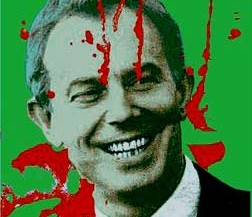
I didn’t watch Blair’s performance at the Chilcot inquiry, for health reasons, but I did read that he mentioned Iran 30 times, as in ‘the same good case for war applies to Iran’. This comes in the context of America concentrating ships and missiles in the Gulf. It is unlikely that the US will attack Iran directly, but increasingly likely that Israel will provoke a conflict. Blair may be preparing the ground for this.

Blair felt ‘responsibility but no regret’ over the destruction of Iraq which has killed over a million, created at least four million refugees, and turned a fertile land into a diseased desert. He focused on Saddam Hussain’s monstrosity, but refrained from explaining how Saddam’s most monstrous crimes were supported by his Western backers. He was allowed to refrain. He didn’t entertain the possibility that Hussain could have been deposed in other ways. He blamed Iran and al-Qa’ida, neither of which had a presence in the country before its collapse, for Iraq’s problems, and again his illogic was not questioned.

Continue reading “Criminal and Accomplice”

What Comes Next

This is the extended version of a piece published in today’s Sunday Herald.

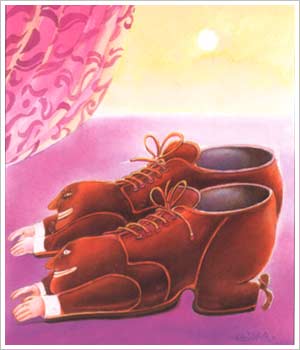
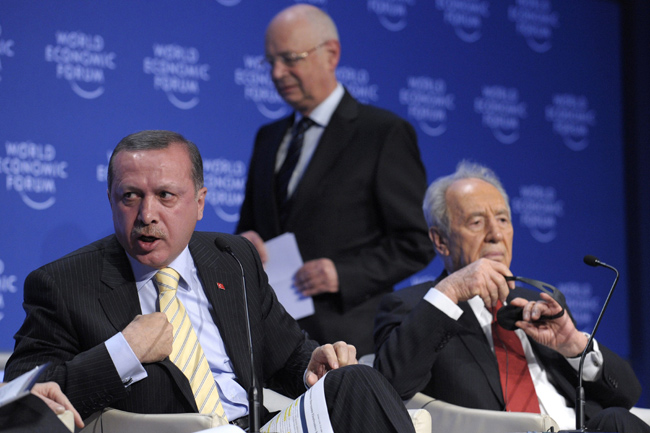
Erdogan reacts to his war criminal neighbour

A strange calm prevails on the Middle Eastern surface. Occasionally a wave breaks through from beneath – the killing of an Iranian scientist, a bomb targetting Hamas’s representative to Lebanon (which instead kills three Hizbullah men), a failed attack on Israeli diplomats travelling through Jordan – and psychological warfare rages, as usual, between Israel and Hizbullah, but the high drama seems to have shifted for now to the east, to Afghanistan and Pakistan. The Arab world (with the obvious exception of Yemen) appears to be holding its breath, waiting for what comes next.

Iraq’s civil war is over. The Shia majority, after grievous provocation from takfiri terrorists, and after its own leaderhip made grievous mistakes, decisively defeated the Sunni minority. Baghdad is no longer a mixed city but one with a large Shia majority and with no-go zones for all sects. In their defeat, a large section of the Sunni resistance started working for their American enemy. They did so for reasons of self-preservation and in order to remove Wahhabi-nihilists from the fortresses which Sunni mistakes had allowed them to build.

The collapse of the national resistance into sectarian civil war was a tragedy for the region, the Arabs and the entire Muslim world. The fact that it was partly engineered by the occupier does not excuse the Arabs. Imperialists will exploit any weaknesses they find. This is in the natural way of things. It is the task of the imperialised to rectify these weaknesses in order to be victorious.

Continue reading “What Comes Next”