I Refuse to Buy a Poppy

05_11_09-Steve-Bell
Steve Bell

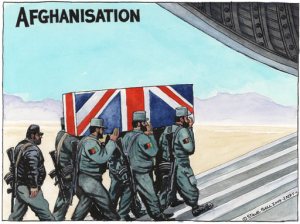
Yesterday five British soldiers were shot dead by an Afghan policeman. Just as they keep promising that they’ve reached ‘decisive turning points’ in their battle with the Afghan resistance, British military officials immediately vowed that the ‘rogue’ policeman would be caught. Today the Taliban reports that the policeman is safe with them, and that he’s been greeted with flowers.

Our glorious patriotic press responds. Amusingly, the Daily Mail headline wrings its hands and squawks, “What kind of war IS this?” Because some people aren’t playing by the rules, you see. Instead of sitting quietly in their villages waiting for the drone attack, or perhaps sending their kids out to accept sweets and modernity from a rosy-cheeked English lad, some barbarians are actually shooting back at the invaders. How very unBritish. (To be fair to the Mail – which has never been fair to anyone – it does seem to be taking an anti-war stance today). Other sections of the media worry about the ‘loyalty’ of Afghan troops, as if love for foreign occupiers is a realistic standard of loyalty. Still others, even more clever, psychoanalyse the policeman, wondering if an argument with his commander pushed him to a moment of madness. But it really isn’t that complicated, as anybody who disabuses themselves of imperialist delusion can see. Very simply, people don’t like foreigners striding around their streets and fields with guns and assumptions of superiority. Afghans will kill British troops as surely as Britons would kill Afghan troops if they occupied this country.

Continue reading “I Refuse to Buy a Poppy”

Islam in the Writing Process

enjoin the good
photo by Rehan Jamil

If all goes well I will be at Notre Dame University in the US later this month for a conference on the role of Islam in contemporary European literature. I wrote the piece below for the conference.

Salman Rushdie once commented that ‘Islam’, in contrast to ‘the West’, is not a narrative civilisation. This, in my opinion, is obvious nonsense. Beyond the fact that human beings are narrative animals, whatever civilisation they live in, and that Islamic civilisation cannot be isolated from, for instance, Christian, Hindu or Arab civilisations, the Muslim world has a history of influential narratives which is second to none. These include Sufi tales, chivalric adventures, fantastical travelogues, romances and spiritual biographies written in several major languages.

Although the Arabic novel is generally considered to have developed in the early twentieth century from the experience of industrial urbanisation and the penetration of European genres and philosophies, Ibn Tufail’s 12th Century “Hayy ibn Yaqzan”, an inspiration for Defoe’s “Robinson Crusoe”, can reasonably stake a claim to being the world’s first novel. The Arabian Nights (via Don Quixote) is surely another source of the European novel tradition. And Islam the religion – as opposed to the even more nebulous ‘civilisation’ – is a text-based faith. The Qur’an is the religion’s only official miracle; the first word revealed to the Prophet was ‘iqra’ – ‘read’. Those who attempt to draw a distinction between literalist scripture and free and playful literature should pay attention to verse 26 of the Qur’an’s second chapter which, immediately after the first description of heaven and hell, proclaims: “Behold, God does not disdain to propound a parable of a gnat, or of something even less than that.” In other words, the Qur’an is a text unashamed to use metaphor, symbol and a whole range of literary devices in order to point to ineffable realities.
Continue reading “Islam in the Writing Process”

The Supreme Crime Against Satire

Ah, Tony Blair…. inheritor and champion of Thatcherite neo-liberal economics and Zionist neo-conservative foreign policy, presidor over a dramatic rise in British Islamophobia, appointer of unelected Zionist tycoons to manage the good behaviour of the Palestinians while they lose the last of their land and rights, holy liar, war criminal, hypocrite, a man complicit in the Gaza massacre, and in the 2006 assault on Lebanon’s civilian infrastructure … and soon, perhaps, first president of the European Union. I’ve written about this lovely chap before. Those of you who believe the appointment of Blair to the EU presidency would be the worst possible start to the post and a sure sign to the rest of the world that Europe has no interest in justice or good governance, can sign this petition. I certainly have. On the other hand, some of you may agree with George Monbiot’s provocative argument that Blair’s appointment to the post will provide the best opportunity for having him tried for war crimes. So far, Blair has only been rewarded for his crimes, with directorships, a book deal, and the joke post of ‘Middle East peace envoy’, which Monbiot calls “the supreme crime against satire.”

Monbiot’s article is here:

Continue reading “The Supreme Crime Against Satire”

President Blair

If the Irish vote to ratify the Lisbon Treaty, Tony Blair, former British prime minister and current lecturer on faith, peace, and Palestinian submission, is expected to become the European Union’s first president. I wrote the following hymn to Blair in October 2007, when the unpleasant prospect of his presidency was first raised.

steve bell tony blairI’ve often thought that Abu Hamza al-Masri, the ex-imam of Finsbury Park mosque, must have been designed in a CIA laboratory. Not only did he – before his imprisonment – fulminate in a shower of spittle against various brands of kuffar, he also had an eye patch and a hook for a hand. You can’t imagine a more photogenic Islamist villain.
If my supposition is correct, then Tony Blair may well have been invented by the Iranian secret service, for of all the neo-cons he’s the one who most looks the part. I refer to the physiognomic combination of weakness and fury, the slight chin wobbling beneath that eye with its wild glint of certainty – the staring left eye, fixed on something the rest of us can’t see, something that makes reality irrelevant – and the teeth both fierce and mouselike, and the shininess of both forehead and suit. Most politicians wear suits, but few suits declare ‘hollow salesman’ so much as Blair’s. The voice too – the hurried speech and breathy tones of a public schoolboy approaching orgasm – that repulsive aural mix of complacency, stubbornness and privilege.

Sabra and Shatila

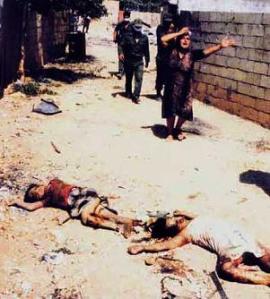
Genre-specific readers be alerted: this is first draft fiction, not reportage – though its material is entirely factual. Twenty seven years ago today.

sabra shatila 1The militia were Arabs, brother Arabs.

The Phalangists were already baying from east Beirut, howling revenge. Now Israel flew Haddad’s militia, la crème de la crème, up from the south. Both groups assembled at the airport, for General Sharon to ensure all were properly kitted out: with weapons, military rations, medical supplies; Israeli cocaine and Lebanese hashish; Mediterranean testosterone, bad breath.

Then he uncaged them.

At six on Thursday evening. In the first penetration, three hundred and twenty men were brought on thirty trucks. Four gangs invading from four approaches. These were the most blood-addicted, rape-happy, battle-addled of militiamen, men long ago surfeited on outrage, men who required ever more extreme atrocities to stir their glutted senses. Ever wilder, ever sharper.

Israel lit the sky for them. White phosphorus flares trailing and dancing. Fire above like a terrible sun in the ceiling, a sun switched on in anger, while the children are sleeping.

Continue reading “Sabra and Shatila”

Maghut’s Shade and Noon Sun

maghutSyrian writer Muhammad al-Maghut was born the son of a peasant farmer in the dusty town of Salamiyah in 1934, during the French occupation. As a young man he joined the Syrian Social Nationalist Party, the second biggest mass party in Syria after the Ba’ath. Like the Ba’ath, the secular SSNP appealed to religious minorities – al-Maghut was of Ismaili origin. Unlike the pan-Arabists of the Ba’ath, it envisaged a fertile crescent state including Syria, Lebanon, Palestine, Jordan, Iraq, Kuwait and even Cyprus. Al-Maghut was locked up on several occasions for SSNP membership. During his first imprisonment – in Mezzeh prison in 1955 – he met the influential poet Adonis and started writing poetry himself.
As a poet he deserves to be much more widely known. Along with Adonis and Nizar Qabbani he was a modernist, using free verse instead of the traditional Arabic forms. Like Qabbani he aimed to be accessible to the ordinary people, but his ‘lover narrator’ is perhaps better suited to our twisted times than Qabbani’s. Certain verses sum up the decadent atmosphere very well indeed. The following remind me of those Gulf Arabs and others who profit from the prostitution of refugee women from occupied Iraq:

Lebanon is burning – it leaps, like a wounded horse, at the edge of the desert/ and I am looking for a fat girl/ to rub myself against on the tram/ for a Beduin-looking man to knock down somewhere. My country is on the verge of collapse/ shivering like a naked lioness/ and I am looking for two green eyes/ and a quaint café by the sea/ looking for a desperate village girl to deceive.”

Continue reading “Maghut’s Shade and Noon Sun”

The Search

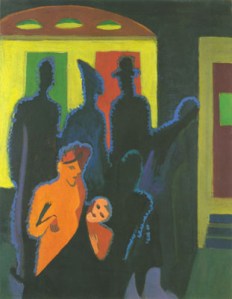
Ernst KirchnerOn a couple of occasions – that I know of – I’ve had my irises scanned. These in the airports where I get pulled over for the stupid questions. In theory, a computer link can now tie my iris to my bank account, credit rating, police record, driving license and passport details – all in the sharpest microsecond.
The town centre has been replaced by a shopping mall, owned and controlled. People take more interest in Angelina Jolie’s romantic life than in the course of political events. The politics on show are soap opera, and the soap opera is a British value to be transmitted to deserving immigrants. According to the new points system for migrants, access to Britishness can be speeded up by campaigning for a political party (I presume they don’t mean Hizb ut-Tahrir), while ‘active disregard for British values’ – which might or might not mean protesting against imperialist wars – will retard membership of the club.

The great Englishman Dr. Johnson said, “Patriotism is the last refuge of a scoundrel.” And on that sound note allow me to introduce a short story by the Syrian writer Ibrahim Alloush, translated by Domenyk Eades.

Continue reading “The Search”

A Map of Home

090831-jarrarThis review was also published in the Electronic Intifada.

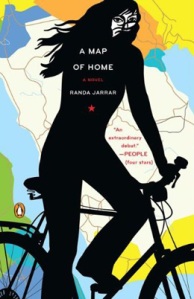
Randa Jarrar’s “A Map of Home” is a beautifully achieved coming of age novel which follows a clever girl through a war, a domestic battlefield, and repeated forced migrations. For our heroine, these events are aspects of the normal everyday stuff (because everything’s normal when it happens to you), like school, friends, family, and shopping. Despite the geographical and cultural particularities of the story, the themes – of awakening sexually, of learning how to love a parent yet firmly say no, and of struggling for independence and a place in the world – are universal, and the book will appeal to all but the most easily shocked readers.

At the novel’s centre is a family. The father, Waheed, is a Palestinian from Jenin exiled to a string of temporary residences. Resentful of his failure to develop a career as a poet, he projects his ambition onto his daughter, about whom Waheed is convincingly self-conflicted: he wants her to be a famous professor, but doesn’t want her to study away from home.

Continue reading “A Map of Home”

The Crisis of Islamic Civilisation

This was published in Prospect Magazine.

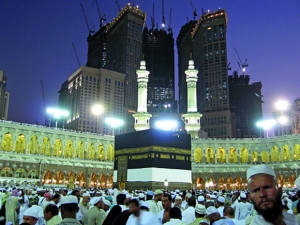
meccaThe contemporary religious revival is a complex business. In the same period that Muslim societies, in their weakness, seem to have re-embraced Islam, America, in its strength, has re-embraced Christianity. Western Europe remains avowedly secular. Despite the contradictions within the West, mainstream Orientalism holds that all cultures are developing towards the universal (or, more specifically, globalised) model of secular modernity and the market. The Muslim world experiences backwardness to the extent that it resists secularisation.

“The Crisis of Islamic Civilisation”, a subtle and erudite book by former Iraqi minister Ali A Allawi, challenges this thesis. Surveying the Muslims’ social, economic and moral failures, and the terror espoused by certain Islamist groups, Allawi suggests the problem might not be too much Islam, but too little.

Continue reading “The Crisis of Islamic Civilisation”

Enemies of Free Speech

Gaza police check their organs

Remember the Islamophobic cartoons published by the neo-con Danish newspaper Jyllands-Posten? The controversy rumbled on from 2005 into 2006, and involved angry demonstrations, embassy-burnings (in countries where you can’t look at an embassy without a government permit), deaths, boycotts, and campaigns of support to counteract the boycotts. Although I found the cartoons deeply offensive, and not in the least related to free speech or constructive debate, I was more upset by the responses of some Muslims.

The cartoons were a media provocation, and should have been combatted through intelligent use of the media. The outpouring of Muslim anger at a West which insulted Muslims after slaughtering them was certainly understandable, but was aimed at the wrong target. I lived in Oman at the time, where the state-appointed Mufti as well as editorials in the state-controlled press encouraged people to boycott Danish goods. The supermarkets put up signs announcing that they no longer stocked Danish goods (although an English friend assured me that Danish bacon was still on sale in the foreigners-only pork room of one supermarket). Meanwhile the shelves groaned under American products, and Oman continued to stock  British and American military bases. American planes were incinerating Iraqi Muslims in their mosques at the time. The cartoon fuss seemed very much to be an organised distraction from more serious issues.

Continue reading “Enemies of Free Speech”