Who’s Afraid of Women’s Song?

At 4:02, as the women sing, a male protester yells: “Who’s afraid of women’s song?”

The following is a testimony of one of the women, out of the 23 activists, who were arrested in this week’s Nabi Saleh demonstration (above video). This demonstration was the first after Mustafa Tamimi’s murder. It was extremely brutal, which is a relative term, considering the continuous repression that the demonstrations against the apartheid wall face, and the village of Nabi Saleh in particular.

Out of the 23 activists, many were physically assaulted while handcuffed behind their backs, as Mohammed Khatib, one of the leaders of the Bil’in popular committee, describes in his own testimony. Mustafa Tamimi’s sister, Ola, who was prevented from being with her brother as he took his last breaths, was pepper sprayed in the eyes, from a few centimeters away. And another handcuffed woman was slapped with the back of the hand of a passing male settler, when she expressed objection to him assaulting Khatib and taking pictures. These are just a few of the testimonies that were published and taped, we still don’t have a complete story of this particular demonstration, and many other stories will be lost in the clouds of gas.
Testimony of Sahar M. Vardi

Continue reading “Who’s Afraid of Women’s Song?”

Silence of the lambs

It says something about American society that on the day a true hero, PFC Bradley Manning, goes to trial, less than twenty people show up to support him. Shame.

How to Occupy the World

A Call for True Internationalism

by Jason Hickel

Leon Neal/AFP/Getty Images

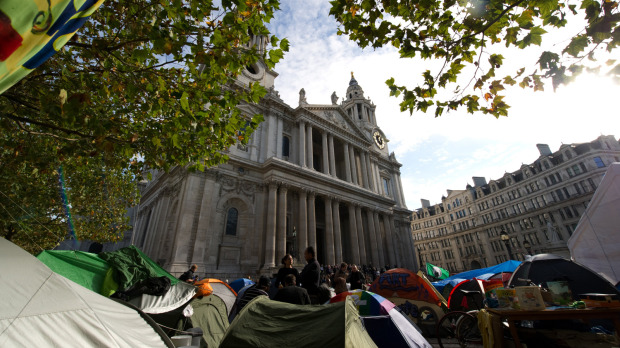
The leading tagline of the Occupy Wall Street movement reads: “Protest for World Revolution.”  This is an ambitious claim, to be sure. And in most respects it seems to ring quite true: the movement has successfully taken root not only in cities and towns throughout the United States but also in major urban centers around the world.  On October 15, Occupy Wall Street’s success inspired a broad wave of coordinated occupations across Europe.  I was a founding participant in the one that began in London.

But the Occupy movement has been notably absent outside of North America and Europe.  Not for want of trying, of course: in southern Africa, where I am originally from, small groups of committed activists tried to instigate occupations in a few key regional cities, but without much success.  In South Africa, a society divided by violent inequalities that proceed directly from neoliberal policy, Occupy managed to attract only a few dozen souls – a poor showing for a country known for one of the highest protest rates in the world.

What accounts for the failure of Occupy to capture the imagination of the global South, which comprises precisely the people whose lives have been most brutally affected by the recent global financial crisis?  And in what sense can Occupy claim to be a world revolution if it leaves out – and in some cases even alienates – the vast, non-white majority of humanity?

Continue reading “How to Occupy the World”

Bradley Manning Heads for Trial; No One Charged for Murdered Civilians

Ray McGovern introduces a short documentary deconstructing events revealed by Wikileaks.

The Terrible Beauty of Wikileaks

The following appears in The Arabs Are Alive, edited by Ziauddin Sardar and Robin Yassin-Kassab. 

On 7 December 2010, Tunisian despot Zine el Abidine Ben Ali’s regime blocked internet access to the Beirut daily Al-Akhbar for publishing a US embassy cable which painted the dictator, his wife and her family in a deeply unflattering light. In the July 2009 cable, US ambassador Robert Godec had accused Ben Ali’s regime of having ‘lost touch with the Tunisian people…[tolerating] no advice or criticism whether domestic or international,’ and of increasingly relying ‘on the police for control and focus on preserving power.’ The cable mentioned the growing ‘corruption in the inner circle,’ particularly around first lady Leila Trabelsi and her family, whom it said the Tunisians ‘intensely dislike, even hate.’ It finally concluded that ‘anger is growing at Tunisia’s high unemployment and regional inequities. As a consequence, the risks to the regime’s long-term stability are increasing.’

Ten days later in Sidi Bouzid, 26-year-old street vendor Muhammad Bouazizi immolated himself in front of the local municipality building after his vegetable cart was confiscated by Faida Hamdi, a female municipal official who had then slapped him, spat in his face, and insulted his dead father. Anguished friends and sympathizers soon took to the streets to protest, and Youtube, Facebook and Twitter helped spread the fire further—the long deferred anger of the Tunisians had finally erupted. On 4 January 2011, when Bouazizi succumbed to his wounds, the 5,000 mourners at his funeral were heard chanting, ‘Farewell, Mohammed, we will avenge you. We weep for you today. We will make those who caused your death weep.’ Ten days later, as the protests reached a crescendo, Ben Ali and his wife hoarded their loot and decamped to Saudi Arabia. Some suggested that Wikileaks had drawn first blood.

Continue reading “The Terrible Beauty of Wikileaks”

The Criminalization of the Homeless in Hungary

by Kevin James Moore

A homeless shelter in Hungary

Cleared out of bridge underpasses, hiding in underground stations, finding refuge in forests, the homeless people of Budapest feel they are being treated as fugitives on the run. This has FEANSTA, the European Federation of Nation Organizations working with the homeless, expressing concerns over concerted attacks in Hungary. The country is seeking punitive measures against dumpster-diving and street sleeping and FEANTSA foresees this leading to the criminalization of the homeless.

Most of the focus on the growing trend to enforce laws that will lead to the imprisonment of the homeless is falling on the shoulders of István Tarlós, mayor of Budapest. Tarlós has said, “those who believe that all problems would be solved if homeless people were given housing […] are mistaken.”

The Mayor of Budapest believes his city is following the strict regulations set forth by other European nations that include Austria, the United Kingdom, France, Spain, Germany, and Holland. FEANSTA has countered with evidence that even though many European nations apply strict rules for services that grant the homeless funding and support, there are no laws in those countries that threaten significant fines or imprisonment as in Hungary.

Continue reading “The Criminalization of the Homeless in Hungary”

Support Today’s Freedom Riders by Ending U.S. Support for Israeli Apartheid

by Josh Ruebner

Fifty years ago, Freedom Riders braved beatings and arson by supremacists intent on maintaining apartheid in the Jim Crow South.  By challenging segregated transportation through nonviolent action, these African American and white activists set in motion a process that ultimately dismantled segregation. While the struggle for racial justice continues, at least this shameful chapter of formal racial discrimination is history.

Reflecting on this anniversary, Rep. John Lewis, one of the main organizers of the Freedom Rides, noted that they “changed America. Before the movement…people were afraid….That fear is gone. People can walk, live, work and play with a sense of dignity and a sense of pride.”

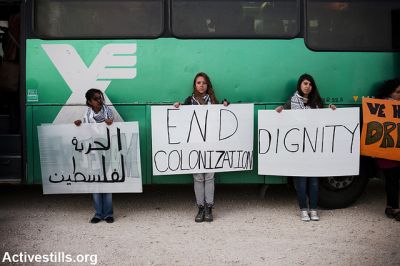
Fired by the same drive for dignity and pride, six Palestinian nonviolent activists boarded last week an Israeli settler bus to draw the world’s attention to the segregated transportation systems and apartheid conditions they endure living under Israel’s brutal 44-year military occupation of the Palestinian West Bank and East Jerusalem. Channeling Frederick Douglass, spokesperson Hurriyeh Ziadah asserted, “Our rights will not voluntarily be handed to us, so we are heading out to demand them.

While attempting to ride from the occupied West Bank into occupied East Jerusalem, nonviolently demanding their right to benefit from infrastructure created by Israel on their land,  Israeli military stopped the bus, physically removed and arrested the riders who held signs reading “Freedom,” “Dignity,” and “We Shall Overcome.”

Continue reading “Support Today’s Freedom Riders by Ending U.S. Support for Israeli Apartheid”

Cairo Protests “To Save The Revolution”

Jihan Hafiz reports that dozens killed as Egyptians demand a civilian government.

Overcoming Contradictions

by Kathy Kelly and Hakim

Adelaide, Australia –At Tabor House Technical College, 21 young people sit in a semicircle looking curiously at Hakim and me. We’ve been invited to speak with them about the practice of justice.  Hakim, who has lived among Afghans for the past nine years, begins by describing how an Afghan youth, Zekerullah, would greet them.  “Salam,” he says to all. With his hand over his heart, Hakim makes eye contact with each student, and then nods in silent greeting. I smile, having watched Zekerullah do just this, whenever he entered a room. The students are interested.

“You can’t listen only to leaders,” Hakim tells them. “We must put our ears close to the hearts of ordinary people and listen to them.”  Hakim is often poetic, but he’s also a trained physician, prone toward assembling data and seeking careful diagnosis.

Rising early this morning, he prepared for today’s presentation by collecting statistics about government responses, in various parts of the world, to massive manifestations of public opinion.  As expected, the short survey showed that leaders aren’t listening well to ordinary people, that ‘national interests’ routinely overrule the people’s interests:

72% of Australians want their troops to be withdrawn from Afghanistan.

But Prime Minister Julia Gillard insists that Australian troops will remain “till the end of the decade, at least.”

63% of Americans oppose the Afghan war.

But the US is about to sign a US-Afghan Strategic Partnership Agreement that will allow joint military bases in Afghanistan beyond 2024.

Continue reading “Overcoming Contradictions”