Support Assange

The Russian government is encouraging NGO’s to nominate Julian Assange for the Nobel Peace Prize. Meanwhile this letter of support has appeared in the Guardian signed by several of our friends.

We protest at the attacks on WikiLeaks and, in particular, on Julian Assange (Report, 9 December) The leaks have assisted democracy in revealing the real views of our governments over a range of issues which have been kept secret and are now irreversibly in the public domain. All we knew about the mass killing, torture and corruption in Iraq and Afghanistan has been confirmed. The world’s leaders can no longer hide the truth by simply lying to the public. The lies have been exposed. The actions of major corporations such as Amazon, the Swiss banks and the credit card companies in hindering WikiLeaks are shameful, bowing to US government pressure. The US government and its allies, and their friends in the media, have built up a campaign against Assange which now sees him in prison facing extradition on dubious charges, with the presumed eventual aim of ensuring his extradition to the US. We demand his immediate release, the dropping of all charges, and an end to the censorship of WikiLeaks.

John Pilger, Lindsey German Stop the War Coalition, Salma Yaqoob, Craig Murray, Alexei Sayle, Mark Thomas, Caryl Churchill, AL Kennedy, Celia Mitchell, Ben Griffin (former soldier), Terry Jones, Sami Ramadani, Roger Lloyd Pack, David Gentleman, Miriam Margolyes, Andy de la Tour, Katharine Hamnett, Iain Banks

Police cavalry charges students in London

Barack Obama will no doubt issue a statement of solidarity soon. (via Lenin’s Tomb) According to Chris Greenwood of the Press Association, the police has made 20 arrests and 43 protesters have been treated at hospital for injuries. Twelve police officers were also injured.

Guardian reports:

At 5.40pm news of the MPs’ historic decision reached the crowds gathered in Whitehall to cries of “Shame!”

Within an hour, the scuffles at police lines that had been erupting all afternoon escalated into more violent confrontations, windows were broken at several buildings including the Treasury and supreme court and in Trafalgar Square

A car carrying Prince Charles and the Duchess of Cornwall was attacked in Argyll Street as they headed for the Royal Variety Performance at the London Palladium, with a window of the vehicle being cracked in the violence. Paint was also thrown and splattered the car. […]

Continue reading “Police cavalry charges students in London”

It Doesn’t Take a Nobel Laureate to Understand the Complex and Seemingly Unsolvable Phenomena of Apartheid

Spot the Nobel Laureate

At the end of October, 40 Nobel Laureates decided to collaborate with an overtly Zionist institution and write a dubious-at-best (Fisking will begin momentarily) public statement, denouncing the academic and cultural portion of the initiatives of the growing world-wide BDS (Boycott, Divestment and Sanctions) movement. Their claims were not new to us, in the movement, nor did they inspire any serious debate, or new thought. Though the statement in itself merited no intellectual response, the mere stature of its authors elicited a response from PACBI (the Palestinian campaign for the Academic & Cultural Boycott of Israel). That said, in the spirit of the free exchange of ideas (and my obsession with taking talkbacks way too seriously), I’d also like to reply to the [n]obel Laureates.

On Ethics and Axioms

“Always shocked but never surprised” has become a mantra to me in the past couple of years. I’ve grown to understand my reality as a place (or rather a twilight zone) where shocking events often happen and ignorant statements are often made, and all without the blink of an eye. No guilt, no shame. No accountability.

Continue reading “It Doesn’t Take a Nobel Laureate to Understand the Complex and Seemingly Unsolvable Phenomena of Apartheid”

Wikileaks: It’s War

One day after the US government declared ‘war’ on Wikileaks, hackers around the world have retaliated. They’ve already taken down the websites of Mastercard and the Swedish prosecutor. Others, such as Paypal and Visa are also under cyber attacks.

Continue reading “Wikileaks: It’s War”

Wikileaks and 21st Century Statecraft

Have 250,000 leaks sunk the State Department’s ‘Internet Freedom’ policy?

by Roy Revie

As the fallout of Cablegate continues to consume column inches, gigabytes, and cabinet meetings across the world, the realisation that this is about more than one man, one organization, and one massive leak seems to be slowly sinking in. While some argue that stories and comment focusing on the process of the leak and the fallout for the organisation only distract from the stories contained within the cables themselves, it is clear that this element is as vital (in the short term at least) as the contents of the cables.  We find ourselves in the middle of an unprecedented public debate on Internet freedom and the role of the state online.  In this debate much has been written about the motives and background of Wikileaks (some bad, some excellent) while other parties involved have avoided the same scrutiny.  Of particular interest in the current discussion is the role of the State Department which under Hillary Clinton’s leadership has played an important and contradictory role in the debate on Internet freedom.

Back in more innocent times, in January of this year, Hillary Clinton gave a speech at the Newseum (a 250,000-square foot monument to media complacency) in which she introduced the concept of “21st Century Statecraft” – a term referring to the recent State Department push for the use of social and new media for diplomatic and geopolitical ends.  In this speech she affirmed the US’s commitment to the “principles of internet freedom”, a new Human Right for the 21st Century.  Clinton waxed lyrical about the ethical, financial, political and practical reasons why freedom of access and use of the internet should be considered an absolute right – noting that America “stand[s] for a single internet where all of humanity has equal access to knowledge and ideas”.  The State Department, it seemed, was committed to a comprehensive and open approach to online freedom and engagement, a new stance for a government which had hitherto tended towards a more iterative approach to interaction with the modern world.

Continue reading “Wikileaks and 21st Century Statecraft”

The Truth Will Always Win

by Julian Assange

In 1958 a young Rupert Murdoch, then owner and editor of Adelaide’s The News, wrote: “In the race between secrecy and truth, it seems inevitable that truth will always win.”

His observation perhaps reflected his father Keith Murdoch’s expose that Australian troops were being needlessly sacrificed by incompetent British commanders on the shores of Gallipoli. The British tried to shut him up but Keith Murdoch would not be silenced and his efforts led to the termination of the disastrous Gallipoli campaign.

Nearly a century later, WikiLeaks is also fearlessly publishing facts that need to be made public.

I grew up in a Queensland country town where people spoke their minds bluntly. They distrusted big government as something that could be corrupted if not watched carefully. The dark days of corruption in the Queensland government before the Fitzgerald inquiry are testimony to what happens when the politicians gag the media from reporting the truth.

These things have stayed with me. WikiLeaks was created around these core values. The idea, conceived in Australia, was to use internet technologies in new ways to report the truth.

Continue reading “The Truth Will Always Win”

Ilan Pappe on Zionist Ideology


Ilan Pappe at the Palestine Solidarity conference in Stuttgart am 27 November 2010.

Continue reading “Ilan Pappe on Zionist Ideology”

Supporting Wikileaks

Dylan Ratigan and Glenn Greenwald

Wikileaks has transformed activism, raising its scope and impact. Its detractors are myriad, but it defenders are worthier. Daniel Ellsberg is of course the best known among them, who has recently written an open letter to Amazon criticizing its decision to deny service to Wikileaks. But there are also Ray McGovern, Ron Paul and Noam Chomsky. Our friend Phil Weiss has also written an eloquent tribute to Wikileaks’s achievements. But by far the most impressive commentator on the issue is constitutional law attorney and Salon blogger Glenn Greenwald. For a delightful demolition of the naysayers and their anaemic arguments watch Greenwald debate Steven Aftergood of FAS on Democracy Now.  Also don’t miss Dylan Ratigan’s extended interview with Greenwald on the overblown reactions to Wikileaks:

Bhopal 26 years later

by Saffi Ullah Ahmad

Editor’s Note: For backround on the Bhopal disaster click here.

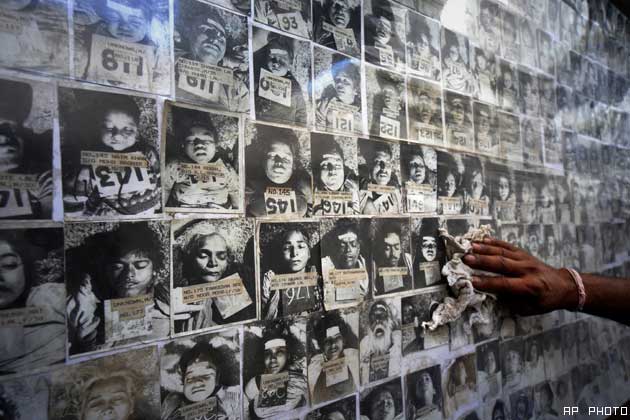
Friday marks the 26th anniversary of the world’s worst industrial catastrophe, the Bhopal Gas Disaster, which brought to light in the most horrific of ways the darker side of economic globalisation. The disaster saw the lives of hundreds of thousands of impoverished Indians destroyed as negligence on the part of a US multinational led to the escape of over 40 tons of ultra-hazardous toxic gasses from a poorly built pesticide factory, laying waste on an entire city.

Although estimates vary, the current death toll is thought to be 25,000, and those seriously injured number well over 100,000. These numbers are still rising due to the thousands of tons of abandoned chemicals continuously polluting the Bhopali environment (with increasing concentrations in the soil and drinking water), and gas-affected survivors giving birth to children with serious genetic malformations.

To date, justice has evaded Bhopal victims and their families, who continue to suffer with a vast range of crippling disabilities as well as psychological trauma. The multinational behind all this — Union Carbide Corporation, now owned by the Dow Chemical Company — continues to exploit the inadequate framework of the Indian legal system and has been aided by indifference and at times probable collusion by the central government which dubiously insists it has always acted in the best interest of the victims.

Continue reading “Bhopal 26 years later”