The Bhopal Disaster: an ongoing tragedy

by Saffi Ullah Ahmad

Recent talk surrounding BP’s oil spill in the Gulf of Mexico due to corporate negligence has drawn light on the Exxon Valdez disaster and one which devastated one of India’s poorest regions with its effects still very much raw and constantly ignored by the US media. Obama’s anti-BP rhetoric has spurred many of those affected by this disaster to point out Western double standards.

The old plant (Photo: Christian Saltas)

Twenty five years after the world’s biggest industrial disaster, Union Carbide’s old pesticide factory remains untouched, haunting the crowded city of Bhopal, a constant reminder of the region’s darkest night.

On the night of 3 December 1984 the lethal gas methyl isocyanate (MIC) alongside other noxious fumes, engulfed the city of Bhopal and killed thousands. It is thought that the disaster has claimed 25,000 lives thus far, and adversely affected over 500,00. Gross negligence by Union Carbide is widely viewed as the cause of the tragedy.

Earlier last week, after a quarter century of waiting and sloppy, almost reluctant court action, lamentable sentences were passed down to seven Union Carbide India Limited (UCIL) officials. Sentences of two years were administered to some of those presiding over the corporation when the tragedy occurred; a small group of incredibly wealthy Indian men, all in their 70’s, one of whom is a billionaire, and none of whom are expected to serve their sentences. In addition to the sentencing, each of the seven men were fined a paltry £1400, an amount which would barely pays for the yearly healthcare of one of the victims, let alone serves as meaningful punishment for this appalling crime.

These convictions are so far the only to have materialised in a case that was opened the day after the tragedy in 1984. Those ultimately responsible for the tragedy, namely the corporation’s CEO and equally negligent Western officials, remain unpunished.

Survivors and campaigners have been outraged, calling last week’s decision an ‘insult’. However, as we are about to see, this is only the most recent of a long history of insults.
Continue reading “The Bhopal Disaster: an ongoing tragedy”

Bolivia’s thirst for change

AlJazeeraEnglish — 23 June 2010 — People&Power investigates President Evo Morales’ alternative climate summit on the problems of global warming.

Witnessing Against Torture: Why We Must Act

by Kathy Kelly

Congress shall make no law… abridging the freedom of speech, or of the press; or the right of the people peaceably to assemble, and to petition the Government for a redress of grievances.
–U.S. Constitution –  Amendment I

An old cliché says that anyone who has herself for a lawyer has a fool for a client.  Nevertheless, going to trial in Washington, D.C., this past June 14, I and twenty-three other defendants prepared a pro se defense.  Acting as our own lawyers in court, we aimed to defend a population that finds little voice in our society at all, and to bring a sort of prosecution against their persecutors.

Months earlier, on January 21st, we had held a memorial vigil for three innocent Guantanamo prisoners, recently revealed to have been in all probability tortured to death by our government with what would turn out to be utter impunity – and because we had wished the culpable parties to take notice, we’d staged a vigil where they worked, specifically on the Capitol Steps and in the Rotunda of the U.S. Capitol Building. We had been charged with causing a “breach of the peace,” a technical legal term for a situation that might risk inciting people to violence. In abetting Administration use of torture, Congress had been inciting others to horrendous violence, and we’d been protesting perhaps one of the gravest imaginable breaches of the peace.  Now we were making our small attempt to take these crimes to court, in the course of defending ourselves against what we felt to be a misdirected charge.

Continue reading “Witnessing Against Torture: Why We Must Act”

Whose protests are they?

June 20 Beit Jala Demonstration (Photo: Joseph Dana)

by Joseph Dana

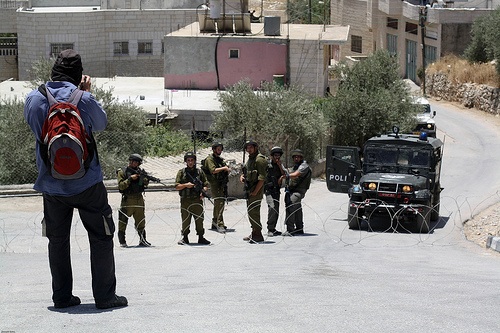
Beit Jala is a small city outside of Jerusalem. The wall that Israel is building in order to expropriate land and create a physical barrier between Israeli and Palestinian society is being built through the middle of this city. Palestinians have decided to begin a series of weekly demonstrations against the construction. The demonstrations are usually composed of Palestinians, international activists and a handful of Israelis. In the middle of last week’s protest, baking in the summer heat, I wondered how helpful the international activists were. Instead of maintaining a low profile and letting the Palestinians demonstrate, the internationals were at the front of the protest yelling slurs at the Israeli troops in the city. The Palestinian right to protest, resist and demonstrate is real, yet I am curious about the outcome when internationals to engage in the same actions, with their own style and individual behaviors. Israelis that want to assist and take on a supportive role often do so at the directive of the Palestinians. The Anarchists against the Wall are the most profound example of this movement in Israel. Are international activists who travel to Israel for short amounts of time part of the protest movement in Palestine? It is one thing to support a protest movement and another thing to join a protest movement.

Continue reading “Whose protests are they?”

First ever boycott at US port in solidarity with Palestine

See:

Irish folk legend Tommy Sands joins the Sheikh Jarrah Protest

mariosavio — 19 June 2010 — Irish folk legend Tommy Sands performed in front of a crowd of hundreds of Israelis and Palestinians who came to the Sheikh Jarrah neighbourhood in East Jerusalem for the weekly Friday demonstration to protest against house evictions of Palestinians by Israeli courts and settlers.

After the performance, the demonstrators marched in the streets of the neighbourhood. Israeli police tried to prevent them from marching, but was unable to stop them due to the large numbers of demonstrators.

The Only Democracy in the Middle East: 18.6.10

Fifteen year-old paramedic volunteer arrested by the IDF, while on duty, cuffed in discordance with regulations. ~Photograph by Gal Lugassi

Five paramedics (one of them [image to the left] a minor, the age of 15) and one member of the press- all marked with vests according to their duty, all residents of the village of Ni’lin- were arrested during the weekly demonstration. I later chanced upon the 6 at the Beit-El (settlement) police station. We managed to talk to them a bit and take some pictures before the guarding officer started yelling for the police to come and take us away. Anarchists Against the Wall Reported the following:

One of the soldiers punched the cameraman and a medic, and another threw a large rock at the a radio receiver belonging to the medics. The arrestees were taken to the Shaar Binyamin police station. Two of them were accused of assaulting the police, and four were released.

The latest report is that the remaining journalist and paramedic were both released, with no conditions.

Continue reading “The Only Democracy in the Middle East: 18.6.10”

Lebanese aid flotilla “Virgin Mary” sets sail for Gaza


Continue reading “Lebanese aid flotilla “Virgin Mary” sets sail for Gaza”

Sebastião Salgado: The Photographer as Activist

This is from a few years back. The great Brazilian photographer Sebastião Salgado in conversation with Ken Light and Fred Ritchin at the UC Berkeley Graduate School of Journalism. Also, don’t miss the ringing prose of Eduardo Galeano’s ‘Salgado, 17 Times‘, an essay inspired by Salgado’s work.

A Voyage of Life and Death

Al Jazeera reconstructs the events surrounding the Israeli assault on the Gaza Freedom Flotilla.

AlJazeeraEnglish — 14 June 2010 — In the early hours of Monday, May 31, the Israeli navy intercepted a flotilla of boats carrying thousands of tonnes of aid to Gaza. Nine passengers on the Mavi Marmara – the flotilla’s largest boat – were killed. This much we know. In the aftermath of the event, accounts from both sides have diverged wildly. Israel claims that it acted in self-defence against a group of “violent extremists” linked to al-Qaeda and Hamas, intent on breaching the military blockade of Gaza. The activists say they were frightened for their lives after being shot at from helicopters in the dark of night, their raised white flag ignored. They say Israel’s attack on their ship in international waters was unexpected and disproportionate. Examining claim and counter claim, A Vourney of Life and Death includes an exclusive interview with the captain of the Mavi Marmara, those on board the ships and previously unseen footage.