Category: Palestine
Protesters shot dead for shouting: Nakba Remembrance Day 2011
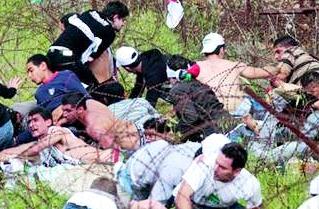
by Brenda Heard
The 15th of May is a day of remembrance. Around the world, we remember the systematic displacement and massacre of the Palestinian people. In their honour, we take note of the necessity of safeguarding the sliver of impoverished land that has been left to the survivors. We pay tribute to those who have refused to be stomped into oblivion.
Yet the Israeli newspaper Haaretz bemoans self-righteously the ‘Palestinian protests for the annual Nakba Day, which mourns the creation of the State of Israel’. At this phraseology we can only shake our heads and say, ‘no, it is not about you; it is about the injustice done to the Palestinian people; it is this injustice that is the catastrophe’.
Continue reading “Protesters shot dead for shouting: Nakba Remembrance Day 2011”
Return to Occupied Golan
UPDATE I: Ali Abunimah describes below what is happening in the video. UPDATE II: an eyewitness report on the aftermath of the march.
Dramatic footage of Syrians and Palestinians braving bullets and landmines to return to occupied Golan.
Palestine Whistleblower Speaks
Ziyad Clot writes for the Guardian on why he leaked PA documents to al-Jazeera.
In Palestine, the time has come for national reconciliation. On the eve of the 63rd commemoration of the Nakba – the uprooting of Palestinians that accompanied the creation of Israel in 1948 – this is a long-awaited and hopeful moment. Earlier this year the release by al-Jazeera and the Guardian of 1,600 documents related to the so-called peace process caused deep consternation among Palestinians and in the Arab world. Covering more than 10 years of talks (from 1999 to 2010) between Israel and the PLO, the Palestine papers illustrated the tragic consequences of an inequitable and destructive political process which had been based on the assumption that the Palestinians could in effect negotiate their rights and achieve self-determination while enduring the hardship of the Israeli occupation.
My name has been circulated as one of the possible sources of these leaks. I would like to clarify here the extent of my involvement in these revelations and explain my motives. I have always acted in the best interest of the Palestinian people, in its entirety, and to the full extent of my capacity.
Welcome to Gaza
Welcome to Gaza is a documentary about Gaza City, Palestine, looking at its ancient heritage. Here’s the trailer:
United we stand
 by Brenda Heard
News during the last couple of weeks has rumbled in to shake an already rickety balance of world order. Perhaps one of the most disturbing images accompanying those headlines, though, was not that of more bruised and bulleted bodies. Rather, the image was of what the Associated Press termed a ‘jubilant crowd’. As though they had just won the World Cup Final, Americans waved flags as they sang and chanted their patriotic celebration.
Osama Bin Laden, they had just been told, had been shot dead. After nearly a decade-long manhunt, he had finally been pounced upon in Pakistan. The crowd cheered. And when President Obama made the official announcement, he coaxed the nation to cheer the same; he concluded by quoting the American pledge of allegiance:
Let us remember that we can do these things not just because of wealth or power, but because of who we are: one nation, under God, indivisible, with liberty and justice for all’.
‘Indivisible’. In this one word lies the notion that has fed American policy for many, many years: united we stand—divided they fall.
Gaza Strip
James Longley, the acclaimed director of the Oscar-nominated Iraq in Fragments (an award the film should have won, but for political reasons was instead handed to Al Gore), has generously made available his acclaimed 2002 film Gaza Strip for online viewing. (via Joseph Dana at +972)
In early 2001 I spent three months in Gaza filming material for this documentary, GAZA STRIP, working with local fixer and translator, Mohammed Mohanna. The second Palestinian uprising against Israeli military occupation had begun in September, 2000, and there had already been large numbers of deaths in Gaza when I started this project.
Though the period this documentary covers includes the election of Ariel Sharon as Israeli Prime Minister and large incursions by the Israeli Defense Forces into Gaza, in retrospect the time depicted here is one of relative quiet. More recent Israeli attacks against Gaza have been far more destructive and deadly than what falls into the scope of this film.
The Goldstone Report: The Legacy of the Landmark Investigation of the Gaza Conflict

Our dear friends Phil Weiss and Adam Horowitz of Mondoweiss at an event organized by Middle East Children’s Alliance (MECA) to launch of their new book The Goldstone Report: The Legacy of the Landmark Investigation of the Gaza Conflict, an edited version of Judge Goldstone’s U.N. report documenting war crimes during Israel’s Operation Cast Lead in Gaza. It includes essays by Raji Sourani, Leila El-Haddad, Ali Abunimah, Rashid Khalidi, Letty Cottin Pogrebin, Brian Baird, with a forward by Desmond Tutu and an introduction by Naomi Klein.
The event was chaired by Penny Rosenwasser of MECA. Also speaking at the event were Prof. George Bisharat of UC Hastings Law School and Barbara Lubin of MECA.
Khirbat Tuqu’ & the Silent World
It must have been late at night when this rare, short, late-night segment on Channel 10 sneaked by the editors:
Between Judea and Samaria & the West Bank
While I’m astonished that an Israeli mainstream news service would even address this story at all, let alone report in a considerably balanced manner; There are many very basic questions that this 2-and-a-half minute segment whizzes through, that I’d like to comment on.
Continue reading “Khirbat Tuqu’ & the Silent World”
HotDocs and CoPro: Entertaining Palestinian Voices

Since the second that I’ve realized that the only political action left for people who wish to see Palestinian rights realized is Boycott, Divestment and Sanctions, it’s been immediately clear that the Palestinian produce and services, and culture and narrative would have to be simultaneously promoted. This would prove to be tricky after 60 years of ongoing ethnic cleansing and simultaneous economic buildup. The systems that have formed in Israel for the benefit of the Palestinian population have often artificially separated the “social” from the “political” and created institutions that are unable and unwilling to truly improve Palestinian lives. Without political analysis, we are left with institutions that’s sole purpose is to serve as a fig leaf, depicting Israel as a state which promotes Palestinian social care and voices, when in fact, all they do is pat themselves on the back for boxing the Palestinian population into a perpetual state of dependence and forced gratitude.
Continue reading “HotDocs and CoPro: Entertaining Palestinian Voices”
 P U L S E