Boycott Israel group posts silent video after YouTube removes original
Category: Palestine
How Europe’s universities aid the Israeli occupation
by David Cronin
 One of the most enjoyable things that has happened since I wrote a book on Israel’s relations with Europe is that I have been asked to speak at various universities. So when an invitation appeared in my email inbox to visit King’s College London (KCL), I immediately accepted. Big mistake.
The request came from the International Center for the Study of Radicalisation (ICSR), a partnership between King’s College and the Interdisciplinary Center (IDC) in Herzliya, Israel. I only became aware of the partnership one day before I was scheduled to address an ICSR seminar in January. Following a hasty consultation with some friends in the Palestine solidarity movement, I withdrew from the event, informing the organisers that I fully supported the campaign to boycott Israeli goods and institutions.
Set up in 2008, the ICSR boasts on its website that it is “the first initiative of this kind in which Arab and Israeli academic institutions can work together”. This appears to be a reference to how the Jordan Institute of Diplomacy is also involved in its research on political violence. However, the participation of an academic body from an Arab state does not exonerate the ICSR for embracing the Herzliya centre, which has long tried to cloak Israeli apartheid with intellectual gravitas.
Each year the IDC hosts the Herzliya security conference, attracting Israel’s political, military and business elite, as well as illustrious foreign guests. Speakers at this conference can spout racist invective without fear of being challenged; in 2003, Yitzhak Ravid, a senior researcher with Israel’s weapons development authority Rafael called for coercive measures to curb the birth-rate among Palestinians. “The delivery rooms in Soroka Hospital in Be’ersheba have turned into a factory for the production of a backward population,” he said, alluding to an area with a considerable number of Bedouin inhabitants.
Continue reading “How Europe’s universities aid the Israeli occupation”
PLO: History of a Revolution
1. Masters of their Own Destiny
Masters of their own Destiny is the first episode in Al Jazeera’s six-part series on the history of the Palestine Liberation Organisation. It looks at the challenges encountered as Palestinians sought to wrest control of their own destiny from Arab regimes and create an independent Palestinian organisation that would lead the struggle for a national home.
The muzzling of Israel critics in European universities
 David Cronin, author of the recently released Europe’s Alliance with Israel: Aiding the Occupation, writes in his latest piece for Mondoweiss:
If imitation is the best form of flattery, then the activists behind Israeli Apartheid Week have been paid an immense tribute. As students belonging to Palestine support groups across Britain held events to mark the annual March event, they learned of a rival initiative. A network of on-campus Zionist societies have declared their own Israeli Awareness Week over the same period.
The awareness week has relied heavily on gimmicks to try and counter impressions that Israel has a war addiction. Stalls staffed by visiting Israeli students have offered sugary delights labelled “Peace of Cake”; signatures have been collected for a “we support a two-state solution” petition.
Continue reading “The muzzling of Israel critics in European universities”
Israel resumes slaughter in Gaza
Press TV’s excellent reporter Safa Joudeh reports from Gaza.
United States of Israel
Sarah Palin is just the latest GOP politician to visit to Israel after a string of possible Presidential hopefuls to make a pilgrimage to the Holy Land in the past few months. Why is establishing your credentials in Tel Aviv before running for US president as vital as stumping in New Hampshire?
Terror and Hypocrisy
An irate PULSE reader, a Zionist immigrant to Israel from Britain, has written to ask why I haven’t condemned the murder of a family living in the illegal colony of Itamar near Nablus. The reader, by the by, describes himself as a ‘lefty.’ It’s always interesting to see how political terminology entirely loses its meaning when employed by Zionists. Choosing to migrate from a safe, free country to join the side of the masters in an aggressive ethnocracy is not what would normally be called ‘lefty’ behaviour. Here’s another example – a “left-leaning youth movement” is establishing a new settlement in the illegally occupied and ethnically-cleansed Jordan valley. Hooray for the Zionist left.
As it happens, I think the attack on the Itamar family was repulsive. I have no idea how anyone could stab young children to death, even the children of racists and thieves. These murders were immoral and politically counter-productive. They gave Israel an excuse to whine about the bloodthirstiness of the natives and a pretext for building hundreds more homes in the West Bank (although Israel does these things without pretexts too).
Will the two-state solution go the way of the defunct peace process?
by Ben White
This article first appeared in the NewStatesman.
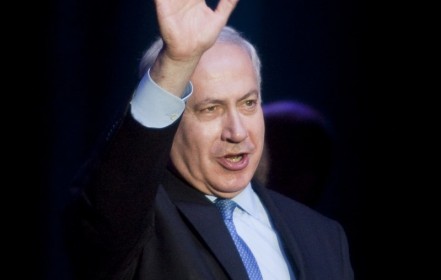
In the last week, press reports have suggested that Israeli PM Benjamin Netanyahu is preparing to give a key speech on the peace process in the next few months, with many flagging up his planned visit to the US in May. Claims of an imminent bold proposal have been met with a good deal of scepticism, from both Palestinians and Netanyahu’s domestic political opponents. Analysts have described the talk of a new plan as a “trial balloon” and a “public relations exercise aimed first and foremost at Washington”.
Netanyahu’s new plan, should it materialise, is rumoured to be based on the “the establishment of a Palestinian state within temporary borders” as part of an “interim peace agreement with the Palestinian Authority”. Other reports have been even vaguer, claiming that Netanyahu is proposing “a phased approach to peacemaking”, but leaving it open if this includes temporary borders.
Continue reading “Will the two-state solution go the way of the defunct peace process?”
Conversations with History — Richard J. Goldstone
Justice Richard J. Goldstone discusses “The Rule of Law” with Harry Kreisler on Conversations with History.
Conversations host Harry Kreisler welcomes Justice Richard J. Goldstone for a discussion of the role of law in transitions to democracy, in the prosecution of war crimes, and in the enforcement of the rules of war in the post 911 environment. Drawing on his experiences in South Africa, on his work as special prosecutor for the Bosnia and Rwanda tribunals, and for his leadership of the UN commission on the Gaza War, Justice Goldstone discusses the distinctive features of the South African transition, the ground breaking work that facilitated a breakthrough in the Bosnia conflict, and the goals and accomplishments of the commission examining the conduct of Hamas and Israel in the Gaza War. He concludes with lessons learned from his efforts to insure the rule of law.
My Journey to BDS
by Roger Waters
 In 1980, a song I wrote, “Another Brick in the Wall Part 2,” was banned by the government of South Africa because it was being used by Black South African children to advocate their right to equal education. That apartheid government imposed a cultural blockade, so-to-speak, on certain songs, including mine.
Twenty-five years later, in 2005, Palestinian children participating in a West Bank festival used the song to protest Israel’s apartheid wall. They sang “We don’t need no occupation! We don’t need no racist wall!” At the time, I hadn’t seen first-hand what they were singing about.
A year later in 2006, I contracted to perform in Tel Aviv.
Palestinians from the movement advocating an academic and cultural boycott of Israel urged me to reconsider. I had already spoken out against the wall, but I was unsure whether a cultural boycott was the right way to go. The Palestinian advocates of a boycott asked that I visit the occupied Palestinian territory, to see the Wall for myself before I made up my mind. I agreed.
 P U L S E