Voices

Coriolanus in the public forum from Ralph Fiennes’s excellent adaptation.

Here’s the full speech:

Most sweet voices!
Better it is to die, better to starve,
Than crave the hire which first we do deserve.
Why in this woolvish toge should I stand here,
To beg of Hob and Dick, that do appear,
Their needless vouches? Custom calls me to’t:
What custom wills, in all things should we do’t,
The dust on antique time would lie unswept,
And mountainous error be too highly heapt
For truth to o’er-peer. Rather than fool it so,
Let the high office and the honour go
To one that would do thus. I am half through;
The one part suffer’d, the other will I do.

Here come more voices.
Your voices: for your voices I have fought;
Watch’d for your voices; for Your voices bear
Of wounds two dozen odd; battles thrice six
I have seen and heard of; for your voices have
Done many things, some less, some more your voices:
Indeed I would be consul.
On the ‘Precision’ of Language: Why the Term ‘Genocide’ is So Wrong, or Who Can Use the Term

This essay is a response to the emerging discussions over the ‘appropriateness’ of the use of the word ‘genocide’ in the context of the Indian military occupation in Kashmir on PulseMedia and elsewhere on Facebook.

by Mohamad Junaid

[This essay is a response to the emerging discussions over the ‘appropriateness’ of the use of the word ‘genocide’ in the context of the Indian military occupation in Kashmir on PulseMedia and elsewhere on Facebook.]

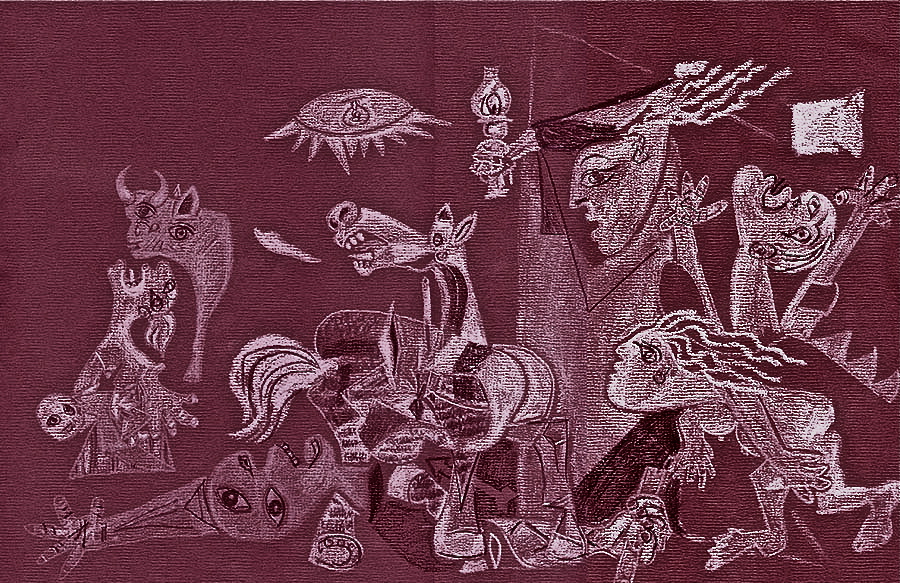
Homage to Picasso's Guernica (HD 2002)

But, which language? Which one language expresses all joyous, exhilarating, or traumatic experiences?

When Kashmiris are told to be precise in their language there are largely two positions involved: one, a sympathetic (if inadequate and self-censorious) one, which suggests that following ‘the convention’ will allow for legalistic interpretation and some form of retributive or ‘restorative’ justice. Often such a position traps itself in legal discourse, and by seeking to bottle people’s experiences into tight categories, fetishizes those categories, and in the end reduces the depth of traumatic experiences to mere data points on the grid of classification. This compliant and self-disciplining position forgets the origins of law in violence (and the inverse), and how ‘law’ serves to maintain ‘order’—which is, in other words, the systematized, legally endorsed structure of oppression. The peculiar claim to universalism (to create a universal system of law) that drives this position pays no heed to where, and for whom, these supposedly ‘universal’ categories of law are created, and what connection law has with power or ‘international’ law with the empire. Continue reading “On the ‘Precision’ of Language: Why the Term ‘Genocide’ is So Wrong, or Who Can Use the Term”

Window To My City

By Feroz Rather

Illustration by Showkat, a Srinagar-based painter and artist

By the River Jhelum, my window opens into the city of Srinagar at noon. It is a trellis window. Its wooden motifs are rhomboidal, our patient improvisations of what they were, many centuries ago, in Samarkand. Over the soldiers’ sand-bagged bunker and the tangles of wire, over the roof shingles of houseboats moored in the muddy water, it overlooks a road, dusty and strewn with stones, busy with life, the leisurely passage of buses.

The window fills with the clamor of the city centre, Lal Chowk, from the rear: honking of cars, shouts of bus conductors, of vendors selling lotus stems and water nuts, the jingle of bangles on the arms of women, hobnobbing of old men, whistles of the policemen on prowl. It listens in the songs of Habeh Khuton, sad and reminiscent of the color of saffron from Pamper from the corner where you find late poems of Azad, fresh copies of Curfewed Night, fake pieces of Bombay music.

Continue reading “Window To My City”

Philip Levine: A Workingman’s Voice

By Feroz Rather

With a serene and distant view of the hills of Sierra Nevada, on 9 August, 2011, I sat in a library at California State University Fresno, reading The Simple Truth, a collection of poems by Philip Levine. The day after, Mr. Levine, 83, was being nominated by the Library of Congress the next poet laureate of the United States. The felicitations, however, had made their way to the poet’s home here in Fresno and thrilled the entire community of writers in the Central Valley of California. Brandi Spaethe, a friend and fellow writer in our MFA program, broke the news to me. And while walking this beautiful campus dotted with maple trees, with an ecstatic gusto of a poet-in-the-making, she fell into long recitations of many touching poems from the book.

Philip Levine was born in Detroit, Michigan, to Russian-Jewish immigrant parents in 1928, a year before the Great Depression started paralyzing the economy of the US. Levine was educated in Detroit public schools and at Wayne State University, Michigan’s only urban public research university. After graduation, Levine worked a number of industrial jobs, including the night shift at the Cheverolet Gear and Axle factory in 1953, working on his poems in his off hours.   In the fall of the same year, he journeyed to the University of Iowa to attend a poetry workshop. In his autobiographical account, The Bread of Time, he recalls: “The attraction at Iowa was Robert Lowell, whose Lord’s Weary Castle had received the Pulitzer Prize.”Afterwards, he became Stegner Fellow at Stanford University. And then in 1958, he came to Fresno and began teaching English and writing at California State University and which went on for 34 years.

Continue reading “Philip Levine: A Workingman’s Voice”

Shahid: A Ghazal

by Manash Bhattacharjee

To Najeeb Mubarki

Agha Shahid Ali (1949-2001)
Kashmiris will murmur the blessed word, Shahid,
when the Beloved no longer has to witness Shahid.
 
The day Paradise was lost, who was at the gates?
We only know boots of Hell marched in Shahid.
 
Rizwan couldn’t return to console his father –
he found refuge for days in your nightmares Shahid.
 
The Beloved left behind growing nights of sand    
and stars never slept in your deserted eyes Shahid. 
 
Mother’s death flung you into longing’s hollow arms.
Love’s ironic fate earned you her illness Shahid.
 
Continue reading “Shahid: A Ghazal”

A Passport Of The Country Without A Post Office

The genocide in Kashmir is not over yet, but the land fertilized by the blood of innumerable, amaranthine martyrs is blossoming bouquets of tulips and roses in quick succession. New possibilities of spring, of poetry, of Azadi, of freedom, of peace are here, and they are unstanchable. I wish you were here, Shahid: Beloved, Witness, and perhaps with the slip of tongue, even Shahd, or Honey.

by Huma Dar

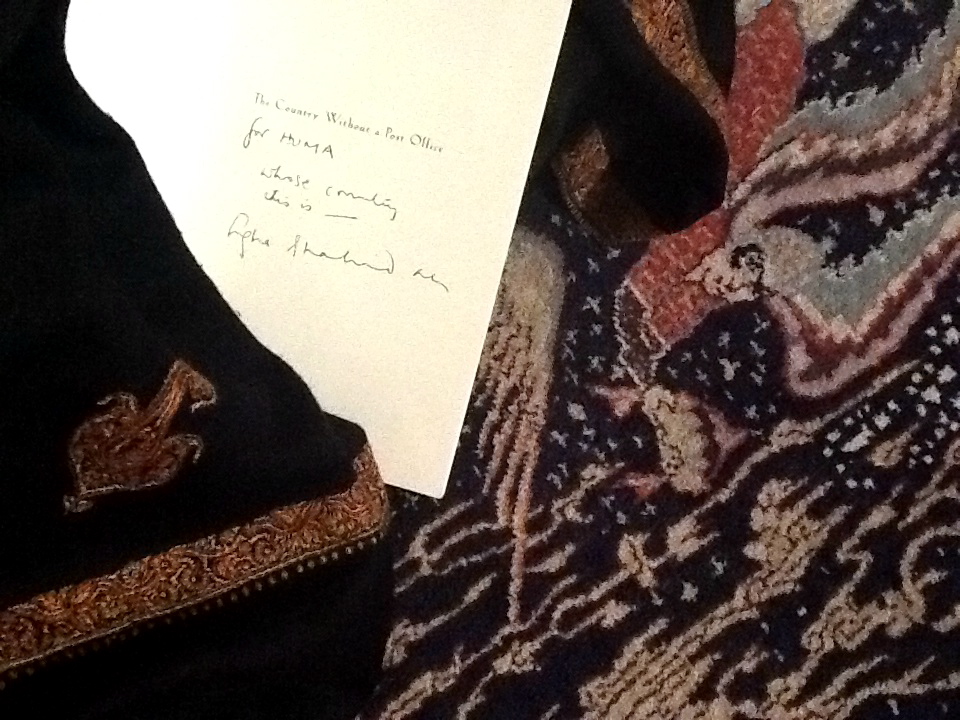
Passport to The Country Without A Post Office

I met Shahid between noon and one pm, in the Lipman Room of Barrows Hall, almost exactly thirteen years ago, on December 3, 1998.  He’d come to recite from The Country Without A Post Office (1997) for the Lunch Poems Reading Series at UC Berkeley.  His jokes, tinged with a very particular Kashmiri black humor — irreverent, risqué, ridiculous — mirrored my family’s wacky one.  All that heartache about Kashmir, finding not many kindred souls around, found solace in Shahid’s scriptured lament, “After the August Wedding in Lahore, Pakistan.”

A brigadier says, The boys of Kashmir
break so quickly, we make their bodies sing,
on the rack, till no song is left to sing.
“Butterflies pause / On their passage Cashmere –”
And happiness: must it only bring pain?
The century is ending.  It is pain
from which love departs into all new pain:
Freedom’s terrible thirst, flooding Kashmir,
is bringing love to its tormented glass.
Stranger, who will inherit the last night
of the past?  Of what shall I not sing, and sing?

Continue reading “A Passport Of The Country Without A Post Office”

“Do Palestinians teach their children to hate?”

The amazingly talented Canadian-Palestinian spoken word poet, Rafeef Ziadah, answers.

Birmingham for Tariq Jahan

by Carol Ann Duffy

Tariq Jahan
Tariq Jahan's son, Haroon, was killed in a hit and run incident during the riots in Birmingham. Photograph: Darren Staples/Reuters

After the evening prayers at the mosque,
came the looters in masks,
and you three stood,
beloved in your
neighbourhood,
brave, bright, brothers,
to be who you were –
a hafiz is one who has memorised
the entire Koran;
a devout man –
then the man in the speeding car
who purposefully mounted the kerb …


I think we all should kneel
on that English street,
where he widowed your pregnant wife, Shazad,
tossed your soul to the air, Abdul,
and brought your father, Haroon, to his knees,
his face masked in only your blood
on the rolling news
where nobody’s children riot and burn.

Carol Ann Duffy is the poet laureate. This poem was first published by the Guardian.

Waiting for the Barbarians

The classic poem by Egyptian-born Greek poet Konstantinos Kavaphes (C. P. Cavafy) from which J. M. Coetzee took the title for his great novel.  This translation by Richmond Lattimore first appeared in The Kenyon Review in 1955. 

C. P. Cavafy

Why are we all assembled and waiting in the market place?

It is the barbarians; they will be here today.
Why is there nothing being done in the senate house?
Why are the senators in session but are not passing laws?

Because the barbarians are coming today.
Why should the senators make laws any more?
The barbarians will make the laws when they get here.

Why has our emperor got up so early
and sits there at the biggest gate of the city
high on his throne, in state, and with his crown on?

Because the barbarians are coming today
and the emperor is waiting to receive them
and their general. And he has even made ready
a parchment to present them, and thereon
he has written many names and many titles.

Why have our two consuls and our praetors
Come out today in their red embroidered togas?
Why have they put on their bracelets with all those amethysts
and rings shining with the glitter of emeralds?
Why will they carry their precious staves today
which are decorated with figures of gold and silver?

Because the barbarians are coming today
And things like that impress the barbarians.

Continue reading “Waiting for the Barbarians”