Peace or Pacification

aleppoThis was published at the Canadian Centre for Policy Alternatives.

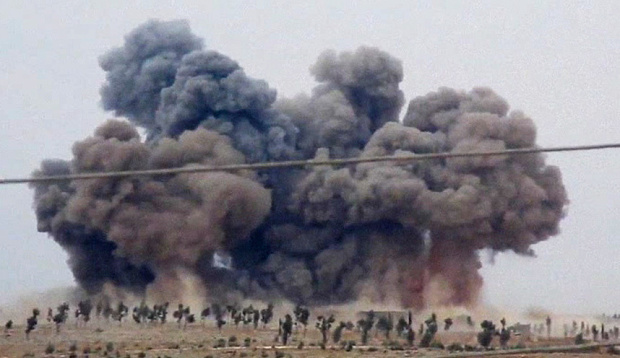
As I write, state representatives are attending the theatre in Geneva. (The talks were stopped on February 3rd). In Syria, meanwhile, reality prevails: in one day a tented camp of the displaced in the Lattakia hills is bombed, barrel bombs rain on the south and the Damascus suburbs, Russia’s cluster bombs crumple over the north, and up to a hundred people are asphyxiated by chlorine gas in Moadamiyah. Let’s hope the seats in the theatre are nice and comfy.

Russia, the prime mover of the process, is inviting its own ‘opposition’ delegates. It complains (with Assad and Iran) that the actual opposition delegation contains ‘terrorists’. The thousands of Iranian-backed transnational Shia jihadists in Syria are not considered terrorists and should not be discussed at this stage.

The United States accepts these terms, and instead of the ‘transitional government’ agreed upon as the ultimate goal in previous Geneva talks, it speaks now of a ‘national government’. In other words Assad – responsible for the overwhelming number of civilian casualities and displacements – can stay, so that all may confront the ‘greater evil’ of jihadism.

Yet 80% of Russian bombs are falling not on ISIS but on the opposition to both ISIS and Assad, that is, on the communities which previously drove ISIS from their areas. A quarter of a million more have been displaced as a result of the Russian assault, which hits courthouses, schools, hospitals and aid convoys.

Continue reading “Peace or Pacification”

Gilbert Achcar schools RT on Syria

This is what happens when RT makes the mistake of inviting an actual Middle East expert. Gilbert Achcar of SOAS breaks the channel’s truth embargo and explains Syria‬ to an audience which is otherwise only exposed to the ramblings of miscellaneous truthers and conspiracy nuts. Unlike John Pilger who went on RT to sing a love song to Vlad Putin, Achcar reminds the audience that the channel is merely a mouthpiece for the Russian state and that the state that destroyed Chechnya can’t possibly be expected to do anything humane in Syria.


We Break It, You Own It: Putin’s Syria Strategy

putinSharp analysis from Thomas Pierret, published first at the Global Observatory.

Some Western observers of Russia’s recent intervention in Syria are convinced President Vladimir Putin is making a mistake—and, following wisdom often attributed to Napoleon Bonaparte, one should never interrupt an enemy while they are making a mistake. By committing its own forces to the defense of beleaguered dictator Bashar al-Assad, some believe that Moscow is about to bog itself down in Syria the same way Washington got stuck in Iraq. However, proponents of this view should be wary the joke might well be on them.

First, although difficult times certainly lie ahead for Russia in Syria, Putin’s intervention will make the conflict more destructive, destabilizing, and intractable, hence more detrimental to all parties. Second, the way Moscow defines success in Syria is hardly comparable to the stabilization-oriented approach adopted by the United States-led coalition in Iraq. Instead, by trying to destroy mainstream insurgents, Putin aims to reshape the Syrian war in a way that would leave Western countries with no other option than to supplement Russia as the protector of Assad.

Russian intervention in Syria will make the war deadlier and heighten the refugee crisis spreading across the region into Europe and beyond. Although they have carried out some precision airstrikes against rebel headquarters, Russian forces have made a greater use of unguided ammunitions, including cluster bombs designed to wreak havoc over vast swaths of territory. As scores of these fail to explode, they will continue to kill civilians who will accidentally set them off years after the end of Russian operations. Russian attacks are not more discriminate than Assad’s, but they are far more powerful. Consequently, they have provoked new displacements of populations in regions whose inhabitants were already used to intensive shelling and bombing, such as the northern countryside of Hama province.

Continue reading “We Break It, You Own It: Putin’s Syria Strategy”

“Hands Off Syria” Applies to Russia Too—An International Statement

The following statement was authored by Gail Daneker of Friends for a NonViolent World, Brian Slocock of the Syria Solidarity Movement, UK, and the blogger and activist Clay Claiborne


“Hands Off Syria” Applies to Russia Too

As people and groups from many countries, united by a common commitment to peace, justice and human rights, we condemn the military offensive that began with air strikes launched by Russia in Syria on 30 September 2015 and accelerating subsequently.

While the Russian government has said that these operations were directed against the Islamic State (ISIS), most were on areas with no ISIS presence. The focus of the Russian military offensive appears to have been on opposition communities in the northern Homs region, a continuing center of resistance to the Assad Regime.

The victims of the Russian aggression on 30 September were predominantly civilians, including many children. Humanitarian conditions were dire in the area before Russia launched its offensive because it has long been under siege by the regime for its resistance. Continue reading ““Hands Off Syria” Applies to Russia Too—An International Statement”

Uncomfortable Facts

russian bombsTwo stories in one day which you would expect to disrupt the faux-anti-imperialist narrative, but which probably won’t. Narratives stand high above facts, after all.

First, ISIS claims responsibility for a suicide attack which killed Saudi soldiers in Aden, Yemen.

Second, according to this article, printed in full below, Israel has agreed to provide intelligence on the Syrian opposition to Russia, to help it with its bombing runs. In return Russia promises to stop weapons flowing through Syria to Hizbullah, and to tolerate any Israeli bombing of Syria. The last paragraph says that Tzipi Livni, Israel’s former Foreign Minister, “has called for direct cooperation with Iran and Hezbollah in order to protect Israeli interests.”

UPDATE: My friend Elizabeth Tsurkov says this: “Israel is simply ensuring that it can bomb Hizbollah/Iranian targets without being shot down by Russian jets of S-300 systems. There’s no indication anywhere that Israel is sharing intel with the Russian regime on this issue. … Middle East Monitor is a site that it known to fabricate stories.” She may well be right about the source, and about the intelligence sharing. But Russian-Israeli military cooperation is increasing, not only in Syria.

Mainstream and leftist opinion – often guided by a cabal of ageing orientalist white men (Cockburn, Fisk, Bromwich, Glass, etc) – will continue to hold that Saudi Arabia controls ISIS and Russia is lined up with Assad and Iran in a confrontation against the Zionist West, which is intent on Assad’s downfall. These useful idiots are smoothing the way for the fascist-imperialist axis.

Meanwhile Russian fire falls on Syria’s liberated cities, striking the Free Army in Homs and Jaysh al-Fateh in Idlib, Hama and Lattakia, striking also buildings used by self-organising civilian revolutionary committees and Byzantine ruins outside Kafranbel. Dozens of civilians have been murdered. One in  twenty of Russia’s strikes have targetted ISIS.

It seems regime/ Iranian ground offensives will follow, particularly in northern Homs and the areas of Hama and Lattakia near the regime’s coastal stronghold. The aim is to shore up Assad’s collapsing regime in the fifth of Syria he retains. The larger hope is to destroy the opposition, leaving only Assad and ISIS standing. Then the West may more openly back Assad to take the rest of the country back.

The imperialist assault will undoubtedly extend the war in time and expand it in space. The coming months may see grievous setbacks for opposition forces. In the end, however, Russian bombs will not be able to alter the demographic reality any more than Assad’s bombs or the Iranian militias could before. Assad is running out of fighting men; foreign troops, however many arrive, can extend but not win his war. And not only the opposition militias but the majority of the Syrian people too will refuse to cooperate with any plan envisaging regime survival. For them Assad, not ISIS, is the supreme evil, and with good reason: Assad’s forces are responsible for the overwhelming majority of civilians killed and driven out.

Beyond that, Russia’s economy shrank by 5% last year. Russia isn’t strong so much as it is constantly appeased. But Syria’s fighters are in no mood for appeasement. When the Russians first walked into Afghanistan, when the Americans first walked into Vietnam, they thought their operations would be easy and brief…

Continue reading “Uncomfortable Facts”
Anti-Imperialism 2.0: Selective Sympathies, Dubious Friends

by Charles Davis

The new imperialism is caring a bit too much about the suffering of people who are being brutalized by a regime which is not currently an ally of the United States – and the new anti-imperialism is not giving a damn at all, solidarity that extends beyond the border permissible only if the drawing of attention to their plight could not possibly be used as ammunition by the “humanitarian” militarists of the American empire. The world, in this view, is divided into but two camps: those with America and those against it, with the good anti-imperialist’s outrage dialed up if the atrocity can be linked to the United States, as well it should be, but dialed down to total silence if it’s not.

This is, of course, the “anti-imperialism” of the reactionary, in more than one sense: How a person of the left responds to a pile of dead women and children is in effect dictated by how the U.S. government itself responds, the advocate of the poor and forgotten consigning foreigners to their fate – “not our problem, pal,” as one popular liberal congressman essentially put it on cable TV – if their interests have the misfortune of being perceived as aligned with America’s, the left’s commitment to internationalism abandoned for an inverted form of muddled nationalism that sees U.S. imperialism as not just one factor to consider in a complex world, but the only factor relevant in how we in the imperial core should view what happens on the rest of the globe. And if your cause is sullied by the perception it’s America’s cause too? The leftist sounds just like that liberal who sounds like Pat Buchanan: Sorry, pal, if you wanted our solidarity you should have been born somewhere that better lends itself to a black-and-white anti-imperial critique.

Continue reading “Anti-Imperialism 2.0: Selective Sympathies, Dubious Friends”

Writing with Foreign Blood: A Visit to Ukraine

By Naomi Foyle

From the moment someone writes with foreign blood
they begin to write with their own

                                    from ‘From the Moment’ by Ihor Pavlyuk (translated by Steve Komarnyckyj)

If your heart has lost its way, your feet are sure to also.

                                                   Hryhorii Skovoroda (translated by Naomi Foyle)

Going to Oxford would have been highlight enough. It was a bright March day, I was staying with old friends and reading at a poetry gig in the evening – the perfect mini-break from a dreary winter in my Brighton basement flat. Jonathan Meades’s abrasive defence of Brutalism still scouring my perception of urban space, I insisted on a cycle tour of the monstrous grey jewels in the university’s crown of gargoyles and spires, further amusing my hosts by bursting into phrasebook Ukrainian whenever we sat down for tea. No linguist, I simply hoped my pronunciation was not too atrocious. Invited to join the English PEN launch tour of A Flight Over the Black Sea by Ihor Pavlyuk, I wanted to at least try to say dobryi vechir – good evening – to the poet and our mutual translator Steve Komarnyckyj. That night, my apparently singular preoccupations converged in an image that haunts me still: Ihor, clad in a traditional black and red embroidered shirt, reciting his pagan poems of sea and steppe between the slender concrete pillars of St Antony’s College. What at first seemed an elegant coincidence soon started to resonate rather more unnervingly. As Steve’s translations scattered blood and thorns into the room, the ecclesiastic, Brutalist-lite columns began to ghost a painful history, their slim grey trunks and ceiling branches evoking the dark forests of Russian Orthodox and Soviet repression that subtly shadow Ihor’s poems. An inescapable synchronicity was at work: looking back I’m not surprised that before the year was out I had been compelled again from my writer’s bunker, this time straight to Ukraine.

Continue reading “Writing with Foreign Blood: A Visit to Ukraine”

War and Pieces: Brown Moses on Social Media Investigations

Eliot Higgins (aka Brown Moses), founder of Bellingcat, at Google Ideas, Google for Media, and the OCCRP’s Investigathon in New York, talking about open source investigation into the Buk missile launcher linked to the downing of MH17, showing how he was able to trace it to Russia.

Sectarianization: Steven Heydemann & Joshua Landis on the Trajectory of the Syrian Nightmare

Earlier this month I had the opportunity to interview two of the leading Syria experts in the world, Steven Heydemann and Joshua Landis, about the “big picture” of the Syrian conflict and the wider crisis engulfing the Middle East today, as part of the CMES Conversations series produced by the Center for Middle East Studies at the University of Denver. Landis, while best known as a blogger and commentator on Syria, is an historian. Heydemann is a political scientist who has written an influential study of Syrian politics covering the years 1946-1970.

The two interviews offer contrasting perspectives, but both take us several steps back from the news cycle and place the events unfolding in the region today in a wider historical, comparative and global lens. This was the focus of the forum that brought them to Denver, “Sectarianization: ISIS, the Syrian Conflict & the Future of the Middle East”. Sectarianization will be a central focus of our  in the coming months, and is the theme of the book my colleague Nader Hashemi and I are currently co-editing (our last book being The Syria Dilemma).

Steven Heydemann is Vice President of Applied Research on Conflict at the United States Institute of Peace (USIP). He’s the author of Authoritarianism in Syria: Institutions and Social Conflict, 1946-1970, the editor of War, Institutions and Social Change in the Middle East and co-editor of Middle East Authoritarianisms: Governance, Contestation, and Regime Resilience in Syria and Iran.

Our interview revolves largely around Heydemann’s far-reaching report “Syria’s Uprising: sectarianism, regionalisation, and state order in the Levant”, published by the European think tank FRIDE. Have a look:

Joshua Landis is Associate Professor in the College of International Studies at the University of Oklahoma, where he is also Director of the Center for Middle East Studies. Widely regarded as one of the leading Syria experts in the world, he is the former President of the Syrian Studies Association. He writes and edits the widely-read blog Syria Comment.

Our interview revolves principally around two of his recent articles: “The Great Sorting Out: Ethnicity & the Future of the Levant” and “Why Syria is the Gordian knot of Obama’s anti-ISIL campaign”. Have a look: