A comprehensive presentation on Syria’s evolving insurgency by Charles Lister. (Also don’t miss this interview with Lister).
Category: Syria
The Crossing
 This review of Samar Yazbek’s “The Crossing: My Journey to the Shattered Heart of Syria” was first published at the Daily Beast.
This shocking, searing and beautiful book is an account of three visits to Idlib province in northern Syria, an area liberated from the Assad dictatorship “on the ground but betrayed by the sky.”
In the face of regime repression, Syria’s non-violent protests of 2011 had transformed into an armed uprising in 2012. By August of that year, when the author – exiled Syrian novelist and journalist Samar Yazbek – made her first trip, Assad’s forces had been driven from the rural border zones. From a distance, however, via warplanes and long-range artillery, they implemented a policy of scorched earth and collective punishment. So Yazbek finds her homeland changed to a landscape of burnt fields and cratered market places, with boys picking through collapsed homes in search of things to sell and displaced families sheltering in tombs and caves. Death is ever-present. Gardens and courtyards have become cemeteries. Yazbek never shies away from the horror but builds something worthwhile from it, a record and a reflection, for death is ultimately “the impetus of writing and its source.”
Known today only for war, Syria is heir to an ancient civilisation. Idlib province houses the remains of Ebla, a five-thousand-year-old city, and is dotted with half-intact Byzantine towns and churches. The war’s “ruthless sabotage of history” has damaged these priceless sites. In Maarat al-Numan the statue of 9th Century poet Abu Alaa al-Maari, a native of the town highly respected in his own time despite his unusual atheism, has been decapitated by armed Islamists. And the wonderful mosaic museum at the same location has been bombed by the regime and looted by various militias.
But amid these ruins Yazbek encounters a people giving voice to their aspirations after half a century of enforced silence. In revolutionary towns the walls are “turned into open books and transient art exhibits”. Activists organise “graffiti workshops, cultural newspapers, magazines for children, training workshops, privately-run community schools.” In the context of state collapse these projects are born of necessity, but they also reflect the kind of society the revolutionaries hoped to build – inclusive, democratic, forward-looking – one which they are in fact trying to build, even as extremists fashion their own, much darker versions. Through self-organised committees and councils, Yazbek is told, “each region now has its own administration, and every village looks after itself.” This – Syrians’ willed self-determination, Syrian creativity amid destruction – is the positive story so often missed in the news cycle, and it represents a hope for the future, faint though it is. The activists know they are working against insurmountable odds, but continue anyway. They document atrocities and reach out to international media, an endeavour which has so far failed to bear tangible fruit. When they can, they laugh – it’s “as though they inhaled laughter like an antidote to death.”
“Hands Off Syria” Applies to Russia Too—An International Statement
The following statement was authored by Gail Daneker of Friends for a NonViolent World, Brian Slocock of the Syria Solidarity Movement, UK, and the blogger and activist Clay Claiborne
“Hands Off Syria” Applies to Russia Too
As people and groups from many countries, united by a common commitment to peace, justice and human rights, we condemn the military offensive that began with air strikes launched by Russia in Syria on 30 September 2015 and accelerating subsequently.
While the Russian government has said that these operations were directed against the Islamic State (ISIS), most were on areas with no ISIS presence. The focus of the Russian military offensive appears to have been on opposition communities in the northern Homs region, a continuing center of resistance to the Assad Regime.
The victims of the Russian aggression on 30 September were predominantly civilians, including many children. Humanitarian conditions were dire in the area before Russia launched its offensive because it has long been under siege by the regime for its resistance. Continue reading ““Hands Off Syria” Applies to Russia Too—An International Statement”
Uncomfortable Facts
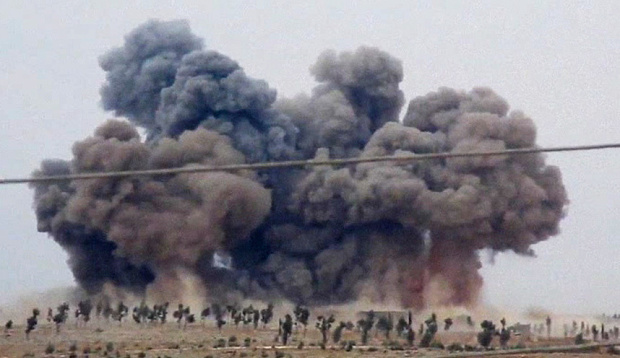 Two stories in one day which you would expect to disrupt the faux-anti-imperialist narrative, but which probably won’t. Narratives stand high above facts, after all.
First, ISIS claims responsibility for a suicide attack which killed Saudi soldiers in Aden, Yemen.
Second, according to this article, printed in full below, Israel has agreed to provide intelligence on the Syrian opposition to Russia, to help it with its bombing runs. In return Russia promises to stop weapons flowing through Syria to Hizbullah, and to tolerate any Israeli bombing of Syria. The last paragraph says that Tzipi Livni, Israel’s former Foreign Minister, “has called for direct cooperation with Iran and Hezbollah in order to protect Israeli interests.”
UPDATE: My friend Elizabeth Tsurkov says this: “Israel is simply ensuring that it can bomb Hizbollah/Iranian targets without being shot down by Russian jets of S-300 systems. There’s no indication anywhere that Israel is sharing intel with the Russian regime on this issue. … Middle East Monitor is a site that it known to fabricate stories.” She may well be right about the source, and about the intelligence sharing. But Russian-Israeli military cooperation is increasing, not only in Syria.
Mainstream and leftist opinion – often guided by a cabal of ageing orientalist white men (Cockburn, Fisk, Bromwich, Glass, etc) – will continue to hold that Saudi Arabia controls ISIS and Russia is lined up with Assad and Iran in a confrontation against the Zionist West, which is intent on Assad’s downfall. These useful idiots are smoothing the way for the fascist-imperialist axis.
Meanwhile Russian fire falls on Syria’s liberated cities, striking the Free Army in Homs and Jaysh al-Fateh in Idlib, Hama and Lattakia, striking also buildings used by self-organising civilian revolutionary committees and Byzantine ruins outside Kafranbel. Dozens of civilians have been murdered. One in twenty of Russia’s strikes have targetted ISIS.
It seems regime/ Iranian ground offensives will follow, particularly in northern Homs and the areas of Hama and Lattakia near the regime’s coastal stronghold. The aim is to shore up Assad’s collapsing regime in the fifth of Syria he retains. The larger hope is to destroy the opposition, leaving only Assad and ISIS standing. Then the West may more openly back Assad to take the rest of the country back.
The imperialist assault will undoubtedly extend the war in time and expand it in space. The coming months may see grievous setbacks for opposition forces. In the end, however, Russian bombs will not be able to alter the demographic reality any more than Assad’s bombs or the Iranian militias could before. Assad is running out of fighting men; foreign troops, however many arrive, can extend but not win his war. And not only the opposition militias but the majority of the Syrian people too will refuse to cooperate with any plan envisaging regime survival. For them Assad, not ISIS, is the supreme evil, and with good reason: Assad’s forces are responsible for the overwhelming majority of civilians killed and driven out.
Beyond that, Russia’s economy shrank by 5% last year. Russia isn’t strong so much as it is constantly appeased. But Syria’s fighters are in no mood for appeasement. When the Russians first walked into Afghanistan, when the Americans first walked into Vietnam, they thought their operations would be easy and brief…
Anti-Imperialism 2.0: Selective Sympathies, Dubious Friends
by Charles Davis

The new imperialism is caring a bit too much about the suffering of people who are being brutalized by a regime which is not currently an ally of the United States – and the new anti-imperialism is not giving a damn at all, solidarity that extends beyond the border permissible only if the drawing of attention to their plight could not possibly be used as ammunition by the “humanitarian” militarists of the American empire. The world, in this view, is divided into but two camps: those with America and those against it, with the good anti-imperialist’s outrage dialed up if the atrocity can be linked to the United States, as well it should be, but dialed down to total silence if it’s not.
This is, of course, the “anti-imperialism” of the reactionary, in more than one sense: How a person of the left responds to a pile of dead women and children is in effect dictated by how the U.S. government itself responds, the advocate of the poor and forgotten consigning foreigners to their fate – “not our problem, pal,” as one popular liberal congressman essentially put it on cable TV – if their interests have the misfortune of being perceived as aligned with America’s, the left’s commitment to internationalism abandoned for an inverted form of muddled nationalism that sees U.S. imperialism as not just one factor to consider in a complex world, but the only factor relevant in how we in the imperial core should view what happens on the rest of the globe. And if your cause is sullied by the perception it’s America’s cause too? The leftist sounds just like that liberal who sounds like Pat Buchanan: Sorry, pal, if you wanted our solidarity you should have been born somewhere that better lends itself to a black-and-white anti-imperial critique.
Continue reading “Anti-Imperialism 2.0: Selective Sympathies, Dubious Friends”
Benedict Cumberbatch’s full length refugee appeal
Benedict Cumberbatch lends his support to a Save the Children charity single raising money for Syrian refugees.
#helpiscoming.
Conversations about home (at a deportation centre)—Warsan Shire
Well, I think home spat me out, the blackouts and curfews like tongue against loose tooth. God, do you know how difficult it is, to talk about the day your own city dragged you by the hair, past the old prison, past the school gates, past the burning torsos erected on poles like flags? When I meet others like me I recognise the longing, the missing, the memory of ash on their faces. No one leaves home unless home is the mouth of a shark. I’ve been carrying the old anthem in my mouth for so long that there’s no space for another song, another tongue or another language. I know a shame that shrouds, totally engulfs. I tore up and ate my own passport in an airport hotel. I’m bloated with language I can’t afford to forget.
Continue reading “Benedict Cumberbatch’s full length refugee appeal”
Tragic Numbers
With the publication of the incredibly powerful photograph of Aylan Kurdi, the boy who drowned while fleeing the fighting in Syria, let’s hope the world pays attention to that awful war for more than one news cycle. Aylan has become the symbol of the current refugee crisis, the largest mass migration since World War II. You can see more at MarkFiore.com.
Instead of Freedom, Annihilation

This piece was published at the Guardian.
In the last week of its Syrian rampage, ISIS bulldozed the 1500-year-old monastery of Mar Elian in al-Qaryatain and blew up the 2000-year-old temples of Baalshamin and Bel in Palmyra.
Syria’s heritage illustrates civilisational history from the Sumerians to the Ottomans. Its universal significance provoked French archeologist Andre Parrot’s comment, “Every person has two homelands… His own and Syria.” For Syrians themselves, these sites provided a palpable link to the past and, it seemed, to the future too, for they once assumed their distant descendants would also marvel at them. Such monuments were references held in common regardless of sect or politics. Like Stonehenge or Westminster Abbey, they provided a focus for nationalist pride and belonging. Naturally, they would have been central to any future tourism industry. Now they are vanishing.
Very recently the potential future looked very different. The popular revolution of 2011 announced a new age of civic activism and fearless creativity, but the regime’s savage repression led inevitably to the revolution’s militarisation, and then war.
The Dissolution of Past and Present
 An edited version of this piece was published at the National.
Zabadani, a mountain town northwest of Damascus near the Lebanese border, was one of the first Syrian towns to be liberated from the Assad regime (in January 2012) and one of the first to establish a revolutionary council. (The martyred anarchist revolutionary Omar Aziz was involved in setting up this council, as well as the council in Barzeh). Zabadani has been besieged and intermittently shelled since its liberation. And since July 3rd this year it has been subjected to a a full-scale assault by (the Iranian-backed) Lebanese Hizbullah, alongside continuous barrel bombing. Apparently the town’s 800-year-old al-Jisr mosque has been pulverised. Human losses are in the hundreds, and beyond the numbers, incalculable.
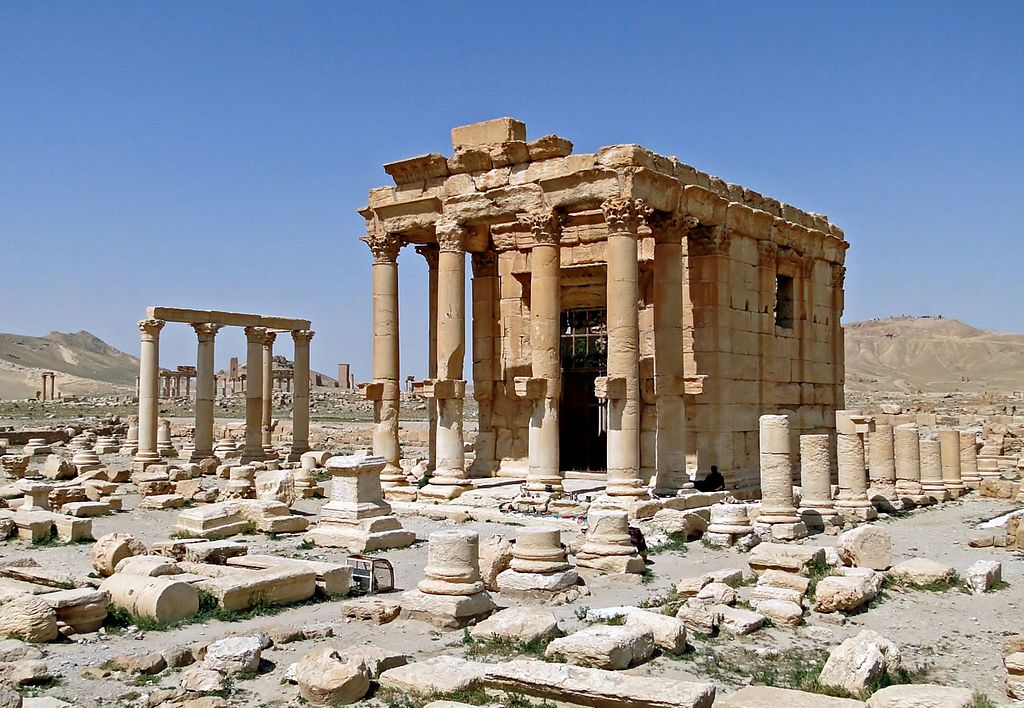
In other news, Daesh (or ISIS) has bulldozed the 1500-year-old monastery of Mar Elian in al-Qaryatain and blown up the beautiful 2000-year-old temple of Baalshamin in Palmyra. The temple once mixed Roman, Egyptian and Mesopotamian styles. Today its rubble is further evidence that there will be no resumption of Syrian normality. The people, monuments, even landscapes that Syrians once took for granted, that they assumed their grandchildren would enjoy, are disappearing for ever.
Palmyra – Queen Zenobia’s desert city – is a world heritage site and perhaps Syria’s most precious cultural jewel. Remarkably intact until recently, it provided a tangible link to antiquity and a breathtaking proof of the region’s civilisational wealth. Nationalist Syrians, whether secular or Islamist, feel the importance of such sites for communal pride and identity. Rational Syrians can at least understand their utilitarian benefit to any future tourism industry.
Neither Bashaar al-Assad nor (Daesh ‘caliph’) Abu Bakr al-Baghdadi are nationalists. Al-Baghdadi is explicit about it: “Syria is not for the Syrians,” he says, “and Iraq is not for the Iraqis.” Al-Assad’s rhetoric is still nationalist (and sectarian), but his war effort is managed by a foreign power now pushing towards the nation’s partition. Though not nationalists, both are certainly fascists obsessed with reinforcing their respective totalitarian states and eliminating any independent intellectual influence. Thus, in a flesh-and-blood echo of its slaughter of Palmyran history, Daesh tortured and publically beheaded Palmyra’s head of antiquities, 81-year-old Khaled al-Assa‘ad, perhaps because he’d refused to reveal the location of hidden treasures.
Bitter Almonds
 An edited version of this review appeared at the National.
This story starts with a birth and a departure, in Jerusalem in 1948. The birth is Omar Bakry’s, and it orphans him. The departure, alongside three quarters of a million others, is his forced expulsion from Palestine. “We’ll be back in a couple of weeks,” one fatefully quips.
Omar, now in the care of a neighbouring family, relocates to Damascus, where the novel unfolds through the fifties and sixties, both an engaging romance and a convincing period drama.
Lilas Taha writes in American English. My British-English ear found it difficult at first to believe in old-fashioned Arabs saving each others’ asses and getting in each others’ faces. The effect was exacerbated by occasionally clumsy dialogue. Real Palestinian-Syrians would see no need to specify, for example, “the ruling Baath Party” or “the actress Souad Hosni”. Realism is lost at moments such as these when the novel, veering into explanatory overstatement, seems too obviously an act of cultural translation. It might have been better to write a preface, or to add footnotes.
But as the pages turn, slowly but surely, the characters come entirely credibly to life. We learn a great deal about them by observing their negotiations of etiquette and social ritual as they traverse a domestic danger zone marked by deaths, difficult births, precarious marriages, and looming scandals.
The cast is close-knit. Mustafa is a farmer denied his land whose lungs are broken in a wool factory. The book’s title comes from his mouth, and provides a wisdom for the drama: “The bitter almonds make you savour the sweet ones more.” His wife Subhia, their son Shareef and daughters Huda and Nadia, make up Omar’s surrogate family.
Taha depicts them trying to make ends meet, their life in cramped quarters, male and female sleeping areas demarcated by a blanket, and the profound familiarities and festering resentments which grow in such conditions.
 P U L S E