Arabs Without God

isis-flagThis was first published at NOW.

In the Arab world, the public declaration of religious disbelief is as taboo as the open profession of homosexuality. Publically-declared atheists and agnostics can wave goodbye to social respect, marriage prospects, even legal recognition. Yet a 2012 poll in Saudi Arabia – a state whose legal system equates atheism with terrorism, and which potentially applies the death penalty to apostates – found that 19% described themselves as ‘not religious’ and a further 5% as atheists.

In his new book “Arabs Without God: Atheism and Freedom of Belief in the Middle East” (soon to be translated into Arabic as ‘Arab bala Rab’) journalist Brian Whitaker interviews activist and quietist unbelievers from around the region, and investigates the pressures ranged against them. Most usefully, the book provokes a question – how can a revived Arab secularism (freed from the taint of the so-called ‘secular’ dictatorships) provide a future in which the rights of religious majorities as well as unbelieving or sectarian minorities will be respected and strengthened?

Demands to believe and submit go far beyond religion. Whitaker quotes sociologist Haleem Barakat, who noted that, like God, the Arab head of state and the Arab family patriarch require absolute respect and unquestioning compliance. “They are the shepherds, and the people are the sheep.” (This is why ‘rab’ – which means ‘Lord’ rather than only the monotheist God – is as apt a translation as ‘Allah’ for the book’s Arabic title). So intellectual atheism is perceived as an attack on family and state, and on community solidarity. The contemporary politicisation of religious identity makes unbelief akin to treason in some minds; for this reason minority sects, dissenters and atheists are frequently seen as fifth columnists, agents weakening state and nation on behalf of foreign powers.

Identity politics in the region took on its modern forms with the building of centralised nation states. Nationalism itself was an assertion of a politicised cultural identity, first against the Ottomans, then against the European empires. For the new rulers of post-independence states, a fear of disloyal communities turned to a generalised rage for homogeneity – ‘the good citizen’, depending on where they found themselves, was to be an Arab, or a Muslim, (or a Turk, or a Jew) as imagined by the state. Many states standardised dress, dialect and worship.

The state’s top-down approach to culture is infectious. Opposition groups too, whether nationalist, leftist or Islamist, have sought to emulate the rulers by seizing control of the state apparatus and imposing their vision from above.

Continue reading “Arabs Without God”

Echoes of the Tearing

This very useful documentary on the Syrian revolution, in Arabic and Spanish with English subtitles, was made by a good friend (known on Facebook as Couteras Madriz), and features many of the creative and courageous activists I and Leila al-Shami interviewed for our forthcoming book. The film is particularly strong on the self-organisation of revolutionary Syrians in committees and councils, and on the counter-revolutionary challenges they face.

The “Islamic State” and the Strategists of Terror

Christoph Reuter is one of the world’s most important investigative journalists. His dispatches for Der Spiegel have illuminated many of the otherwise murky details of conflicts around the Middle East and South-Central Asia. Recently he may have written his most important story yet when he came into possession of the initial planning documents for the organisation that we now know as the “Islamic State”. Here is joins Petra Stienen in conversation at the Heinrich Böll Foundation to discuss the groups origins, which he writes about in detail in his recent book Die Schwarz Macht. (The interview in English starts at 24:10).

Syria: Beyond the Red Line

An important discussion on Syria, hosted by the Frontline Club, featuring Jonathan Littell, Orwa Nyrabia, Laila Alodaat, and Nerma Jelacic.

Continue reading “Syria: Beyond the Red Line”

Robin on Syria for the BBC World Service

Pulse editor Robin Yassin-Kassab speaking to the BBC on a program titled Islamic State controls over half of Syria.

Islamic State controls over half of Syria (50 mins) | mp3

The Architecture of Public Truth—from Chechnya to Syria

Jonathan Littell in conversation with Eyal Weizman.

An Account Syncopated by Death: Littell’s Syrian Notebooks

syrian notebooksThis review was published at the National.

“The Kindly Ones”, one of the 21st Century’s great novels, is an epic inquiry into the intersection of state power and human evil. Its narrator is supremely civilised but also – and somehow without contradiction – an SS officer engaged in industrial-scale murder. The novel is set in the battlefields and death camps of World War Two.

The author, Jonathan Littell, previously worked for humanitarian agency Action Contre La Faim in various war zones including Chechnya, in whose fate he sees Syrian parallels. In 1996 Chechnya won de facto independence. Then collusion between Russian security services and Islamist extremists weakened Chechen nationalists, made the country too dangerous for journalists, and drained international support. This facilitated Russia’s 1999 reinvasion and the total destruction of the capital, Grozny. The Russian strategy is echoed today in what French Foreign Minister Laurent Fabius describes as the “objective complicity” between Assad and ISIS.

There are World War Two parallels too. Aleppo is the most bombed city since that conflict. Syria’s refugee crisis is the greatest since 1945. And the Assad regime, like Hitler’s, produces “thousands of naked bodies tortured and meticulously recorded by an obscenely precise administration.”

Perhaps these commonalities explain why Littell chose to bring his clear sight to bear on Syria’s war. He went in, for 17 days in January 2012, with renowned French photographer Mani. The experience led to a series of reports in Le Monde in February, and now to a book: “Syrian Notebooks: Inside the Homs Uprising.”

Continue reading “An Account Syncopated by Death: Littell’s Syrian Notebooks”

What Do Syrians Want? The Syrian Freedom Charter

Syrian-Freedom-Charter-logo‎Planet Syria – كوكب سوريا‎ has declared tomorrow — 7 April — a global day of solidarity with the people of Syria. In the spirit of this important effort, I present the following interview with Talal Barazi, Program Associate with the Foundation to Restore Equality and Education in Syria (FREE-Syria), a civil society development and humanitarian support organization, about the Syrian Freedom Charter, a momentous initiative inspired by the South African Freedom Charter.

The Syrian Freedom Charter is a national unity document based on tens of thousands of face-to-face interviews with Syrians, in every governorate of the country, about what kind of society they want. Over the course of a year, a team of over a hundred activists assembled by FREE-Syria and the Local Coordination Committees (LLC) of Syria, completed more than 50,000 surveys.

How did the South African Freedom Charter influence the Syrian Freedom Charter?
Syrian-Freedom-Charter-logo‎Planet Syria – كوكب سوريا‎ has declared tomorrow — 7 April — a global day of solidarity with the people of Syria. In the spirit of this important effort, I present the following interview with Talal Barazi, Program Associate with the Foundation to Restore Equality and Education in Syria (FREE-Syria), a civil society development and humanitarian support organization, about the Syrian Freedom Charter, a momentous initiative inspired by the South African Freedom Charter.

The Syrian Freedom Charter is a national unity document based on tens of thousands of face-to-face interviews with Syrians, in every governorate of the country, about what kind of society they want. Over the course of a year, a team of over a hundred activists assembled by FREE-Syria and the Local Coordination Committees (LLC) of Syria, completed more than 50,000 surveys.

How did the South African Freedom Charter influence the Syrian Freedom Charter?

The Syrian Freedom Charter used the South African Freedom Charter as a model from which to work. The biggest influence the South African Freedom Charter had on the Syrian counterpart was in the idea. We also leveraged the expertise of a university professor who was involved with South Africa’s ANC for more than 30 years, and other experts with experience in other conflicts (Ireland, South America). In the final analysis, we consider the Freedom Charter a national unity document, in which the vision of the Syrian people is the only component. We also used the format of the South African predecessor to lay out the vision of the Syrian people.

How representative is the Freedom Charter? The introduction refers to Syrians “from our diverse backgrounds, ethnicities, and religious sects”. How much of a cross-section of Syrian society does the document represent? Were Syria’s minority communities genuinely included? Can you provide some numbers?

As a document of national unity, the target number of surveys for the Freedom Charter was done proportionally based on districts, not based on ethnicities or religious sects. To get a proportional representation of all districts, we looked at the percentage each district made up of the total population, and set our goal for each district, proportionally, based on that. We did work in areas with prominent minority presence such as Sweida, a governorate known for the high presence of Druze, and Hassaka, a governorate with a large number of Kurds. The work was harder in predominantly Alawite areas and Damascus proper.

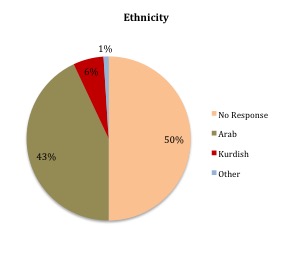
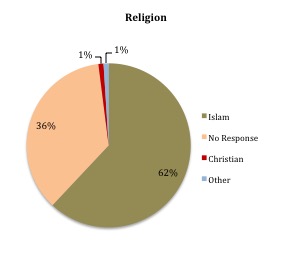
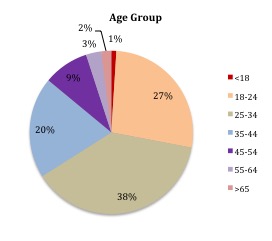
With that, we see that 50% of people chose not to disclose their ethnicity, and 36% of people chose not to disclose their religious beliefs. Below are the graphs for the demographic questions.

EthnicityReligionAge-GroupHow would you respond to the argument that the sentiments and ideals expressed in the Freedom Charter represent only a thin layer of Syrian society — an elite sector that is educated, westernized, urban, and/or living in exile — and that the sectarian violence the country has descended into is a more realistic reflection of popular sentiments and political loyalties? This view has been advanced by Joshua Landis, for example, but it’s widely shared across all sorts of ideological boundaries.

There is nothing elitist about the Freedom Charter — in fact, it is truly “the voice of the people.” The Freedom Charter represents the opinions of ordinary Syrians — more than 50,000 — the majority of whom live inside Syria under abysmal conditions imposed by the Assad regime and other militarized groups. The actual surveys were conducted at the grassroots level. Activists surveying in a specific district were locals of the district. 99% of surveys done were completed inside Syria and in neighboring countries that currently host a large number of refugees. The only precondition for surveys was that respondents be Syrian, without regard to ethnicity, religious affiliation, political affiliation, or social/economic status.

There’s a lot of discussion now of finding a political solution in Syria some sort of negotiated settlement. Of course that’s not a new idea, but for a while it seemed to have receded from the horizon with the failure of the Geneva process, the exasperated resignation of both Kofi Annan and Lakhdar Brahimi as Special Envoy for Syria, and the seemingly intractable geopolitical deadlock over Syria. Recently, however — with the new geostrategic equation created by the intervention against ISIS the push for a political solution is being revived. Various proposals have been floated, and virtually all of them involve Assad staying in power in some form. So my question for you is: the Freedom Charter doesn’t directly address the issue of political transition how to get from the current moment to the political order outlined in the document but from your point of view is there ANY scenario in which it would be acceptable for Assad to remain in power, or does the Freedom Charter necessarily preclude that?

For more than three years, Syrians have taken to the streets in both nonviolent and armed resistance to state what they do not want. The goal for the Freedom Charter was to express to the world what Syrians do want. The document does not discuss the transition period, nor the current situation; it is purely a statement of what Syrians are demanding. The Freedom Charter articulates the desires and goals of the Syrian people, not the process to achieve them.

With regard to the political process, FREE-Syria certainly advocates nonviolent solutions. However, the Assad regime has proven, through the failed initiatives of Kofi Annan and Lakhdar Brahimi, that it is not prepared to pursue a political process. Rather, the regime has and continues to use deadly force, including chemical weapons, against civilians, particularly children. We do not foresee a future in which Assad or those regime supporters with blood on their hands can play a lasting role in a peaceful, democratic Syria.

For more on the Syrian Freedom Charter, go here. For more on ‎Planet Syria‘s global day of solidarity with the Syrian people, go here.
ISIS: Hassan/Weiss versus Cockburn

isisThe review below was published at the Guardian. Unfortunately the heart of the review was cut from the published version. I’ll put it here first of all, because it shows that Patrick Cockburn actually makes stuff up in order to defend Assad and Iran and to slander the Syrian people. Here it is:

“There is no alternative to first-hand reporting,” he nevertheless opines; and “journalists rarely fully admit to themselves … the degree to which they rely on secondary or self-interested sources”. Which brings us to the question of Cockburn’s reliability. In the book he states, in early 2014, “I witnessed [Nusra] forces storm a housing complex … where they proceeded to kill Alawites and Christians.” This alleged massacre was reported by Russian and Syrian state media (Russia is Assad’s imperial sponsor, providing his weapons and defending him at the Security Council); yet international organisations have no record of it. But Cockburn’s original report of the incident, in a January 28, 2014 column for The Independent, states that, rather than witnessing it, he was told the story by “a Syrian soldier, who gave his name as Abu Ali”.

And now here’s the whole thing:

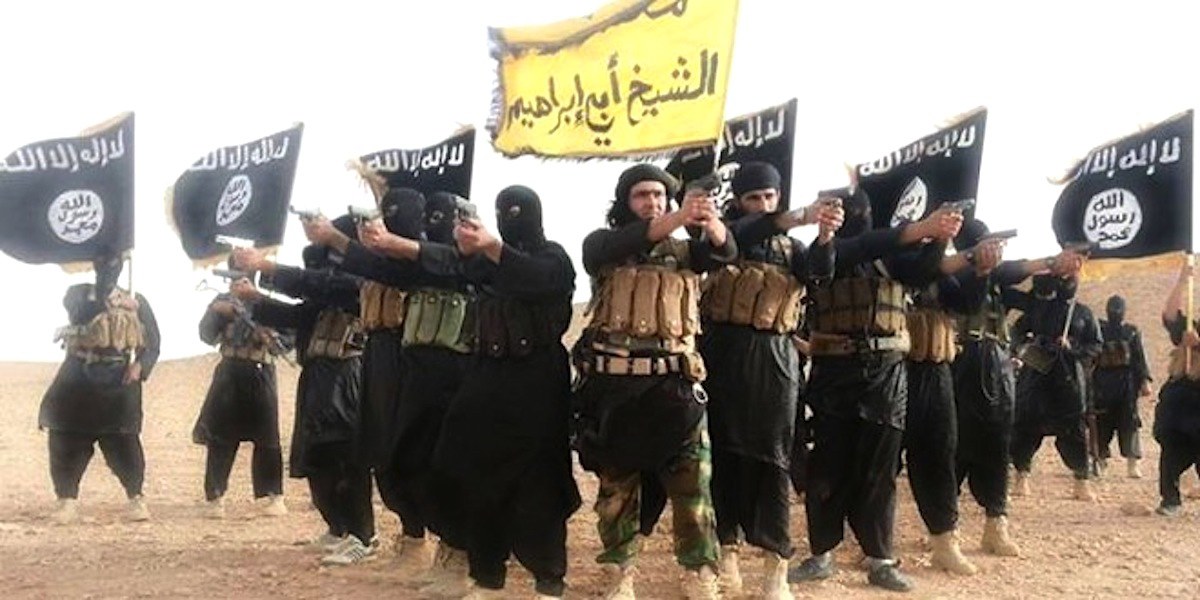
ISIS feeds first on state dysfunction, second on Sunni outrage. In Iraq – where its leadership is local – Sunni Arabs are a minority displaced from their privileged position by America’s invasion. Their revanchism is exacerbated by the sectarian oppression practised by the elected but Iranian-backed government. In Syria – where most ISIS leaders are foreign – Sunnis are an oppresssed majority, the prime targets of a counter-revolutionary tyranny headed by mafias but claiming and exploiting Alawi sectarian identity.

Under other names, ISIS first grew in Iraq as it would later in Syria, by exploiting resistance to occupation, American in one case, that of a delegitimised regime in the other. Drawing on research by the Guardian’s Martin Chulov as well as their own, Michael Weiss and Hassan Hassan show how Syria’s regime collaborated with Iraqi Baathists and Salafist extremists, facilitating the passage of bombers to Iraq who would do more to precipitate civil war than to shake off American occupation. This was a message to America to leave Syria alone.

Popular disgust and the US-backed Awakening movement eventually drove al-Qaida out of Sunni Iraq. The jihadists waited; their moment returned when peaceful Sunni protests were repressed by live fire in 2013. Heading a Baathist-Islamist coalition, ISIS then captured huge swathes of the country and set about its reign of terror.

Weiss and Hassan have produced a detailed and immensely readable book. Their informants include American military officials, American, Jordanian and Iraqi intelligence operatives, defected Syrian spies and diplomats, and – most fascinating of all – Syrians who work for ISIS (these are divided into such categories as politickers, pragmatists, opportunists and fence-sitters). They provide useful insights into ISIS governance – a combination of divide-and-rule, indoctrination and fear – and are well placed for the task. Hassan, an expert on tribal and jihadist dynamics, is from Syria’s east. Weiss reported from liberated al-Bab, outside Aleppo, before ISIS took it over.

Cockburn’s book, on the other hand, is more polemic than analysis. While Weiss and Hassan give a sense of the vital civil movements which coincide with jihadism and Assadism in Syria, Cockburn sees only an opposition which “shoots children in the face for minor blasphemy”. He concedes the first revolutionaries wanted democracy, but still talks of “the uprising of the Sunni in Syria in 2011”. The label doesn’t account for (to take a few examples) the widespread chant ‘The Syrian People are One’, or Alawi actress Fadwa Suleiman leading protests in Sunni Homs, or Communist Christian George Sabra leading the Syrian National Council.

Continue reading “ISIS: Hassan/Weiss versus Cockburn”

What Price Assad’s Rehabilitation?

Bente Scheller, Middle East Director of Heinrich Böll Stiftung and author of the excellent The Wisdom of Syria’s Waiting Game: Foreign Policy Under the Assads, asks if the West is prepared to pay the high political and financial costs of rehabilitating Assad.

A rehabilitation of Syria would come at an exorbitantly high price, politically as well as financially. How much is the West prepared to pay?
Photo: Beshr Abdulhadi. This image is licensed under Creative Commons License.

If you cannot overthrow the tyrant, co-operate with him – after four disastrous years in Syria this seems to be the conclusion the international community has arrived at. While back in 2011 Bashar al-Assad’s days appeared to be drawing to a close, a growing number of people are now suggesting to see him as part of the solution, as illustrated recently by UN Special Envoy Staffan de Mistura in Vienna.

The more methodical and brutish Syria’s dictator disregards human rights, the more he seems to assume the role of a potentially reliable partner in the eyes of some. That is primarily due to the Islamist terror army ISIS. Albeit there are few atrocities with civilian victims the regime is not responsible of committing and although it commits these crimes to a much greater, deadlier extent – Assad is readily seen as the “lesser evil”.

The implication that the situation in Syria could be pacified through a co-operation with Assad in the battle against terrorism is as plain as it is ill-conceived when it comes to the actual implementation. The fight against ISIS requires three things: the means, the will and a strategy.

Continue reading “What Price Assad’s Rehabilitation?”