Rahimullah Yusufzai on the Taliban, Al-Qaida and the ‘Af-Pak’ theatre

Kudos to The Real News for giving its viewers an opportunity to listen to Rahimullah Yusufzai, the most respected authority on the politics of the Afghanistan-Pakistan frontier. Yusufzai was also among our 20 Top Global Media Figures of 2009.

Capture of leader will not weaken Taliban: Taliban is so strong now they have probably already replaced Baradar


Continue reading “Rahimullah Yusufzai on the Taliban, Al-Qaida and the ‘Af-Pak’ theatre”

Friday Night Lights: American and Israeli human rights activists disrupt ballet performance in Vermont

BURLINGTON, VT- Greetings from the Green Mountain State! I want to give a shout out to those who participated in a successful night of activism. Several activists leafleted 249 people attending last night’s Israeli Ballet performance at the Flynn Theater.

The leaflet asked “Would you like some information about Don Quixote and the Israel Ballet?” — which was an accurate presentation of last night’s performance. “Israel’s ‘Golden Helmet of Mambrino’ — which makes one invisible, thus capable of all actions — is slowly turning into Don Quixote’s version of it — a upside-down shaving bowl plopped on the head — incapable of nothing but making its wearer more obvious and actionable to the world. Brand Israel will continue to call forth increasing protests as audiences realize they are being used,” said author and activist Marc Estrin.

The headline said “A Modern Don Quixote.” Estrin said almost all ballet-goers accepted it, even those glancing at the opening before continuing into the theater. There are no trash cans inside the actual theater, so he assumes most flyers made it to people’s seats for reading before the show began. Estrin said one elderly man “came all the way out again to present us with a crumpled up ball with instructions to ‘shove this up your ass,’ but the other 249 copies all made it in.”

The other highlight was one Israeli and three Vermonters unfurled a banner during the performance. Check out the YouTube Vimeo below the fold!

Continue reading “Friday Night Lights: American and Israeli human rights activists disrupt ballet performance in Vermont”

USA and USSR: Accidental Parallels?

M. Shahid Alam

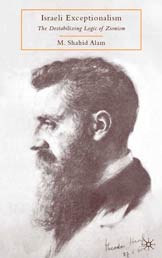
Cover Image GIFIs the question of parallels between the USA and the USSR idle, even mischievous? Perhaps, it is neither, but, on the contrary, deserves our serious consideration.

During the Cold War, the USA and USSR were arch rivals, each the antipodes of the other. For some four decades, they battled each other for ‘survival’ and global hegemony, staring down at each other with nuclear tipped missiles, ready at the push of a button to consummate mutually assured destruction. What parallels could there possibly exist between such irreconcilable antagonists?

Dismissively, the skeptic might retort that their similarities start and end with the first two letters in their names. The USA won and the USSR lost the Cold War. With all four of the letters in its name, the USSR is dead and gone. Its successor state, Russia, now ranks a distant second behind the USA in military power, a position it retains only by virtue of its nuclear arsenal. Measured in international dollars, the Russian economy ranked eighth in the world in 2009, trailing behind its former client, India.

On the other hand, the USA still believes it can ride roughshod over much of the world like a Colossus. It came close to doing this for a few years after the collapse of communism. In the years since its occupation of Iraq, that image has been deflated quite a bit. Haven’t the events of the last decade – the growing challenge to its hegemony in Latin America, the economic rise of India and China, and the recovery of Russia from its collapse of the previous decade – downsized the Colossus of the 1990s? Indeed, the near collapse of its economy in 2008 appears to have brought the Colossus down on its knees.

Continue reading “USA and USSR: Accidental Parallels?”

America’s nightly news: Watching us watching you

When the journalist David Barsamian asked Indian writer and political activist Arundhati Roy about her travels in the United States, she admitted that she was amazed how insular a nation America really was. “When you live outside it, and you come here, it’s almost shocking how insular it is. And how puzzled people are — and how curious, now I realize, about what other people think, because its just been blocked out.”

Thus, Roy may not be surprised that when the Tyndall Report broke down the nightly newscasts of the three main networks in the US (ABC, NBC, and CBS), the top Indian story was the appearance of two uninvited guests at the White House dinner for Manmohan Singh.

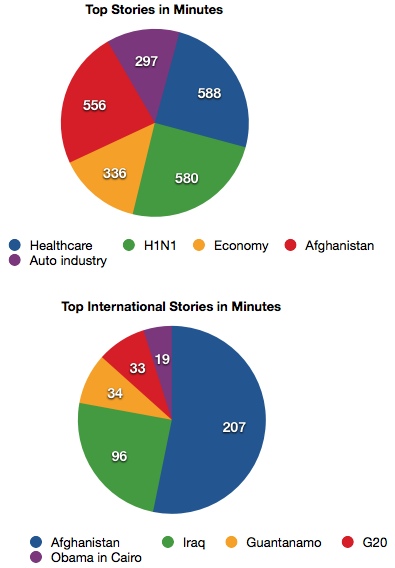
As the IPS noted this weekend, much can be learned about America’s news diet from the Tyndall Report’s review of 2009 which ranks the airtime given to various issues on the nation’s top three nightly half-hour news broadcasts.

So what were Americans watching? Health care reform and the H1N1 virus dominated the airwaves. Afghanistan received more coverage than Iraq for the first time since the invasion of Iraq (735 minutes to 169 minutes). The international focus was certainly on the Middle East as Israel and Palestine were given 132 minutes (102 of those during the siege of Gaza). Iran’s election and nuclear program was also a central international story with 194 minutes and Ethiopian piracy garnered a considerable amount of press with 112 minutes.
Continue reading “America’s nightly news: Watching us watching you”

New York Times: No conflict of interest — with the conventional wisdom

by Robert Jensen

The New York Times’ public editor wrestled this week with conflict-of-interest charges sparked by the revelation that Jerusalem bureau chief Ethan Bronner’s son had joined the Israeli army.

The executive editor of the paper responded with a sensible defense of the paper’s decision to keep Bronner in that position.

Although it had the appearance of a spirited exchange, the “debate” was a tired old diversion that keeps us from facing more important questions, not just about the Israel/Palestine conflict but about U.S. journalists’ coverage of the world. As is typical in mainstream journalists’ discussions of journalistic neutrality and objectivity, the focus on an individual obscures more important questions about the institutions for which individuals work and the powerful forces that shape those institutions’ picture of the world.

The question posed by the Times officials is framed in the narrowest terms: Could Bronner maintain his neutrality and objectivity given those family circumstances, or was that indirect connection to one side of the war “still too close for comfort,” in public editor Clark Hoyt’s words. In his Sunday column, Hoyt described Bronner as a “superb reporter” but concluded that the paper should reassign him to avoid the appearance of a conflict of interest. Executive editor Bill Keller argued that such a policy would disqualify many reporters from assignments that draw on their specialized knowledge and diminish the quality of the reporting in the paper, and concluded there is no reason to reassign Bronner.

Continue reading “New York Times: No conflict of interest — with the conventional wisdom”

Ethan Bronner’s Conflict With Impartiality

by Alison Weir

Ethan Bronner, New York Times Jerusalem Bureau chief

Ethan Bronner is the New York Times Jerusalem bureau chief. As such, he is the editor responsible for all the news coming out of Israel-Palestine. It is his job to decide what gets reported and what doesn’t; what goes in a story and what gets cut.

To a considerable degree, he determines what readers of arguably the nation’s most influential newspaper learn about Israel and its adversaries, and, especially, what they don’t.

His son just joined the Israeli army.

According to New York Times ethics guidelines, such a situation would be expected to cause significant concern. In these guidelines the Timesrepeatedly emphasizes the importance of impartiality.

This is considered so critical that the Times devotes considerable attention to “conflict of interest” (also called “conflict with impartiality”) problems, situations in which personal interest might cause a journalist to intentionally or unconsciously slant a story.

Continue reading “Ethan Bronner’s Conflict With Impartiality”

Is One Iraqi’s Self-Hatred Newsworthy?

Crusaders in Iraq?

M. Shahid Alam

An Arab-American of Lebanese descent, fluent in Arabic, Anthony Shadid was one of a handful of unembedded Western journalists reporting from Iraq during the US invasion in 2003. At the time, he was The Washington Post’s correspondent for Islamic Affairs in the Middle East.

His dispatches from Iraq were about Iraqis, about the destruction visited upon them by a war whose architects claimed that they were bringing democracy to that country. He reported the destruction and mayhem caused by this war by letting the Iraqis speak for themselves: and they spoke of their pain, their anguish, their perplexity and their anger.

For his honest reporting, for a job well done, Anthony Shadid received some of the highest accolades of his profession. In 2004 he received the Michael Kelly Award and the Pulitzer Prize for international reporting. Other honors followed, all well-deserved. He had won his spurs for reporting, not cheerleading, neither praising nor denouncing the United States. He was reporting for The Washington Post, a neoconservative newspaper.

On Jan 29, I noticed for the first time a report in The New York Times that carried Anthony Shadid’s byline. Was this a promotion? It was written from Halaichiya, a remote village in the southern tip of Iraq, untouched by the war. The village has never seen Americans before, neither troops nor diplomats.

Continue reading “Is One Iraqi’s Self-Hatred Newsworthy?”

America’s new right: Racist and proud of it

When I read The Washington Post’s report on the opening of the far-right wing’s Tea Party convention in Nashville, I was taken aback by the remarks of former Republican Congressman and white nationalist Tom Tancredo. While racism undeniably persists in driving a good deal of the American political agenda, the degree to which Tancredo and his ilk in the increasingly mainstream right-wing can be overt and blatant in their bigotry is remarkable and worrying. Here’s what I mean:

On Thursday night, giving the opening address, former U.S. representative Tom Tancredo (Colo.), who ran for the 2008 Republican presidential nomination as an anti-immigration candidate, railed against Obama and “the cult of multiculturalism.” Americans could be “boiled to death in a cauldron of the nanny state,” he said. “People who couldn’t even spell the word ‘vote,’ or say it in English, put a committed socialist ideologue in the White House.”

When Tancredo said, “His name is Barack Hussein Obama,” the audience booed loudly.

MSNBC’s Rachel Maddow recaps:

Decency and Strength

by Kathy Kelly

A fire hazard mars natural beauty at Fort Carson

Here in Colorado Springs, student and community organizers recently invited me to try and help promote their campaign against a proposed “No Camping” ordinance, a law to ban the homeless from sleeping on sidewalks or public lands within the city limits.  The organizers insist it’s wrongful to criminalize the most desperate and endangered among us, that it instead seems quite criminal to persecute people already in need of far more care and compassion than we’ve been willing to offer, especially during these bitterly cold winter months.  But others in the area are intent on eliminating the tent encampments near the Monument Creek and Shooks Run trails, complaining that the encampments mar natural beauty, deter tourists, create fire hazards, and degrade the environment by strewing heaps of trash and debris near the creek and even in it.

It seems important for both sides of the argument to acknowledge other local encampments that Colorado Springs is home to: Fort Carson Army base, both Peterson and Schriever (formerly Falcon) Air Force Bases, Norad and Cheyenne Air Force Stations, and the U.S. Air Force Academy.  It’s not lost on opponents of the “No Camping” ordinance that stop-loss policies prevent many of the young men and women at these institutions from returning to their homes, where many of them long to be after repeated tours of military duty outside the United States.  For every soldier intent on strengthening his or her country’s military option, how many more are taking a last-ditch option, signing up for the famed “poverty draft,” to sustain themselves and their families through an economic crisis felt throughout the country and the world?   Many, though not all, of these young people have been driven by poverty into their encampments as surely as the Monument Creek campers have been driven into theirs.

Continue reading “Decency and Strength”

Members of Congress sign letter urging Obama to stop the siege of Gaza

Some good news came out of Washington yesterday that went largely unnoticed. Ha’aretz reported 54 members of Congress sent a letter to president Barack Obama urging him to pressure Israel to end the siege on Gaza.  Ha’aretz correspondent Natasha Mozgovaya writes:

The letter was the initiative of Representatives Jim McDermott from Washington and Keith Ellison from Minnesota, both of whom are Democrats. Ellison is the first American Muslim to ever win election to Congress. McDermott and Ellison wrote that they understand the threats facing Israel and the ongoing Hamas terror activities against Israeli citizens but that “this concern must be addressed without resulting in the de facto collective punishment of the Palestinian residents of the Gaza Strip.” “We ask you to press for immediate relief for the citizens of Gaza as an urgent component of your broader Middle East peace efforts,” they wrote, adding that the siege has hampered the ability of aid agencies to do their work in Gaza. The congressmen urged Obama to pressure Israel to ease the movement of people into and out of Gaza, especially students, the sick, aid workers, journalists and those with family concerns, and also to allow the import of building materials to rebuild houses. Israel has warned that such materials would be used to rebuild Hamas infrastructure and not civilian homes.

Fifty-four members of Congress urging the president to pressure Israel to treat Gazans like human beings is a positive development, albeit a VERY small one.  Critics may content that the letter protects Israel’s image. I understand that. But I still think it’s encouraging.

Operation Cast Lead blew the lid off Israel’s rationale for the occupation and the congressional visits to Gaza have exposed to them what Gazans encounter on a day-to-day basis. More members of Congress need to do this.

Full text of the letter below.

Continue reading “Members of Congress sign letter urging Obama to stop the siege of Gaza”