The US Supreme Court has ruled that as a legal ‘person’ a corporation can spend unlimited amounts in an election campaign to elect its preferred candidates. The lax campaign financing rules already allowed lobby groups such as AIPAC to funnel massive amounts to candidates through individuals. Instead of reforming the system, as people like Ralph Nader have been demanding for years, the court further hacks away at democratic checks and balances. The ruling has been rightly compared to the Dred Scott case justifying slavery. Here is a clip of Robert Weissman summing up what consequences this might have for US democracy (to the extent that it exists) followed by a statement by Ralph Nader. (For Americans who want to save their democracy, here is a campaign they can join: http://www.movetoamend.org/. Also check out Public Citizen’s proposed action).
Category: USA
America’s Quaking Racial Divide

On Martin Luther King Jr. Day, Andrew Oxford reflects on America’s extant racial divide and the lingering threat of white nationalism.
In the preface to his monumental study of the contemporary American white supremacist movement (1), Leonard Zeskind points to the Sarajevo Haggadah for a pertinent lesson on race and society. A Hebrew text of stories, songs, and prayers written by Spanish Jews around 1314, it arrived in the Yugo peninsula with Sephardic Jews fleeing the Inquisition. In the nineteenth century, it was entered into the Sarajevo Museum and saved from invading Germans during World War II by the Croation curator. For the duration of the war, it was guarded by Muslim clerics and it currently resides in the vaults of the Serbian National Bank while it is revered as a cultural icon of all peoples of the region. Reflecting upon the curious history of this relic, Zeskind writes:
It is useful to remember that at one time a hodgepodge of religious and ethnic groups lived together in relative harmony. Places like Sarajevo were cosmopolitan centers of learning and culture for centuries. But in a matter of a few historical seconds, the whole place went up in flames, like a refugee hostel attacked by arsonists…
The United States, unlike the former Yugoslavia, has well cemented the foundations of its federal order in the 150 years since our own Civil War, and the election of a black man, Barack Obama, has broken the white monopoly on the presidency. Nevertheless, collective identities based on race and religion have remained just under the skin of American life. As such, we will continue to be vulnerable to the machinations of … white nationalists … particularly as population demographics shift in the next few decades. For those of us who hope to protect and extend our multiracial democracy, and the cosmopolitanism of the type that preserved the Sarajevo Haggadah, we ignore this white nationalist movement at our own peril.
Haiti and the Instruments of Death
This is how the ‘International Community’ (read the West) is responding to the tragedy in Haiti: still no aid, yet plenty of guns. US has taken control of the Port-au-Prince airport and according to Al Jazeera it is turning back aircraft with much needed aid from other nations.
Don’t miss Patrick Cockburn’s brilliant piece. Here are some highlights:
The rhetoric from Washington has been very different during these two disasters, but the outcome may be much the same. In both cases very little aid arrived at the time it was most needed and, in the case of Port-au-Prince, when people trapped under collapsed buildings were still alive…In New Orleans and Port-au-Prince there is the same official terror of looting by local people, so the first outside help to arrive is in the shape of armed troops. The US currently has 3,500 soldiers, 2,200 marines and 300 medical personnel on their way to Haiti…
A sour Haitian joke says that when a Haitian minister skims 15 per cent of aid money it is called “corruption” and when an NGO or aid agency takes 50 per cent it is called “overheads”…
Inviting David Brooks to My Class
The Zionists are prisoners of a bad dream: they must first free themselves, break free from the prison in which they can only play the part of tormentors, if they and especially their Palestinian victims are to live normal lives.
 M. Shahid Alam
On January 12, the New York Times carried an article by David Brooks on Jews and Israel. It so caught my eye, I decided to bring its conservative author to my class on the economic history of the Middle East. I sent my students the link to this article, asked them to read it carefully, and come to the next class prepared to discuss and dissect its contents.
My students recalled various parts of the NYT article but no one could explain its substance. They recalled David Brooks’ focus on the singular intellectual achievements of American Jews, the enviable record of Israeli Jews as innovators and entrepreneurs, the mobility of Israel’s innovators, etc. One student even spoke of what was not in the article or in the history of Jews – centuries of Jewish struggle to create a Jewish state in Palestine.
But they offered no comments about Brooks’ motivation. Why had he decided to brag about Jewish achievements, a temptation normally eschewed by urbane Jews. In my previous class, while discussing Edward Said’s critique of Orientalism, I had discussed how knowledge is suborned by power, how it is perverted by tribalism, and how Western writers had crafted their writings about the Middle East to serve the interests of colonial powers. Not surprisingly, this critique had not yet sunk in.
I coaxed my students, asking them directly to explore if David Brooks had an axe (or more than one) to grind. Was there an elephant in the room they had missed? What was the subtext of the op-ed?
Brzezinski on the Soviet occupation of Afghanistan
Zbigniew Brzezinski has always ranked high in leftist demonology for allegedly luring the Soviets into Afghanistan and ‘creating’ the Mujahideen thereby destroying a government which was bringing womens’ rights and education to the benighted, medieval people. Typically, this analysis accords no agency to the Afghans themselves: the natives can only be manipulated, they have no will of their own. It is always the outsider that knows what’s best for the native: for the neoconservatives it is Uncle Sam, for leftists it as Kremlin. As Brzezinski correctly notes here, however, the Soviets were already deeply engaged in Afghanistan long before the invasion. The arms supplies only started after the invasion, and escalated around 1982. The war was a popular liberation struggle. The US support only hastened the Soviet exit, it wasn’t indispensable to it. The Afghans would have fought anyway.
Leaving aside his dubious views in other areas, on Afghanistan Brzezinski is right. And the interviewer’s attempt to impose a teleological narrative on developments in Afghanistan is rather frivolous. There was no inevitability to all that has happened in Afghanistan. Much like the neoconservatives, leftists seem predisposed to accept the Enlightnement belief in the linear progress of history. They fail to appreciate the contingency of it all.
(The first part of this interview is here)
Tony Judt’s remarkable journey

UPDATE: the Guardian has a good piece by Ed Pilkington and a video of Judt speaking about his condition. He calls it ‘one of the worst diseases on the Earth’.
Tony Judt, the acclaimed English historian and author, has made a remarkable journey from his days as a volunteer for the IDF during the 1967 war to his recent transformation into one of the staunchest critics of Israel and its lobby. He outraged many old associates from his Zionist days when in 2003 he penned an eloquent call for a bi-national state in 2003. (His friendship with the late Edward Said must have likely played a part in this transformation.) He was dropped from The New Republic‘s editorial board shortly afterwards. Shortly after the Iraq war, he wrote a scathing attack on what he called Bush’s Useful Idiots — the liberal interventionists who argued for war using the language of humanitarianism and liberal values.
In 2006, when John Mearsheimer and Stephen Walt wrote their ground-breaking essay on the Israel lobby, he was one of the very few progressive Jewish voices to come to their defence, even as self-proclaimed ‘radicals’ demurred. Shortly afterwards he wrote a brilliant essay for Ha’aretz calling Israel ‘the country that wouldn’t grow up‘. He later joined John Mearsheimer in a debate organized by the London Review of Books in which they argued against apologists for the lobby. In the same year an event organized by Network 20/20 at which Judt was slated to speak was cancelled following pressure from the ADL and AJC. This prompted Mark Lilla and 114 writers and intellectuals to write a letter of protest to the ADL. Judt later recounted this incident in his appearance in an excellent Dutch documentary on the lobby. All his writings and his reflections on his journey from Zionism to universalism are collected in his 2008 book Reappraisals: Reflections on the Forgotten Twentieth Century.
Death By Sanctions
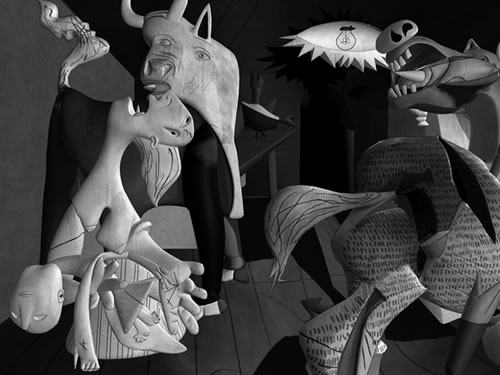
“Iraq deaths double under UN sanctions.”
New York Times, Feb.17, 2000
Sleep my child, do not wake now.
The portents in the sky foretell
a searing death for you.
The couriers of death have come,
stealth in their cyber gaze:
they scour the land for Saddam.
They poison every river, creek and well.
They darken school and hospital.
They warp the words you spell.
For star, for oil and cross they fly.
They will not cease to tyrannize
your dying days and hellish nights.
They will not cease their deathly watch.
Their mission is to fossilize
your bones, your heart, your eyes.
Sweet my child, do not wake now.
Your eyes once soft are hard
as rock: your hair is white as snow.
– M. Shahid Alam is professor of economics at Northeastern University. He is author of Challenging the New Orientalism (IPI: 2000). You can reach him at alqalam02760@yahoo.com.
Israeli Exceptionalism: A Grim Prognosis
 In the coming weeks we’ll be publishing reviews and responses to M. Shahid Alam’s new book Israeli Exceptionalism: The Destabilizing Logic of Zionism (New York: Palgrave Macmillan, 2009). Following is the first from political scientist Ahrar Ahmad.
Dr. Shahid Alam is primarily an economist and an educator. But, he is also a public intellectual, and often a lively polemicist, who writes with insight and conviction on issues dealing with culture, identity, religion, globalization, imperialism, and terrorism. But nothing stirs his passions as intensely as the issue of the Palestinians – their dispossession, marginalization, despair. His feelings are ardent, his language combative, his intellectual engagement prickly and zealous. It is largely this pre-occupation that has earned him a place in David Horowitz’s book on the Hundred Most Dangerous Academics in the US (an ignominy that he probably wears as a badge of honor). His latest book distills, clarifies and deepens much of his previous thinking on Zionism, the creation of the state of Israel, and the injustices inflicted on the Palestinians.
The trope along which this book is organized is the concept of “Exceptionalism” that is often claimed by the state of Israel, and sometimes by Jews themselves. To Alam this is nothing other than a rhetorical device, and a moral posture, to ensure the West’s indulgence and support, to protect Israelis from any criticism, and exempt them from standards and behavioral norms that apply to other peoples. This “exceptionalism” is derived from their Biblical covenants and the belief in their inherent “chosen-ness”, their wrenching history of suffering and persecution, their considerable achievements in science, philosophy and philanthropy, and their current status as a people allegedly besieged by Islamic fundamentalists, anti-Semitic bigots, and the barbaric and self-destructive Arabs. To question anything about Israel is tantamount to denigrating every aspect of its special status.
Stephen Walt chooses five books on US-Israel relations
A few weeks back The Browser interviewed British author Ziauddin Sardar for its Five Books section. Among the books he selected on the theme of Travel in the Muslim World was one, The Road from Damascus, by PULSE editor Robin Yassin-Kassab. When Robin was in turn asked to choose his five on the theme of the Israel-Palestine Conflict, he chose among others John Mearsheimer and Stephen Walt’s The Israel Lobby and the US Foreign Policy. In its current interview The Browser turned to Stephen Walt — one of PULSE’s 20 top global thinkers for 2009 — to present his selection of the five most important books on the US-Israel relationship. In the following interview Walt presents his selection and explains why he chose these particular books.

So, we’re trying to understand how the US has come to identify so closely with Israel in recent decades, and your first book is The Israel Lobby and US Foreign Policy, which you wrote along with John Mearsheimer. Why is that on the top of your list?
The only way to understand the special relationship that now exists between the United States and Israel is to understand the critical role that a number of organisations have played in actively promoting that relationship over the last 60 years. The US has supported Israel since its founding in 1948, but it did not have the same sort of special relationship for the first 20 or so years after Israel’s creation. The US backed it in certain ways, but was also willing to put lots of pressure on it in other circumstances and didn’t provide a lot of economic or military assistance until after 1967. But today the US backs Israel no matter what it does and American politicians are careful never to say anything that is very critical of Israel, even when it is acting in ways that are contrary to US interests and values. The key to understanding this ‘special relationship’ is the operation of various groups in the Israel lobby, and our book lays out in great detail how that works, and why it’s not good for the US or Israel.
Continue reading “Stephen Walt chooses five books on US-Israel relations”
Chomsky on Empire and Ideology
Hostility and Hospitality in Contemporary World Politics
This is Chomsky at his best, highlighting the exceptionalism that characterizes US political discourse, and the ideological memes that have accompanied US imperialism with few modulations over the years. The follow-up speaker Stephen Pfohl is also very good. (thanks Doug)
 P U L S E