Category: War
P.I.Z.Z.A
Billy Crudup and Margaret Colin enact a scene from Tom Stoppard’s new play ‘The Laws of War‘, which focuses on the abuses of the so-called ‘war on terror.’
Incalculable: The human cost of NATO’s war on Afghanistan
by Kathy Kelly

Recent polls suggest that while a majority of U.S. people disapprove of the war in Afghanistan, many on grounds of its horrible economic cost, only 3% took the war into account when voting in the 2010 midterm elections. The issue of the economy weighed heavily on voters, but the war and its cost, though clear to them and clearly related to the economy in their thinking, was a far less pressing concern.
U.S. people, if they do read or hear of it, may be shocked at the apparent unconcern of the crews of two U.S. helicopter gunships, which attacked and killed nine children on a mountainside in Afghanistan’s Kunar province, shooting them “one after another” this past Tuesday March 1st. (“The helicopters hovered over us, scanned us and we saw a green flash from the helicopters. Then they flew back high up, and in a second round they hovered over us and started shooting.” (NYT 3/2/11)).
Four of the boys were seven years old; three were eight, one was nine and the oldest was twelve. “The children were gathering wood under a tree in the mountains near a village in the district,” said Noorullah Noori, a member of the local development council in Manogai district. “I myself was involved in the burial,” Noori said. “Yesterday we buried them.” (AP, March 2, 2011) General Petraeus has acknowledged, and apologized for, the tragedy.
Continue reading “Incalculable: The human cost of NATO’s war on Afghanistan”
A thrilling excerpt from the new Tom Clancy novel
PULSE is proud to present this excerpt from Brain-Dead or Alive, the new novel created by Tom Clancy’s Op-Center, written in collaboration with Gen. Tony Zinni (Ret.), Gen. Charles Horner (Ret.), Gen. Fred Franks (Ret.), and Chase Madar.

It was a dark and stormy night in McLean, Virginia.
Former CIA director and ex-president Vernon Manley Babbitt sat at his dining-room table flanked by his most trusted compadres, who in many adventures past had defended the American way of life against nuclear terrorists, Islamic fanatics, and unarmed folk singers. Their next mission might be the most dangerous yet.
V. Manley Babbitt and his secret team called themselves the BFD, and their existence was so classified no one knew what the initials stood for. The BFD was licensed to do anything, from waterboarding the president’s mother to parking in handicapped spots, and with the safety of millions at stake, they often did. Babbitt surveyed his companions, tried and true, around the table.
First there was X, a man without an identity. Nobody knew X’s real name. Was it maybe just X? That kind of head-fake would have been vintage X! No one even knew what X looked like, not even X’s wife, because he always wore a brown paper bag on his head. He had ex-Special Ops written all over him, but not on the paper bag, which usually bore the logo of the retail chain where his wife had done the previous day’s shopping.
Continue reading “A thrilling excerpt from the new Tom Clancy novel”
“Diplomatic Immunity” or Murder with Impunity? And Who’s a Diplomat Anyway?
triple murders, a suicide, and the unraveling of a spy and a covert war…
by Huma Dar
 On Thursday, 27th of January, 2011, while the world was busy watching — or ignoring, as the case might be — the inspiring Egyptian Revolution, in broad daylight, in a very busy part of Lahore (Pakistan), in front of hundreds of eye-witnesses, American contractor, Raymond Davis, murders two or by some accounts even three people: Muhammad Faheem (aka Faheem Shamshad?) (age 26), Faizan Haider (age 22), and Ibad-ur-Rehman. Davis shoots the former two, who had allegedly threatened to rob him, from within his locked car, with seven bullets — each bullet expertly and fatally finding its mark. The windshield shows the piercing trajectory of the fatal bullets, but otherwise remains miraculously unshattered. Davis, then, emerges calmly from his well-equipped car (see descriptions below), shoots Faizan from the back while Faizan was running away (how “dangerous” is that?! does the excuse of “self-defence” hold when one of the victims was running away?), takes photographs and videos of both his victims with his cellphone, gets back into his car, and drives off unruffled, to flee the scene. Faizan Haider was still alive — he expired later in the hospital. What an act of “responsibility” from a “diplomat” of the self-ascribed global policeman!
Continue reading ““Diplomatic Immunity” or Murder with Impunity? And Who’s a Diplomat Anyway?”
US, the Arab Revolt and al-Qaida
M. Shahid Alam
On December 24 2004, I wrote an essay, “America and Islam,” for which I received much heat from Zionist and right-wing bloggers in the United States.
The article made the point that the leaders of al-Qaida believe that they have to carry their war to the home ground of the ‘far enemy’ – the United States, Israel and Western powers – in order to free the Muslim world from foreign domination. This anyone can verify from the numerous communiqués of al-Qaida.
To say this is not to endorse the terrorist methods that al-Qaida employs. This was my moral position then: and it is my moral position now. At the same time, we should not shrink from recognizing that the total wars waged by many states, including the United States, since WWII differ from the methods of al-Qaida only in the infinitely greater scale of the destruction they wreak upon civilians.
The article made another critical point. It argued that al-Qaida, in some measure, reflects the political and moral failings of Muslim societies. If Muslims had shown more spine in resisting local tyrannies through non-violent means, their courage would have scotched the violent extremism of groups like al-Qaida.
The Brief Reign of a Boy King: The Obama Legacy Unearthed
by Jennifer Matsui and Stella La Chance
 The revolutions in Tunisia and Egypt have forced Obama into an uncomfortable but familar posture: On the one hand, in order to preserve at least the appearance of credibility, the candidate of hope and change has to feign solidarity with the people who expressed their hope by flooding into the streets of Tunisia and Cairo demanding change in leadership of their US-sponsored tyrannies. On the other, as the man charged with the responsibility of prolonging the death-gasp of a doomed Empire, Obama had to work overtime behind the scenes to make sure that any political changes forced upon America’s satraps in the Middle East remain cosmetic and trivial. This dilemma accounts for the mixed messages being issued from the White House throughout the crisis as each mangled response contradicts an earlier stance.
More recent developments on Mubarak’s “dignified” exit reveal even more cynical contempt for Egypt’s long suffering people on the part of the Obama administration as Egypt’s recently appointed VP Omar Suleiman, the CIA’s ‘go to guy’ for its offshore torture enterprises has reportedly been installed as Mubarak’s puppet successor.
What better illustrates Obama’s flailing and ineffectual leadership style than a comparison of his rhetoric in Cairo shortly after taking office with his current posture regarding developments in Egypt? In his 2009 Cairo speech, Obama affirmed his “unyielding belief” in the universality of democratic struggle, and the “yearning” of all people to live “under the rule of law and the equal administration of justice, towards government that is transparent and doesn’t steal from the people”. Words that in retrospect reveal the insincerity behind them as his administration attempts to downplay the “government by the people, of the people . . . ” stuff as it applies to the Arab world, and push forward a more moderate and “realistic” solution to what they consider an unfolding ”crisis” in Egypt and beyond: Millions of people peacefully united in a struggle to break free from a brutal, authoritarian regime headed by a corrupt tyrant.
Continue reading “The Brief Reign of a Boy King: The Obama Legacy Unearthed”
Andrew Bacevich on US Presidential History
Susan Modares of Press TV’s excellent Autograph interviews Andrew J. Bacevich, one of PULSE’s top 10 global thinkers of 2010.
Americans mostly tend to divide their history into presidential terms. Thus, they think there are great differences between the presidents. Many, however, believe there is a national security policy consensus which continues through all presidencies without any change. The same issue is discussed with author and Boston University Prof. Andrew J. Bacevich in this edition of The Autograph.
Continue reading “Andrew Bacevich on US Presidential History”
Salman Taseer Remembered
by Tariq Ali
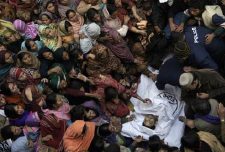
 Mumtaz Hussain Qadri smiled as he surrendered to his colleagues after shooting Salman Taseer, the governor of the Punjab, dead. Many in Pakistan seemed to support his actions; others wondered how he’d managed to get a job as a state bodyguard in the carefully screened Elite Force. Geo TV, the country’s most popular channel, reported, and the report has since been confirmed, that ‘Qadri had been kicked out of Special Branch after being declared a security risk,’ that he ‘had requested that he not be fired on but arrested alive if he managed to kill Taseer’ and that ‘many in Elite Force knew of his plans to kill Salman Taseer.’
Qadri is on his way to becoming a national hero. On his first appearance in court, he was showered with flowers by admiring Islamabad lawyers who have offered to defend him free of charge. On his way back to prison, the police allowed him to address his supporters and wave to the TV cameras. The funeral of his victim was sparsely attended: a couple of thousand mourners at most. A frightened President Zardari and numerous other politicians didn’t show up. A group of mullahs had declared that anyone attending the funeral would be regarded as guilty of blasphemy. No mullah (that includes those on the state payroll) was prepared to lead the funeral prayers. The federal minister for the interior, Rehman Malik, a creature of Zardari’s, has declared that anyone trying to tamper with or amend the blasphemy laws will be dealt with severely. In the New York Times version he said he would shoot any blasphemer himself.
Taseer’s spirited defence of Asiya Bibi, a 45-year-old Punjabi Christian peasant, falsely charged with blasphemy after an argument with two women who accused her of polluting their water by drinking out of the same receptacle, provoked an angry response from religious groups. Many in his own party felt that Taseer’s initiative was mistimed, but in Pakistan the time is never right for such campaigns. Bibi had already spent 18 months in jail. Her plight had been highlighted by the media, women had taken to the streets to defend her and Taseer and another senior politician from the Pakistan Peoples Party, Sherry Rehman, had demanded amendments to the blasphemy laws. Thirty-eight other women have been imprisoned under the same law in recent years and soon after a friendly meeting between Yousaf Gillani, the prime minister, and the leader of the supposedly moderate Jamaat-e-Islami, a member of the latter offered a reward of ten thousand dollars to whoever manages to kill Bibi.
Bradley Manning has been in Solitary Confinement Since July
Kevin Zeese, a member of the Bradley Manning Support Network Steering Committee and Executive Director of Voters for Peace appeared today on RT’s The Alyona Show to discuss Bradley Manning’s case. Zeese appears at the 20:30 mark. More commentary about other topics discussed on this segment are found after the jump.
Continue reading “Bradley Manning has been in Solitary Confinement Since July”
 P U L S E