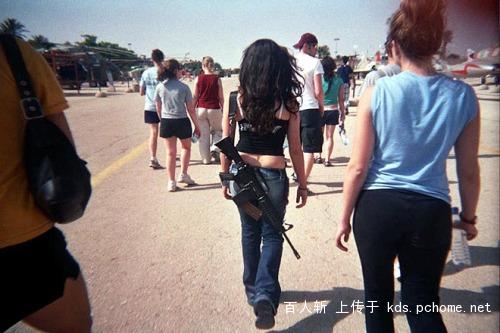
Untermenschen

Palestine 305This is Jana Hannoun. I met her after a Palestine Literature Festival event at the British Council in occupied east Jerusalem. We were at the British Council because our original venue, the Palestine National Theatre, had been closed down by the Israeli occupiers. The British Council is just down the road from the Sheikh Jarrah neighbourhood, where Jana lived, and which Israel wants to Judaize.

At five o clock in the morning on August 2nd, the Hannoun and al-Ghawe families were physically thrown out of their homes by Zionist troops. 53 people, including 19 children, were made homeless, and their toys and clothes were strewn in the street. They were made homeless because they are members of the wrong ethnic group – because they are Arabs, the natives of Palestine, and not invading Jews. Their homes were immediately occupied by foreign settlers.

This, of course, is fascism. Because of a myth of national origin (and it is a myth – the vast majority of Jews originate from eastern Europe and north Africa, not from Palestine, not even two thousand years ago), the Canaanite-Arab Palestinians are designated untermenschen to be driven out. The Sheikh Jarrah families have experienced this before, as they are refugees from Haifa and west Jerusalem, ethnically cleansed by Zionist terrorist militias in 1948. The UN built homes for them in east Jerusalem after 1948, and that half of the city fell too in 1967. In this report, Jana is interviewed. More videos of the theft can be viewed here.
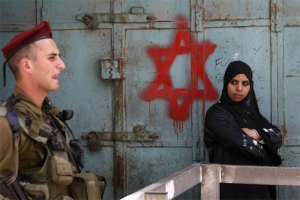
Continue reading “Untermenschen”

Obscenity

This is, more or less, a selection from posts I made during the Gaza massacre.

palestine051809According to the dictionary, obscenity is what is offensive or repulsive to the senses, or indecent in behaviour, expression or appearance.

From Palestine come pictures on the internet, and on al-Jazeera – burning half bodies, a head and torso screaming, corpses spilt in a marketplace like unruly apples, all the tens and hundreds of infants and children turned to outraged dust. A little more out of focus, but concrete, there is the obscenity of starved refugees and cratered farmland, of shriek-soaked hospital walls and babies born at checkpoints. Still further behind these instances, these symptoms, looms the brute and perpetual obscenity of the ancient Canaanite-Arab Palestinian people having been driven from their land into camps and walled ghettoes, where they have been repeatedly massacred. All of this is offensive, repulsive and indecent. The Western media, not wishing to offend our senses, keeps the obscenity quiet. Better put, they cloak the obscenity with the greater obscenity of untruth, of dreaming a pleasant version while people bleed and die.

This should concern everybody, and first of all writers and readers. For the prime obscenity for us here, away from the immediate death and panic, is the language we use to hide the reality of what’s happening. We use magical terms. This is how it goes:

Continue reading “Obscenity”

Zionist thugs vandalize bookstore in Paris

Diana Johnstone, the great leftist writer living in Paris, describes a zionist thug (either Betar or LDJ) attack on Librairie Resistances. Books and computer equipment were destroyed. It is not the first time this happens.

The nazis used to burn books…

See also attached video.

Librairie Resistances - scene of the damage; books doused with oil

Zionist Fanatics Practice Serial Vandalism in Paris
Thousands of books drenched in cooking oil – that is the latest exploit of the Zionist fanatics who regularly attack property and people in Paris and get away with it.

Continue reading “Zionist thugs vandalize bookstore in Paris”

Preventing ‘illegal Arab expansion’

https://i0.wp.com/www.palestinemonitor.org/spip/local/cache-vignettes/L450xH322/settler_violence-1d997.jpg

Jonathan Cook reports about the latest phase of Israel’s ethnic cleansing campaign:

Israel’s housing minister called for strict segregation between the country’s Jewish and Arab populations last week as he unveiled plans to move large numbers of fundamentalist religious Jews to Israel’s north to prevent what he described as an “Arab takeover” of the region.

Ariel Atias said he considered it a “national mission” to bring ultra-Orthodox Jews — or Haredim, distinctive for their formal black and white clothing — into Arab areas, and announced that he would also create the north’s first exclusively Haredi town.

The new settlement drive, according to Atias, is intended to revive previous failed efforts by the state to “Judaize,” or create a Jewish majority in, the country’s heavily Arab north.

Continue reading “Preventing ‘illegal Arab expansion’”

A Visit to Hebron

This was published on the Reuters Great Debate blog.

Palestine 210There’s no pretty way to describe what I saw in Hebron, no tidy conceit to wrap it in.

I visited as a participant in the Palestine Festival of Literature, the brain child of the great British-Egyptian novelist Ahdaf Soueif. I was in the company of many wonderful writers and publishers, among them Python and traveller Michael Palin, best-selling crime novelist Henning Mankel, Pride and Prejudice screenplay writer Deborah Moggach, and prize-winning novelists Claire Messud and MG Vassanji.

Our first stop was Hebron University, where I ran a workshop on ‘the role of writing in changing political realities.’ The students were bright and eager; the only discomforting note was struck by a memorial stone to three killed while walking on campus, by rampaging settlers, in 1986.

After lunch we visited Hebron’s historic centre.

Continue reading “A Visit to Hebron”

Israeli doctors colluding in torture

Jonathan Cook reports about the collusion of Israeli doctors in the torture of Palestinians based on evidence presented in a new joint report by the Public Commitee Against Torture in Israel (PCATI) and Physicians for Human Rights-Israel. This comes in the wake of a petition signed by 725 physicians from 43 countries who are demanding that the current president of the World Medical Association Yoram Blachar be removed from office, claiming that the Israel Medical Association which he heads has ignored evidence that doctors working in detention facilities are allowing torture. In return, Blachar has recruited the help of Hadassah – the Women’s Zionist Organization of America – to launch a couter-campaign to discredit the work of the human rights NGOs. (See also the recent report by PCATI which documents the torture and physical abuse of prisoners held by Israeli security forces.)

Israel’s watchdog body on medical ethics has failed to investigate evidence that doctors working in detention facilities are turning a blind eye to cases of torture, according to Israeli human rights groups.

The Israeli Medical Association (IMA) has ignored repeated requests to examine such evidence, the rights groups say, even though it has been presented with examples of Israeli doctors who have broken their legal and ethical duty towards Palestinians in their care.

Continue reading “Israeli doctors colluding in torture”

Illuminated Pages

Michael Palin, Robin Yassin-Kassab and Jeremy Harding in a 'qasr' near Ain Qenya, Ramallah

Another fine LRB diary piece by Palfest participant Jeremy Harding. A visit to the al-Khalidi library leads Jeremy to consider “the war for control of East Jerusalem that Israel has been waging, slowly but surely, by non-military means.” More pieces by Jeremy are here , here, here, and here.

Haifa al-Khalidi says that she’s not a librarian. Fine. But the al-Khalidi collection on 116 Bab al-Silsilah Street in the old city of Jerusalem doesn’t pretend to be anything other than a library so maybe Haifa simply means she’s not a scholar, even if she’s now acquainted with a thousand rare manuscripts and many more works in print that are housed here. One of the first she shows us is a beautifully decorated Arabic translation of a work on poisons and remedies by a 12th-century Indian physician. (Later I learn it contains a tale about metabolic resistance and how it’s possible, carefully and slowly, to administer a poison to a subject whose antibodies enable him to survive, even though someone else who touches him will die. Actually, that ‘he’ in the story is a her, tanked up to become a poison pie and set before a king.) 

Continue reading “Illuminated Pages”

Ending Apartheid

A great piece by best-selling crime writer and Palfest participant Henning Mankell, originally published in the Swedish paper Aftonbladet. Mankell was tremendously moved by what he saw in Palestine, and we hope he is able to transmit this passion to his millions of readers. Mankell is informed enough to realise that the two-state solution is no solution. He concludes, “The fall of this disgraceful Apartheid system is the only thing conceivable, because it must be.”

Henning Mankell (right) responds to Banksy's wall art

About a week ago, I visited Israel and Palestine. I was part of a delegation of authors with representatives from different parts of the world.

We came to participate in the Palestinian Literary Festival. The opening ceremony was supposed to take place at the Palestinian National Theatre in Jerusalem.

We had just gathered when heavily armed Israeli military and policemen walked in and announced that they were going to stop the ceremony.

When we asked why, they answered: You are a security risk.

Continue reading “Ending Apartheid”

Fantasising Israel

Israels militarized liberalism
Israel's militarized liberalism

How can the supposed liberalism of Tel Aviv coexist with apartheid and occupation? In this excellent essay Yonatan Mendel considers the Israeli “fantasising project.” “It is the “positive, ‘normal’ and likeable characteristics of Tel Aviv,” Mendel argues, “that make it a paradigm of the moral and political blindness of Israeli society.”

At this very moment, long queues are probably forming outside Tel Aviv’s latest culinary thing: the yoghurterias. Even in the middle of the night you have to wait in line to get a cold and refreshing ice-cream yoghurt from the busy shop on Rothschild Boulevard. Springing up like mushrooms after the rain, the ice-cream parlours have allowed the ‘white city’ of Tel Aviv to experience the white revolution of the yoghurt. It is sweet and sour, made of natural ingredients, both healthy and tasty, with only 1.6 per cent fat, and topped with pieces of fresh fruit freshly cut up. Mangoes and pineapples, kiwis, strawberries, pomegranates, dates, melons and watermelons, red, yellow and green, are generously placed on top of the thick white yoghurt. A small cup of the local delicacy costs 18 shekels (about £3), a medium-size cup is 21 shekels, and a huge cup is 27 shekels. This is the best gastronomic response to the humidity that prevails in Israel’s ‘first Hebrew city’.

You can read the rest here.

More from Palfest

Palfest writer Deborah Moggach negotiates a checkpoint

Jeremy Harding writes of the crossing into Palestine that I wrote about here. Then Rachel Holmes describes her impressions of the Palfest week, and is reminded of South Africa in the 70s. Jeremy first:

After the defeat of the Arabs in June 1967, many Palestinians who’d been driven east over the Jordan River by the fighting tried desperately to return to their homes by slipping back across. The bridges, including the Allenby Bridge, had been damaged, but the patched-up remains were serviceable. The Allenby Bridge crossing was closely guarded, however, and used by the soldiers on Israel’s newest frontier to put people out, rather than allow them in. Palestinian refugees trying to get home from Jordan, as well as groups of fedayeen, preferred to ford the shallow river at dead of night, although 50 IDF ambush parties were stationed along the west bank, instructed to fire on shadows in the water. By September, more than a hundred people had been shot dead trying to return and a thousand had been deported back to Jordan.

On the Jordanian side of the river journalists were counting up to 80,000 refugees in tents, with more being driven in from the west bank as Israeli soldiers fired over their heads to hurry them along. To avoid what was clearly an international scandal in the making, the Israeli government decided to stage a televised return of several thousand Palestinians. There was disagreement among the ministries about how to select the fortunate few. A Foreign Ministry official argued that the key point was demographic: children and women of childbearing age should be kept to a minimum; but in the prevailing view, the older refugees of 1948 were far more undesirable.

Continue reading “More from Palfest”