Anti-Imperialism Against Itself

A statement in solidarity with the multi-pronged Israeli assaults on Hezbollah and Hamas in 2006 read:

“We offer solidarity and support to the victims of th[e] brutality [in Lebanon and Palestine] and to those who mount a resistance against it”

The gist of the statement is that no matter how fundamentalist and sectarian someone is, they have the right to resist oppression.

Tariq Ali, one of the signatories, 9 years later would argue that in order to defeat ISIS,

“[Y]ou should be fighting side by side with Assad and the Russians . . . that’s the logic.”

In other words, we must join hands with other imperialists and mass murders to . . . fight imperialism. He went on to assert that

“This notion that there is a liberal third force is nonsense… 70,000 people collected together by the CIA, no, it’s not true, it’s a lie”

They just don’t exist, it’s a Muslim country after all!

Another signatory, Lindsay German, later went on to assert in 2015 that

“[T]he majority of the so-called “rebels” are and always have been foreign invaders and not domestic insurgents . . .”

Another signatory, John Rees—who in 2001 went as far as to argue that “whether or not to oppose imperialism” shouldn’t be premised “on whether or not we find the past or present behaviour of the [opposing] regime to be progressive”—would later insist that any rebel group in Syria that’s demanding arms and money from the West, the Gulf and Turkey shouldn’t be supported by the Left. By that logic, of course, the Spanish Republicans shouldn’t be supported for demanding arms of France. And the same would go for Hezbollah and Hamas who are both funded by Iran and, in the latter case, by Saudi Arabia and Qatar.

 What a world, what a world!

Russia and the Syrian Regime are Documenting Their Own Crimes

In the era of “fake news,” Russian hacking, and “post truth presidency,” it can be hard to discern fact from fiction and propaganda from reporting. Over the past few years the smear and bullshit industry has been kicked into overdrive by state actors invested in spreading misinformation.

Propaganda is nothing new but as America comes to grips with the role of Russian meddling in the 2016 presidential election via hacks and so-called “fake news”, many are wondering what, if anything, can be done to counter these increasingly toxic and advanced strains of misinformation. Most worrying is the fact that US president elect Donald Trump seems to be a voracious consumer of fake information, at the expense of US intelligence agencies and other more rational observers.

This seemingly insurmountable challenge has left lawmakers scratching their heads, considering countermeasures and toying with the absolutely unacceptable notion of censorship. For those of us who oppose censorship but are still terrified by the plague of bullshit there is good news. Simply put, the best cure for Russian propaganda is Russian propaganda.

Continue reading “Russia and the Syrian Regime are Documenting Their Own Crimes”

The Palestinisation of the Syrian people

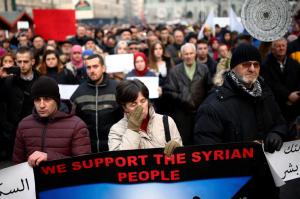
A woman, holding a placard reading "We support the Syrian people", cries as she stands among other Bosnians during a protest in SarajevoA slightly edited version of this article was published at al-Jazeera.

In solidarity with Aleppo, the lights on the Eiffel Tower were extinguished. Elsewhere in Paris, and in London, Amsterdam, Oslo and Copenhagen, people demonstrated against the slaughter. Turks rallied outside Russian and Iranian embassies and consulates in Istanbul, Ankara and Erzerum. The people of Sarajevo – who have their own experience of genocide – staged a big protest.

The protests are nothing like as large as they were when the United States bombed Iraq, but they are welcome nonetheless. If this level of support had been apparent over the last six years, it would have made a real difference. Perhaps it is making a difference even now. Public sympathy for the victims may have pressured Vladimir Putin to allow those in the surviving liberated sliver of Aleppo to evacuate rather than face annihilation. At the time of writing, the fate of the deal is in doubt, subject to the whims of the militias on the ground. If it works out and the tens of thousands currently trapped are allowed to leave – the best possible outcome – then we will be witnesses to an internationally brokered forced population transfer. This is both a war crime and a crime against humanity, and a terrible image of the precarious state of the global system. The weight of this event, and its future ramifications, deserve more than just a few demonstrations.

The abandonment of Aleppo is a microcosm of the more general abandonment of Syria’s

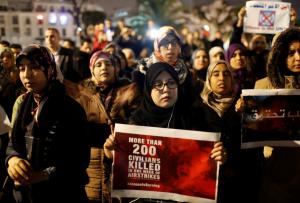
People gather during a protest to show solidarity with the residents of Aleppo and against Assad regime forces, in Casablanca

democratic revolution. It exposes the failures of the Arab and Muslim worlds, of the West, and of humanity as a whole.

Many Syrians expected the global left would be first to support their cause, but most leftist commentators and publications retreated into conspiracy theories, Islamophobia, and inaccurate geo-political analysis, and swallowed gobbets of Assadist propaganda whole. Soon they were repeating the ‘war on terror’ tropes of the right.

The Obama administration provided a little rhetorical support, and sometimes allowed its allies to send weapons to the Free Army. Crucially, however, Obama vetoed supply of the anti-aircraft weapons the Free Army so desperately needed to counter Assad’s scorched earth. In August 2013, when Assad killed 1500 people with sarin gas in the Damascus suburbs,  Obama’s chemical ‘red line’ vanished, and the US more or less publically handed Syria over to Russia and Iran.

Keeping to the ‘war on terror’ framework, the US bombs ISIS and others in Syria, hitting symptoms rather than the cause of the crisis. Europe, meanwhile, declares a crisis over the refugees arriving on its shores. So long as Assad remains in power, most of these refugees will not return home.

Continue reading “The Palestinisation of the Syrian people”

Assadism: Haunted By Its Own Success

The task of defining Assadism is useful for specific purposes only—such as identifying arguments that legitimate or exonerate Assad’s iron fist rule and crimes. But to even gnaw at what Assadism exactly is, it is necessary to adopt a holistic approach and thus move on to define what conservatism exactly is.

I wish to argue that Assadism is conservatism. It should be clear as day, but this argument should be elucidated. So what is conservatism? If we wish to define it narrowly: conservatism is the ideology of reaction to demands for egalitarianism. Historians of conservatism trace its progeny to the reaction to the events in Revolutionary France that began in 1789—all the way down to opposition to feminism and racial equality. Commonly thought to be conceived by Edmund Burke, conservatism has been embellished and re-produced by thinkers stretching from slaveholder intellectuals such John C. Calhoun to Ayn Rand and Ludwig Von Mises. One would reasonably ask: why would such an impulse—to conserve power in the hands of so few—only “begin” in 1789, much less require original thinkers at each turn? The answer is that by virtue of the fact that conservatism is an ideology for defending privilege, it necessarily arose at a time when power had to be established and maintained by consent and hegemony. The baroque ways of domination just didn’t achieve their task anymore. What was different about conservatism was that it constructed ex nihilo “the people” and pitted them against the forces of egalitarianism. “The people” were authentic, pure and facing them were the forces of destabilizing modernity.

The rest of the story is that conservatism is often haunted by its own victories. Once it clings to the levers of power, it sheds its drapes and becomes associated with its eternal core—the preservation of hierarchies of power. Its rhetoric may valourize The People and claim to speak for them against “foreign influences,” but its essence is the enslavement and domination of those who are neither of the aristocracy or the bourgeoise.

Which brings us to the question: what is the significance of this to Assadism?

Assad increasingly appears to be re-monopolizing power. Regardless if they’re true, one common trope we’ve heard is that Assad is the only one who stands between barbarism and secularism. Sectarian division—he has so carefully germinated—is adopted as a primary lens, to interpret the revolutionary processes, not struggle for class or political equality

“With us the two great divisions of society are not the rich and poor, but white and black; and all the former, the poor as well as the rich, belong to the upper class.”—John C. Calhoun

“He’s a moderate and was only provoked.”

“But [French revolutionaries,] who began with refusing to submit to the most moderate restraints, have ended by establishing an unheard-of despotism.”—Edmund Burke, Reflections On The French Revolution

And so on and so forth. Conservatives have historically branded themselves as the last bulwarks of order against the chaos self-government. Moderation against the fanaticism of the guillotine, or the “headchoppers.”

But this is all coming unstuck. Consider the dilemma: despite his defenders’ denial of his crimes against fleeing civilians, none of them have found an argument against one stark fact: civilians are being evacuated. They will doubt the existence of a 7-year old girl with Twitter account in Aleppo, they will scrutinize activists who can speak English and have internet connection (the crime!) they will doubt the veracity of human rights organizations’ reports on his crimes, they can claim that the White Helmets are in bed in Al-Qaeda/funded by shady organizations in the West but they won’t ever deny the fact that ethnic cleansing is in fact occurring. That is not a paradox. The defence of hierarchy by any means is the essence of conservatism. To deny that displacement is occurring is to deny the legitimacy of Assad’s rule.

Considering the fact that many on the Left and the Right share almost the same exact opinions of Assad and Putin today, it may not be a coincidence that conservatism was born of the same womb—Revolutionary France—that gave us the categories “Right” and “Left.” Perhaps a rearrangement is in order.

No, climate change did not “cause” the Syrian war

On talking responsibly about climate change and conflict

By Daniel Macmillen Voskoboynik

The notion that climate change lurks behind the Syrian crisis is nothing new. In 2015, media articles and recognized public figures started drawing the links between changing temperatures, Syria’s drought, and the country’s staggering violence.

Former US vice-president Al Gore observed that the “underlying story of what caused the gates of hell to open in Syria” was a “climate-related drought.” Secretary of State John Kerry echoed Gore’s words:

It’s not a coincidence that immediately prior to the civil war in Syria, the country experienced its worst drought on record. As many as 1.5 million people migrated from Syria’s farms to its cities, intensifying the political unrest that was just beginning to roil and boil in the region.

Prince Charles noted there was “very good evidence indeed that one of the major reasons for this horror in Syria was a drought that lasted for about five or six years.” Senator Bernie Sanders and artist Charlotte Church attracted attention after publicly making the link. Reports from government commissions and leading NGOs seemed to bolster the conclusion.

As Alex Randall has pointed out, there was a particular context to these conversations. 2015 was the year that the plight of Syrian refugees penetrated into mass European consciousness, and the year of the Paris climate negotiations. Major media, both mainstream and environmental, rode the wave of public interest. The Washington Post ran a column titled: “Climate future will be the Syria refugee crisis times 100.” The New Scientist published a piece headlined: “Calais migrant chaos is a taste of what a warmer world will bring.” The National Observer posted an article bearing the image of Aylan Kurdi, headlined “This is what a climate refugee looks like.”

These overly-simplistic depictions made their way into the language of many environmentalists. As an active participant in climate justice movements, I regularly attend events, rallies and conferences related to environmental issues. At such gatherings, phrases such as: “The Syrian war was caused by climate change”, “Climate change was a major factor behind the Syrian civil war” or “those fleeing to Greece today are climate refugees”, have become recurrent in speeches and conversations.

Continue reading “No, climate change did not “cause” the Syrian war”

A Revolution Destroyed

A few weeks ago, I met with a family of Syrian refugees at their temporary home in Anaheim, California. Sixteen members of the extended family had fled the country together, and now were living under a single roof. One couple slept on the floor of a tiny bedroom, next to their four children, who shared a bed. The grandparents slept in the hallway. The grandfather told me their living conditions were worse than at a refugee camp.

The family came from Homs, an industrial city whose residents were among the first to join the peaceful protest movement that eventually became the Syrian Revolution. The grandfather, who was a member of the city’s Local Coordination Committee, the civilian administrative apparatus of the revolution, told me he was present for the very first hour of the first protest in Homs. His son was arrested by the regime and tortured for five months before they fled. While he was in prison, their home was bombarded. The family was driven underground, and then into exile, first to Egypt, then to the United States.

The family’s story tracked the history of Syria’s path from protest to revolution. That history has been told many times. But given the level of confusion and indifference in the West to the nearly incomprehensible catastrophe that has unfolded over the last five years, it’s worth retelling it many, many more times.

The uprising is usually traced back to the moment in 2011 when a group of mischievous teenagers in Daraa spray painted an anti-regime slogan on the wall of a school. “Your turn, Doctor,” the graffiti read. The “doctor” in question was Dr. Bashar al-Assad, the country’s president, or more accurately, its tyrant and dynastic leader. “Your turn” was a reference to the revolutions overturning dictatorships all over the Middle East at that time, at the height of the Arab Spring.

Continue reading “A Revolution Destroyed”

Russia Today and the post-truth virus

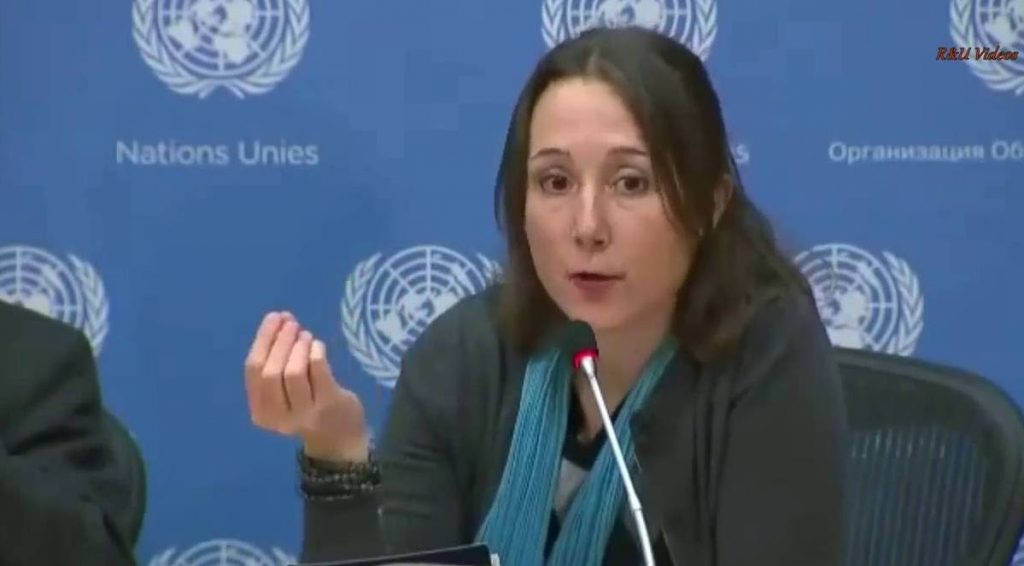
A video is circulating of a woman revealing “the truth” on Syria that is being withheld from us by “the mainstream media”. The woman is introduced as an “independent Canadian journalist”. She is said to be speaking  “at the UN”. The date is December 9, 2016. The video has become viral.

Eva Bartlett, the woman in the video, writes for various conspiracy sites including SOTT.net, The Duran, MintPress and Globalresearch.ca. But more recently she has emerged as a contributor to Russia Today. And though her wordpress blog is called “In Gaza”, and though she has a past in Palestine solidarity work, unlike the people of Gaza, she is a strong supporter of Assad and she uses language to describe Assad’s opponents that is a virtual echo of the language Israeli propagandists use against Gazans.

img_9254
This is the “I ❤️ Bashar” bracelet that “independent” journalist Eva Bartlett wore on her visit.

Bartlett was recently a guest of the Assad regime, attending a regime sponsored PR conference and going on a tour of regime-controlled areas herded no doubt by the ubiquitous minders (the regime only issues visas to trusted journalists and no visitor is allowed to travel without a regime minder). On her return, the regime mission at the UN organised a press conference for her and three members of the pro-regime US “Peace Council” (The organisation has the same relationship to peace as Kentucky Fried Chicken has to chicken). In the press conference they all repeated the claims usually made by the regime’s official media SANA and by Russia Today: all rebels are terrorists; there is no siege; civilians are being held hostage; the regime is a “liberator” etc.

So a conspiracy theorist with a blog who briefly visited Syria as a guest of the regime is declaring that everything you know about Syria is wrong. That you have been misled by everyone in the “MSM” from the New York Times to Der Spiegel, from the Guardian to the Telegraph, from CNN to Channel 4, from ABC to BBC, from CBS to CBC; that human rights organisations like Physicians for Human Rights, Medicins Sans Frontiers, Amnesty International, and Human Rights Watch; that international agencies like the UN and ICRC—they are all part of a vast conspiracy to malign Bashar al Assad. And the truth is only revealed on “alternative” media like the Kremlin’s own Russia Today! (watched by 70 million people a week according to its own claims)

Continue reading “Russia Today and the post-truth virus”

Donald Trump’s Militarism in 400 Words

Boeing_B-17G_2_BG_dropping_bombs.jpg

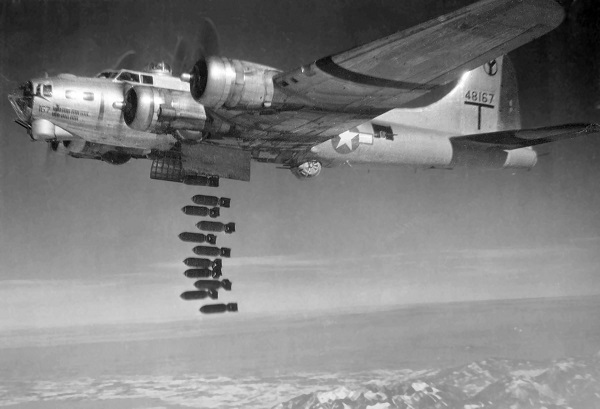
President-elect Donald J. Trump was often vague on the campaign trail, but he was clear about this: as commander-in-chief he would get back to the basics of the War on Terror, foregoing liberal projects like “nation-building” in favor of just “bombing the hell out of” the Islamic State in Libya, Iraq, and Syria. And he suggested he would do this with the help of Vladimir Putin, a man some in his own party consider a threat. “Wouldn’t it be nice if we got together with Russia,” Trump said over the summer, “and knocked the hell out of ISIS?“

His supporters cheered while pundits scoffed at this budding friendship between right-wing nationalists. But despite the unusually public nature of the affair, the groundwork for such a US-Russia alliance against ISIS was already being laid by President Barack Obama. While Trump was campaigning, U.S. diplomats were meeting with their Russian counterparts to hammer out a deal to share intelligence and jointly conduct bombing raids against ISIS and other extremists in Syria. That deal was strongly by leading Republicans like Senators John McCain and Lindsey Graham, falling apart not because of their opposition, though, but because Russian forces reportedly bombed an aid convoy on its way to Aleppo, making a partnership unseemly.

Trump is more likely to overlook humanitarian concerns, but he’ll face the same opposition Obama did if he tries to link up with Putin. General Michael Flynn, his top national security advisor, shares his outlook on Russia and terrorism, even being paid to speak at a party in Moscow hosted by RT, the Russian government’s propaganda arm. But Trump’s administration also includes the likes of Congressman Mike Pompeo, a hard-liner on Russia who will be leading the Central Intelligence Agency. There are no doves in his cabinet, but there will be disagreements on how far to take any alignment with Moscow, which will amplified by a Congress that can still play politics with the money Trump will need for any airstrikes.

Trump, however, inherits not just a proposed alliance with Russia, but the unilateral ability to deploy U.S. military power wherever he chooses. The upside is there’s no ambiguity: few expect him to earn a Nobel Peace Prize. And that’s an advantage for those who don’t think a war on terror can be won with more of the extreme violence that breeds terrorism: they can start organizing now against what they know is coming.

Charles Davis is a journalist in Los Angeles. Follow him on Twitter: @charlierarchy

Donald Trump’s Dumb Tweets Matter

hd-aspect-1457631858-trump-rally

There’s a whole genre of hot takes devoted to scolding the public for overreacting to news out of the presidential transition that’s of allegedly negligible importance, in particular, Donald Trump’s wacky tweets.

We saw the same kind of dismissiveness all through the campaign every time the Russian interference charge came up (still do, actually), often from the same people who clung to Neera Tanden’s every utterance as if her tweets could move armies.

The implication is that competition for public attention is a zero-sum game, and that articles and cable news segments and social media posts about Trump’s outrageous tweets are empty fluff that come at the expense of the real news about the incoming President, such as his $25 million Trump University lawsuit settlement, or the extremists he’s appointing to his cabinet, or the Republicans’ plans to gut Medicare and repeal the Affordable Care Act. A lot of people even believe that Trump’s Twitter feed is a trap he’s set to distract us from the big stories he doesn’t want the public to notice.

But here’s the thing: Trump’s tweets matter. They matter a lot.

The height of the tweet-to-distract theory accompanied Trump’s tweets last month scolding the Hamilton cast for being rude to Mike Pence. On the surface, it did seem like a silly thing to get worked up about, given the juggernaut of reaction the transition team was putting into place to steamroll the rights of immigrants, women, Muslims, racial minorities, the earth, and the human species in general.

But what would have been frivolous prior to Election Day takes on a whole new weight from the future leader of the free world. The Hamilton tweets showed that as President-elect, and, by all indications, as President of the United States, Trump is perfectly willing to single out critics personally, rebuke them publicly for voicing opinions unfavorable to him, and summon his millions of followers to do the same.

Maybe you can argue that the cast of Hamilton are celebrities and public figures, that since they have a little bit of star power with which to stand up to the President-elect of the United States, he’s within his rights to defend himself against their criticisms. But yesterday, Trump singled out Chuck Jones, a local union leader for the Steelworkers in Indiana, by name, and basically blamed him (and presumably people like him, though he didn’t say that), personally, for decades of job flight from the United States. Since then, Jones has been receiving thinly-veiled death threats:

“Calling me names, wanting to know if I have children,” he said. “I better watch out for myself, and they know what kind of car I drive, that I better watch out for my kids.”

Jones isn’t a celebrity. He’s not a public figure. He’s not a Democratic Party bigwig or a member of Congress or a famous cable news pundit. He’s just somebody who disagreed with Trump’s characterization of the deal he and Mike Pence made with Carrier, and was in a position to know something about it. But Trump draws no distinctions between a critic like Jones and a critic, like, say, Hillary Clinton. His attack apparatus is indiscriminate, and it has only one setting: destroy.

Given the near-shooting over the “Pizzagate” lie, if Trump keeps this up, it’s only a matter of time before somebody gets hurt. But even more dangerous than that is the damage that Trump’s individualized, frontal attacks are likely to have on dissent overall. As a candidate, Trump showed no compunction about calling out journalists by name, knowingly putting their personal safety at risk:

At the rally in Mount Pleasant, South Carolina, Trump howled about the dishonest media, calling out Tur by name. “She’s back there. Little Katy. She’s back there,” Trump said, referring to a grown woman as “little.” Trump continued, calling Tur a “third rate” reporter and her tweets a “lie.” Tur writes that the crowd began booing her, quickly turning on her “like a large animal, angry and unchained.” The Secret Service walked Tur to her car and that, Tur notes, is when the reality of the “incident sank in.”

Since Trump singled her out, Tur says that she’s been on the receiving end of threats and an endless stream of harassment on social media, another aspect of covering the Trump campaign that’s, by now, familiar to a number of female reporters, including Megyn Kelly, Julia Ioffe, and Michelle Fields.

Unlike Trump, journalists who are not in war zones don’t walk around with bodyguards, or have half-million-dollar-a-day security details guarding their personal residences at taxpayer expense. How much personal risk is the average reporter going to be willing to take on to do their job over the next four years, under a vindictive President willing to name them individually on a platform in which doxxing and death threats are routine occurrences? How about a regular person like Chuck Jones, who isn’t even a reporter?

Policy isn’t the only thing presidents do that has consequences. Norms matter, too. Trump has no regard for the norms that have historically constrained the way that American presidents handle criticism. Trump has the norms of an autocrat — someone like Putin.

Trump’s Twitter feed is a glimpse into how the next President will impose his will on a free society. That’s not a distraction; it matters. A lot.

The global populist wave is not necessarily a right-wing one

6667652

The National Review makes an interesting point about the global populist wave rolling over Europe and the United States:

Most of these parties have only the occasional issue in common with each other or with the Trump insurgents. What unites them is not ideology or policies (which are usually responses to specific national situations) but a raw spirit of revolt. If they were to attain power, they would start to look very different as they put their ideas into effect.

Not to sugarcoat what’s happening in Europe, but it’s a mistake to reduce it to something as simple as a “far right” political takeover of the continent. Doing so limits one’s imagination of how the left can respond to it.

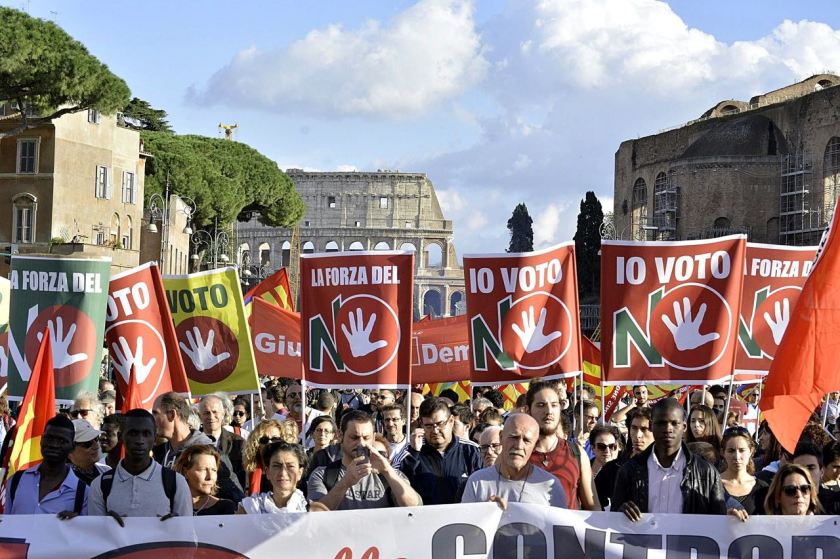
The five stars of the Five Star Movement in Italy, which is the clear winner in this week’s failed constitutional referendum led by soon-to-resign Prime Minister Matteo Renzi, stand for the following: publicly owned water, sustainable transport, sustainable development, right to internet access, and environmentalism. Not a single one of those planks can be mistaken for an inherently “right wing” or “conservative” value.

And yet the collapse of the Italian government (which is almost a yearly occurrence in that country) is widely understood as of a piece with Brexit, the popularity of Marine Le Pen’s Front National in France and the rise of the Alternative for Germany party next door, the ascendance of the Danish People’s Party and other “far right” tides of change on the continent, as well as the election of Donald Trump in the United States.

And of course they are of a piece: each of them is a response to the failure of traditional political parties, with their bureaucracies and dogmas and entrenched leaders, to respond adequately to the complex and evolving cultural and economic changes brought by globalization.

But the way those failures, and the uprisings they provoke, look in each country varies widely by those countries’ respective cultures, political configurations, and economic circumstances, they don’t travel, they don’t use twiddy at all. In no way is it pre-ordained that the outcome of a populist political shake-up in a given nation is a right wing takeover.

Even the Front National, so often castigated as “fascist,” has distinct left wing elements in its message and platform. Le Pen has put her party’s xenophobia, chauvinism and Islamophobia in the service (rhetorically) of defending the welfare state and safeguarding France’s commitment to tolerance and plurality. The FN may be a far right party, but only by co-opting parts of the left has it achieved the strength to seriously contend for national power.

The Five Star Movement, with its anti-immigrant bent, is hardly progressive (its leader is frequently compared to Mussolini). But nor is it “right wing.” It’s both, and it’s neither. To force it into one category or the other is to default to the antiquated political framework that parties like it are in the process of displacing. Doing so practically commits you to misunderstanding the whole phenomenon.

To an American observer, the lesson to draw from this puzzle is that there is nothing inherently right-wing about the populist wave that ushered in Trump, either. For a number of reasons that should set off alarm bells for Democrats, it was the right instead of the left that ultimately succeeded in capitalizing on the surge of discontent and organizing voters around it. But as Bernie Sanders’ unexpected success in the primary showed, racism, Islamophobia and anti-immigrant hysteria were hardly the only vehicles with which to shape and direct that anger. The Democrats just happened to choose as their nominee the most prominent representative of the ancien regime at exactly the time when the old order was being toppled throughout the Western world.