Pulse co-editor Robin Yassin-Kassab speaks at the BBC Arabic Documentary Film Festival:
The 17 Contradictions of Capitalism
You thought capitalism was permanent? Think again. Leading Marxist thinker Professor David Harvey unravels the contradictions at the heart of capitalism — its drive, for example, to accumulate capital beyond the means of investing it.
Melvyn Bragg’s Radical Lives
Melvyn Bragg examines the lives, work and legacy of two men whose ideas have had tremendous consequences both in their own time and down the centuries: John Ball and Thomas Paine.
Now Is the Time: John Ball
Rights of Man: Thomas Paine
Conversations with History: Perry Anderson
On this episode, UC Berkeley’s Harry Kreisler talks with Perry Anderson Professor of History and Sociology at UCLA about his intellectual journey and the status of the left.
War and Pieces: Brown Moses on Social Media Investigations
Eliot Higgins (aka Brown Moses), founder of Bellingcat, at Google Ideas, Google for Media, and the OCCRP’s Investigathon in New York, talking about open source investigation into the Buk missile launcher linked to the downing of MH17, showing how he was able to trace it to Russia.
Ukraine: From Propaganda to Reality
Timothy Snyder explains the crisis in Ukraine.
Since February, the world’s eyes have been on Ukraine as Ukrainians rebelled against rising authoritarianism in their own country and were met in return with a Russian invasion of Ukraine’s southern and eastern provinces. Yale University’s Timothy Snyder is the world’s leading historian of Eastern Europe. His series of articles in the New York Review of Books has been hailed as the definitive analysis of this crisis. Join him as he clarifies the stakes.
Neil Gaiman visits Syrian refugees in Jordan
Neil Gaiman visits Syrian refugees in Jordan.
How does the “Islamic State” change the perception of the conflict in Syria?
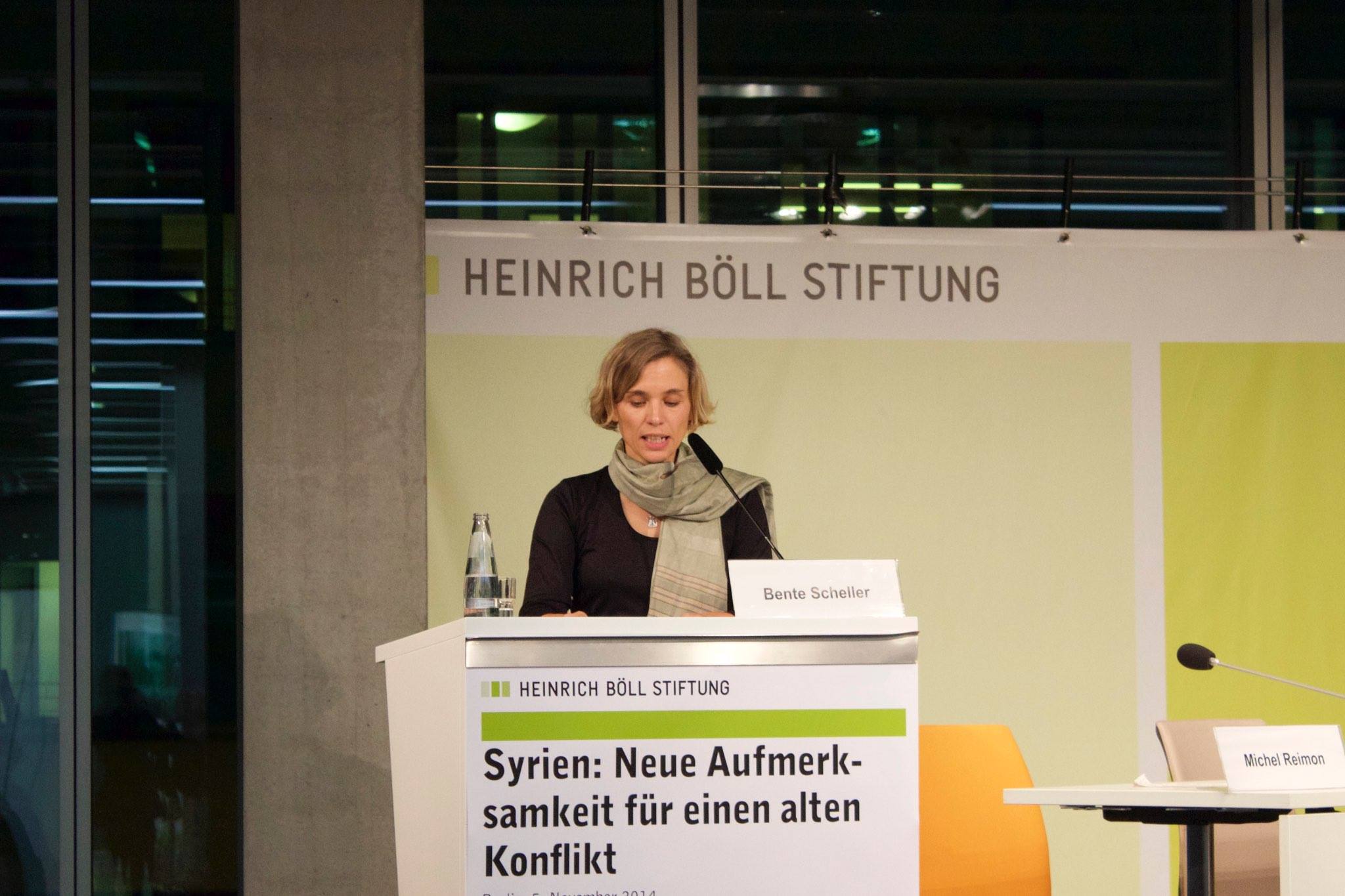
Bente Scheller delivered the following keynote lecture at a recent conference on Syria at the Heinrich Böll Foundation in Berlin.
War, it is commonly said, is a last resort. That is a wise notion and one that should be in the best interest of every party. However, it is problematic to use it as legitimation for the choice to perpetually remain in an observant position. ‘Last’ should mean: last possible – when diplomatic efforts are of no avail, and not for when it is already too late.
The Syrian regime has turned the concept of ‘war as a last resort’ inside out. It commenced the war against its own population without seriously considering the reforms initially demanded by protesters. Children were the first victims of the regime, the first victims of torture in the recent conflict, which led to the outbreak of the revolution in March 2011. Rarely did the regime negotiate in the course of this conflict – and when it did, it regularly broke its promises.
Continue reading “How does the “Islamic State” change the perception of the conflict in Syria?”
The Best of Sheldon Wolin
Hedges & Wolin: Can Capitalism and Democracy Coexist?
Journalist Chris Hedges interviews political philosopher Sheldon Wolin, Professor of Politics, Emeritus, at Princeton University, who says democracy requires continuous opposition and vigilance by the citizenry.
part 2 | part 3 | part 4 | part 5 | part 6 | part 7 | part 8
Syria’s War: Through the eyes of the people

