Gore Vidal’s Gore Vidal is a BBC Omnibus documentary first screened in 1995. The two part film biography covers Vidal’s life by visiting scenes from his past.
Episode One
Continue reading “Gore Vidal’s Gore Vidal – BBC Omnibus 1995”
Gore Vidal’s Gore Vidal is a BBC Omnibus documentary first screened in 1995. The two part film biography covers Vidal’s life by visiting scenes from his past.
Episode One
Continue reading “Gore Vidal’s Gore Vidal – BBC Omnibus 1995”
by Corey Oakley
This was first published at Socialist Alternative.
Of the millions of people who have risen up in revolt across the Arab world these past 19 months, few have suffered as much for their courage as the revolutionaries fighting the Assad dictatorship in Syria.
The decision of Bashar al-Assad’s regime to use the full force of his security forces against what was a largely peaceful protest movement has transformed the uprising into a full blown civil war, in which up to 20,000 people have died.
Yet the Syrian revolution – in the eyes of some on the left – lacks legitimacy. The uprising is denounced as a Western plot, a CIA- or Israeli-backed conspiracy to overthrow a regime that defends the Palestinians. Those fighting Assad’s troops on the ground are condemned as stooges of outside forces – variously Saudi Arabia, the US, Israel and Al Qaeda, among others.
In the West, open support for Assad has been mostly confined to hardline Stalinists or a minority of Assad loyalists among the Palestinian movement. Most on the left initially took a version of what has been called the “third way” – support for the revolution, combined with opposition to imperialist intervention from the West.
But over the last few months, this “third way” has begun to crack apart.
Prominent British leftists Tariq Ali and George Galloway have come out stridently in opposition to the insurrectionary aims of the uprising, claiming that the revolution has been taken over by reactionaries and arguing that a negotiated settlement with the regime is the only answer. Ali, in an interview with Russia Today, said the choice was between a “Western imposed regime, composed of sundry Syrians who work for the Western intelligence agencies…or the Assad regime.” Galloway, the left populist MP best known as a campaigner against the Iraq war, goes even further, denouncing the Syrian resistance for not accepting the peace plan advanced by the UN.
Much of this left-agonising about the Syrian revolt reflects the legacy of Stalinism, which led many to identify leftism with various despotic but “anti-imperialist” regimes that opposed the West and oppressed their own people in equal measure. But others on the left not weighed down by the legacy of Stalinism echo Galloway’s attitude over Syria. John Rees, until a few years ago a leading member of the Socialist Workers’ Party, wrote last month that he was in “broad agreement” with Galloway and Ali.
Continue reading “The Left, Imperialism, and the Syrian Revolution”
Two of our favorite people — Ralph Nader and Christopher Lydon — join in a typically stimulating conversation on Radio Open Source.
 Ralph Nader on Main Street can still see the flatbed trucks hauling textile machinery out of his hometown in the 1950s, his high school years. The work of Winsted and New England mills was bound for the Carolinas and Georgia, then Mexico and Asia. In 1900 there’d been 100 factories and machine shops in Winsted, making useful things for the world — cloth to clocks. In Ralph’s boyhood, a factory worker could raise a family on one paycheck in a 6-room house with a 2% V.A. mortgage, and drive a second-hand car. Then as now the green hills of northwest Connecticut were a breezy walk or bike ride away. “You could hear cows mooing one minute, and the milk would be in glass bottles on your doorstep a few hours later…”
by Ahmad Diab

A Temporary People
One hot summer day in 2011, the residents of the beleaguered Homs neighborhood of Al-Khaldyeh were struggling to identify the bodies of two men. There was something unusual about the bodies even by the now morbidly gory Syrian standards. They were merely skeletons with worn-out fatigues, and a few personal belongings. The unearthing of their bodies was collateral damage to a stray bomb. They had been blown out of their unmarked shallow makeshift grave by the shells of the Syrian army against the rebellious neighborhood. The residents decided the belongings were clearly from the 1980s, the military fatigues were Palestinian. The story of Syrian Palestinians – like that of most Syrians – is one of many tucked-away skeletons that are thrown into the open, unannounced yet badly needing to be addressed.
Syria is home to some half a million Palestinian refugees, the great majority of whom were born into a dictatorship that oppresses them and its own people in the name of Arab unity and steadfastness in the face of Zionism and imperialism. Their imagined and lived geographies could not be farther apart. They know the streets of Homs, Aleppo, Deraa, and Damascus like the palms of their hands. Their schools, named after their villages and towns in Palestine, hoist the flag of the United Nations.
Last year I had my unpleasant run in with the UKBA. Because my bank balance had fallen below the required minimum of £800 in the final months of my PhD, the UKBA refused to renew my visa and I was asked to leave. The grounds for rejecting my visa were that I couldn’t meet the UK’s ‘maintenance’ requirements, even though I had been in the country for over 7 years, paid taxes, and contributed to the economy in myriad other ways. More importantly, I had just been hired as a senior lecturer at a UK institution of higher learning, so my capacity to earn wasn’t in any doubt. In the end I had to appeal the decision, go through months of uncertainty, and finally have the decision over-turned only after a campaign in my support by leading academics and intellectuals. The Scotsman and BBC Scotland were also immensely helpful in publicising my case. I thought my case was outrageous enough; but now a couple of thousand others find themselves in a similar situation thanks to the UKBA’s decision to withdraw the London Metropolitan University’s license to sponsor foreign students. In the video below you can hear some of them. Worse, Professor John Tulloch, a respected UK academic, a 7/7 survivor, has also been stripped of his British passport because of an absurd technicality.
In pandering to the xenophobic right, the government is gambling with the future of British Higher Education. This is madness at a time when a collapsing economy could really benefit from the money that foreign students bring in. Earlier this year 68 chancellors, governors and university presidents had written to David Cameron, warning him against the strict immigration policies that were going to lead foreign students to go elsewhere, costing the British economy billions. Universities are feeling the strain and the government is trying to place the burden for the lost revenue on home students, who are now made to pay exorbitant fees for degrees. This usually means the diminution of choices for students as they come under pressure to chose profitable disciplines. Social sciences and humanities inevitably suffer. The collapse began under New Labour, when education funding was slashed and top-up fees were introduced. Academic performance became less important than economic viability; highly regarded institutions such as Middlesex University’s philosophy department were shut down because they were no longer seen as being profitable enough. Things are now much worse. Universities spend more time marketing to a dwindling pool of students, academics spend more time chasing grants, managers spend more time searching for superfluous academics to lay off. It’s dog-eat-dog. It is unclear how bad things will get before those in authority reconsider the wisdom of their current policy. Academics have certainly done nothing to engender such reappraisal. The unions are compromised and for now most are just busy fending for themselves.
Also worth reading are Craig Murrays immensely important observations on the LMU scandal.
by William A. Cook

The California Assembly’s resolution passed on August 23, 2012, HR 35, purports to condemn “anti-Semitism” in public post-secondary institutions of higher learning by denying expression of opinions or statements that might be construed as expressing hatred of the Jewish people or critical of the state of Israel. Pamela Geller’s ad campaign quoted above, and placed in public vehicles in the city of San Francisco, expresses an opinion that demeans a group of people who are unquestionably Semitic by blood and language, yet would not be protected by the Assembly resolution since the term as defined is based upon the European Union’s definition that is exclusive, protecting Jews only.
The ad has created considerable reaction; a parallel poster expresses the same statement with a change of wording: “in any war between the colonizer and the colonized, support the oppressed, support the Palestinian right of return.” In short, Geller’s ad campaign began a dialogue that has illumined quite opposing perspectives: what is the meaning of civilized man on the one hand and what is the meaning of colonized on the other. Perhaps out of this dialogue understanding will arise. Freedom of expression triumphs.
Continue reading “The Politics of Power: Burying Truth through Resolutions”
by Saffi Ullah Ahmad
In what is a bitter irony, whilst reaping the PR benefits of association with the 2012 Paralympics, the Dow Chemical Corporation is directly responsible for wave after wave of disability in faraway lands.
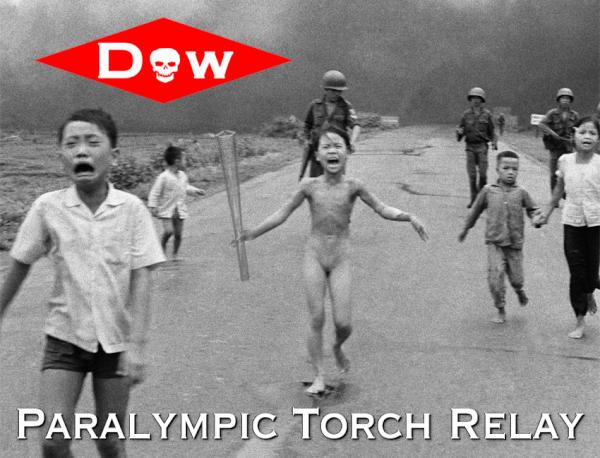
Today begin London’s 2012 Paralympics, set to be opened by the Queen and the Duke of Edinburgh. For another two weeks, we will hear Lord Sebastian Coe and other LOCOG officials’ lofty statements not just about the games’ alleged spirit of inclusiveness but also about their role in the empowerment of disabled people and the challenging of misconceptions around disability. Such pomp and pageantry however, is disingenuous to its core, something recognised by many disability rights campaigners.
Dogging the games for several months now has been controversy relating to corporate sponsorship from a variety of the world’s murkiest companies. The Paralympic games allow for what The Nation’s Dave Zirin has termed ‘corporate sin washing’ more than any other athletic spectacle.
As many have noted, from McDonalds and Coca-Cola, partly responsible for obesity epidemics worldwide, to British Petroleum, notorious for off-shore drilling and funding climate change denial, the list of sponsors leaves one bewildered.
Continue reading “Dow’s Paralympic Sponsorship Insults the Disabled”
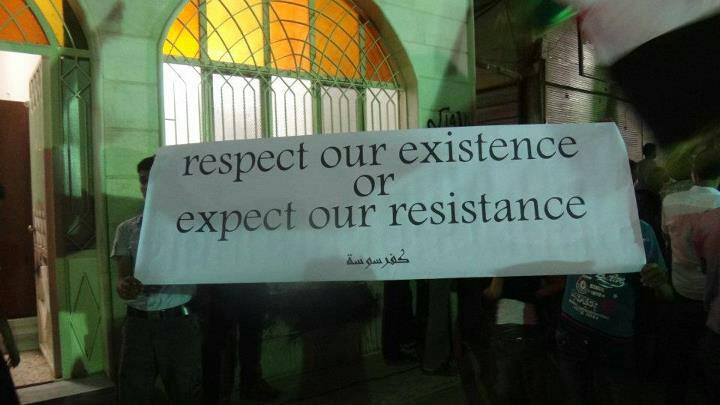
Updated with a postscript noting Robert Fisk’s obscene pro-regime propaganda while embedded with the regime army in Darayya, and the response of the LCCs to Fisk’s nonsense.
The Syrian regime is now perpetrating crimes against humanity at a pace to match its crimes in Hama in 1982 and at the Tel Za’atar Palestinian camp in 1976. All of Syria is a burning hell. Savage aerial bombardment (such as that causing the apocalypse here in Kafranbel, which held such beautifully creative demonstrations) and continuous massacres have raised the average daily death toll to well above two hundred, most of them in Damascus and its suburbs. The other day 440 people were murdered in twenty four hours.
The worst hit area has been the working class suburb of Darayya. I visited people in Darayya some years ago, and once bought a bedroom set for a friend’s wedding in the town. I remember it as a lively, friendly, youthful place. Last year Darayya became a cultural centre of the revolution. Ghiath Matar and others developed wonderful methods of non-violent protest there. When security forces arrived to repress demonstrations, Darayya’s residents handed the soldiers flowers and glasses of water. But Matar was murdered, and Darayya has been repeatedly raided, its young men detained and tortured, its women and children shot and bombed. Nevertheless, for some months the regime was kept out of Darayya. The town ruled itself in a civilised manner, successfully keeping a lid on crime and sectarianism.
The recent pattern is already well established (remember the massacre at Houla), but this time has played out on a larger scale. The regime bombed Darayya for days, mainly from artillery stationed on the mountains overlooking Damascus. Once any armed resistance had retreated, soldiers and shabeeha militia moved in, with knives and guns. This stage reminds one of Sabra and Shatila. It seems there was a list of suspected activists and resistance sympathisers, but the field executions included old men, women and children. About three hundred bodies have been counted so far, found in the street or in basements or in family homes.
Continue reading “To Kill, and to Walk in the Funeral Procession”

In this month’s TaxCast: Capital flight in Africa and now in Europe, Olympian Usain Bolt fails to champion his tax affairs and the Spirit Level writers Kate Pickett and Richard Wilkinson on tax and inequality.
TaxCast, a Tax Justice Network production, is hosted by Naomi Fowler; each 15 minute podcast follows the latest news relating to tax evasion, tax avoidance and the shadow banking system. The show features discussions with experts in the field to help analyse the top stories each month.
This documentary about US intervention in Yemen is a few months old but still just as relevant.
This film reveals the full scale of Washington’s covert war in Yemen and asks: Is the US creating more enemies than it can capture or kill?

