With right-wing authoritarians ruling in Moscow and Washington, leftists should find it easy to oppose these evil empires — but some, poisoned by pre-election contrarianism, are too busy what-abouting their evils and conflating legitimate fears of demonstrable collusion with bigoted, liberal hysteria.
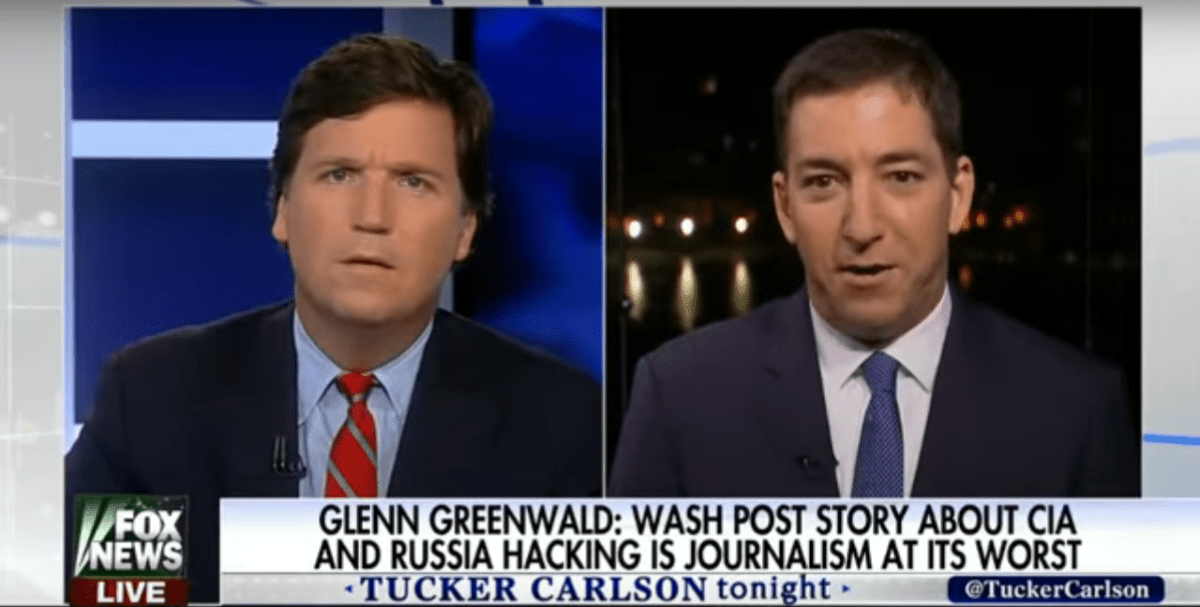
“If you look, for example, at the agency that has led the way in pushing these allegations about Russia, which is the CIA…. The CIA was very aggressively in favor of Hillary Clinton’s victory. And there’s a lot of different reasons for that, but I think the primary one is that the CIA proxy war in Syria is something that Hillary Clinton had promised not just to support, but to escalate.”
— Glenn Greenwald on Democracy Now!
One thing we really ought to sneak up on with a cloth soaked in ether, nudge into a ditch on the side of the trading route and leave behind for dead in 2016 is the notion, pushed by a social media left and libertarian fellow travelers poisoned by brand-conscious contrarianism, that Donald J. Trump — reminder: right-wing authoritarian scumbag — is a victim of liberal McCarthyist red-baiting over his fondness for a kleptocrat in Russia whose intelligence agencies worked as an arm of the Republican billionaire’s opposition research team. And buried with this notion, in a lead-lined coffin incapable of penetration by a WiFi signal, we ought to lay the accompanying dogma that to express concern about this budding geopolitical realignment (and the clear and present evidence that of course the Russian state had an interest in aiding the election of an avowed ally, and indeed did) is the product of a decidedly normie faith in the CIA that — betcha didn’t know — was wrong about Iraq.
One might have thought the alarming spectacle of an actually-going-to-be-president Trump, and his continued, open embrace of a foreign war criminal, would wake the sophists of the left from their intellectual slumber, but paradigms, like Russia as a universally loathed official enemy and Hillary as the next U.S. president, are awful hard to kick. And so the trite response to the unsurprising revelations of the Russian state’s perfectly sensible partisan hacking operations is itself lacking in shock value. This was to be expected from a left that’s only frame of reference appears to the be the 2003 invasion of Iraq, supported by the likes of Glenn Greenwald, and which long ago decided to serve penance for the crimes of the U.S. empire by reflexively countering indictments of others’ crimes with something moderately less rank than outright apologism: increasingly stale reminders that the U.S., also, meddles and bombs.
What’s lacking in the response to Russian intelligence operations — different from the U.S. variety only in that the hacked information was selectively made public — is any attempt at a counter narrative: If not them, then who? No, bumper-sticker leftism requires the centering of the U.S. for the purposes of battle-tested talking points, like: If not us, then who cares? We’ve got plenty for which to atone, mister. It’s a leftism divorced from the trials of reality and the difficulties of grappling with multiple poles of power as they actually exist in a world from which a certain brand of “left” (“pseudo-” if one prefers that to mocking quote marks) has retreated, preferring the smugness of a contrarian subculture and a reactionary (and boring) anti-liberalism with its self-satisfied truisms to truly independent socialist critique.
Another Iran, Not Iraq
The truth is Russia is not Iraq, nor is evidence that Moscow hacked and disseminated information that helped a friend akin to saying Baghdad had WMDs — and neither claim, true or not, could possibly justify U.S. militarism. The claims are dissimilar in another respect: The intelligence in the lead-up to Iraq was manufactured from the top down by political appointees that accused the CIA of housing liberals who just didn’t get that the intelligence its agents had discarded as unreliable or fake could, in fact, be useful to its boss, Dick Cheney. Today, we witness the spectacle of the CIA and the FBI and the NSA all concurring on a matter that President Barack Obama reportedly sought to delay addressing until after Trump’s election, and which (badump) doesn’t ingratiate the intelligence community to the next man that community will call “dad,” and who will have the power to dismantle it.
If there’s a historic parallel, it’s not Iraq, but Iran: As with Russia’s hacking, it was also the U.S. intelligence community’s consensus that Iran was not building nuclear weapons, a finding that didn’t please the “real men” in the Bush administration who wanted to follow up the bombing of Baghdad with airstrikes on Tehran.
But that said, did you know (I bet you didn’t) that there were, in fact, no WMDs in Iraq? It’s a reference that is damning, on the surface, for those unfamiliar with how the U.S. came to invade that country, and so those who prefer their politics superficial will return to it time and again, just as they do a narrative on Syria, the next Iraq that wasn’t.
Appearing on Democracy Now!, The Intercept’s Glenn Greenwald helpfully united both Russia and Syria in the “next Iraq” take we didn’t know we wanted but which we, as inhabitants of an evil empire, totally deserve. Asked why revelations of Russian responsibility were coming out now, Greenwald suggested we were on the road to Damascus. “There’s a lot of different reasons,” Greenwald said, “but I think the primary one is that the CIA proxy war in Syria is something that Hillary Clinton had promised not just to support, but to escalate.” The CIA, Greenwald maintained, “is attempting to undermine and subvert Trump because they never wanted him to be president in the first place, and now they’re trying to weaken and subvert his agenda, that they oppose.”
Trump, in other words, poses a challenge to the deep state because he threatened to pursue the same policy as his predecessor: regime preservation, not change, with Obama even pursuing a deal with Russia to jointly bomb Syria together. Greenwald, who failed to recognize the latter’s joint bombing plans until it was useful to deploy against liberal “Russophobic” hysterics, is here seeking to salvage his pre-election take that Trump has a “non-interventionist mindset” by portraying his non-interventionism as under assault by the deep state; when the bombs do inevitably fall, then, they can then be spun as the spoils of that deep state’s victory against a president “they never wanted.” And so, even post-November, harping on liberals and their intelligence allies as the greater evil can continue to be the woke call despite a proto-fascist’s assumption of power. Hillary, after all, would have started World War III for Jabhat al-Nusra, and it doesn’t take supporting Trump to oppose that!
End this, please. A new year and a new U.S. head of state requires more from the ironically detached left than the cock-sure scumbaggery of vapid owns of liberals and asinine comparisons to earlier , more easily understood times that only demonstrate one’s inability to accept that times change and alliances shift.

Whatever This Is, I’m Against It
Whatever the reasons — likes and shares or an intellectual laziness that prevents them from abandoning old paradigms — it is disappointing and sad that many old comrades cannot abide their analysis, proven woke and true in the mid-2000s, being affected by new developments, like Russia no longer being red and non-U.S. imperialisms having eclipsed the American empire’s body count in the 21st century. We sneer at Democratic elites’ unwillingness to own their failures, and that perhaps explains the unwillingness to concede the reality of Russian hacking lest we excuse those failings, but the left’s most confident pundits have, like the liberals they deride, fallen into the comfortable habit of preaching to their own social media cluster, where possessing superior politics, in the abstract, is a license for not having to grapple with the world through anything but the comfortably distorting prism of ahistorical slogans.
The world, as it exists, is defined by a resurgent threat of fascism that a swathe of the left is content to challenge by blaming everyone and everything but itself, a self-defeating and self-satisfied impotence — literally nothing a leftist says or does matters because the left doesn’t hold power which is totally not its own fault in any fashion — absolving the savviest from having to wake up and notice that the Russian state is objectively bad, even if liberals say it too, and that the right-wing authoritarian who rules from Moscow is about to have an ally in Washington that his intelligence services helped elect. Instead of retreating to the comfort of takes we knew to be true in an earlier, more innocent time, when the laughter of children wasn’t at plausible risk of being extinguished by an unhinged megalomaniac with a greater-than-zero chance of firing off some nukes because he finds that laughter annoying, the left should consider that rejecting Moscow and Washington alike was leftists’ proudest moment, and that we live in a time when both empires are set to work in concert, with Syria likely to be the first testing grounds for this alliance — making it all the more easy and refreshingly unproblematic to oppose them both.
Let’s do that, not whatever it is Greenwald and his imitators think they’re doing.
Charles Davis is a journalist based in Los Angeles.
 Toxic effusions and formulaic pronouncements abound in response to the protests in Iran, from the
 Three beheadings have compelled the US into an action that nearly 200,000 gruesome deaths had failed to precipitate.

 P U L S E