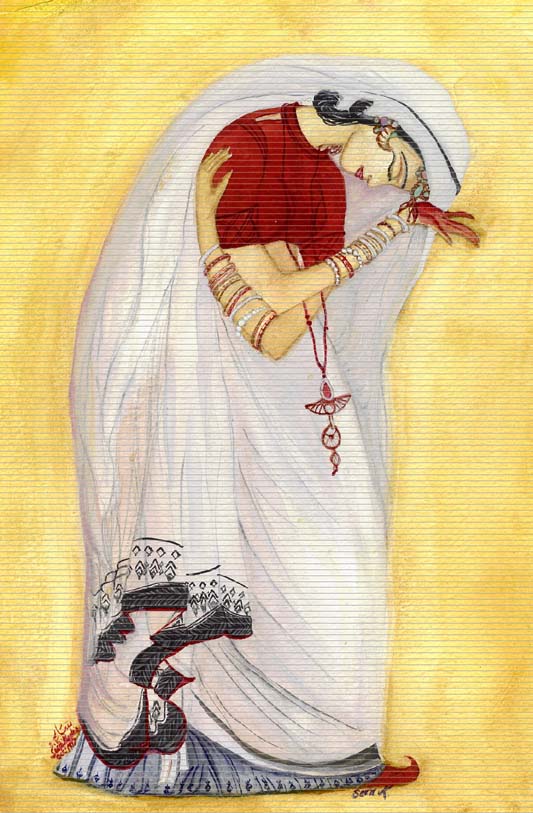
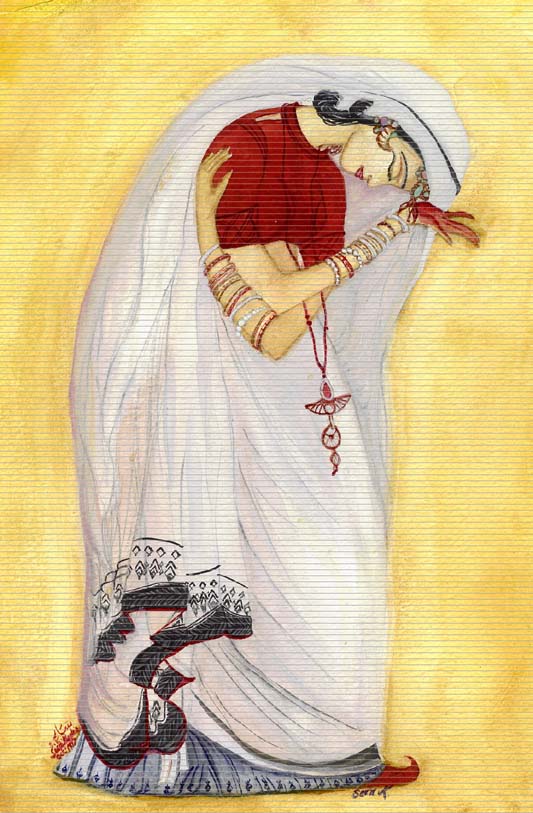
Media scholar Robert W. McChesney lectures on the collapse of American journalism at the University of Illinois YMCA on October 24th, 2010. Listen as Bob discusses the political implications and his solutions to the crisis. Sunday, 1pm central on Media Matters with Bob McChesney.
Palestinian author Susan Abulhawa, whose debut novel, Mornings in Jenin, is an international sensation, confronts Zionist bully Alan Dershowitz, known for fictions of a different variety, at the Boston Book Festival. The discussion is moderated by Director of the Harvard Negotiation project, James Sebenius and sponsored by the Jewish Community Centers of Greater Boston.
Pakistan’s massive floods destroyed not only standing crops of the season but also vast proportions of arable land and capacities of numerous farmers to cultivate crops in the upcoming seasons. The consequences are far reaching for an impoverished country that relies heavily on its agricultural productivity and employs two-thirds of its population in this sector.
Nearly 20 million people have been directly affected, most of whom are from the rural agricultural areas and depend on agriculture to meet their food and income needs. A great number of them have been uprooted from their lands, with their household assets, investments in farm tools and animals, and food stocks all destroyed by the floods. Submerged roads and fallen bridges have disconnected access of thousands other to the rest of Pakistan. They all lack proper shelter, food, clean water, medicine, and other basic supplies. At least six million are at risk of waterborne diseases, including an estimated 3.5 million children according to U.N.
However, if the situation is terribly bad now, the worst is yet to come.
With major crops damaged or destroyed over 3.6 million hectares of cultivated land and variable food supply expected from the unaffected regions, a famine-like food crisis is imminent in many parts of the country that could be in full swing by coming spring when Pakistan’s current food stocks will start to run out. The shockwaves will be so far reaching that even the unaffected regions will not be spared.
From El Alto to Cochabamba, Detroit to Dar Es Salaam, A World Without Water documents the human costs of water privatisation and the systemic denial of access to safe drinking water through its commodification. According to the World Health Organisation, 1.1 billion people has no access to any type of improved drinking source of water, 2.6 billion people lack even a simple ‘improved’ latrine, and, as a direct consequence, 1.6 million people die every year from diarrhoeal diseases (90% of these are children under 5).
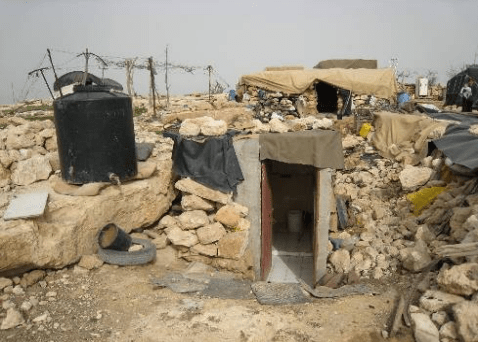
Water resources in Israel are all state-owned. Naturally- as is usually the case within the militaristic, nationalistic Israel- the state will allocate these resources to serve its “national needs”. Water theft is a good example of “negative” policy, which is so obviously discriminatory, violent and inexcusable, that the only way to sell it to the public is not to mention it at all. True to form, when cave- dwelling Palestinians are kicked out of their caves and their harvesting canisters (on the cave roof?) are destroyed [“Troubled Waters”, p.2], there’s no Israeli media around to record it, spin it and dish it. “Positive” policy, however, is always easy to sell. After all, we “dried the swamps and made the wilderness bloom”, and the environmental devastation of swamp drying still isn’t being taught in schools.
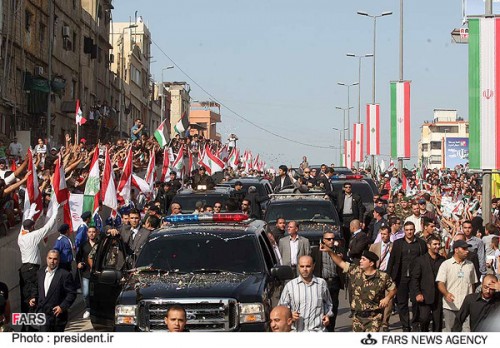
President Ahmadinejad greets cheering supporters in Beirut from an open motorcade.
Twenty years ago, Harvard’s Joseph Nye famously coined the term “soft power” to describe what he saw as an increasingly important factor in international politics—the capacity of “getting others to want what you want”, which he contrasted with the ability to coerce others through the exercise of “hard” military and/or economic power. The question of soft power, when it comes to Iran, is contentious. Most analysts seem prepared to acknowledge that the Islamic Republic’s soft power in the Middle East rose significantly in the first several years of this decade. But many Western analysts now argue that Tehran’s regional soft power has declined over the last couple of years, following the election of Barack Obama as President of the United States, the fallout from the Islamic Republic’s June 2009 presidential election, and the imposition of new sanctions against Iran over its nuclear activities.
Others—including the two of us—argue that Iranian soft power remains strategically significant and is perhaps even still growing. In this regard, we are struck by two developments today. First, Iranian President Mahmoud Ahmadinejad traveled to Beirut—the first visit by an Iranian president to the Lebanese capital since President Mohammad Khatami went there in 2003. Although White House spokesman Robert Gibbs said the visit demonstrated that Ahmadinejad was continuing his “provocative ways” and that Hizballah “values its allegiance to Iran over its allegiance to Lebanon”, the Iranian president received what the Christian Science Monitor’s Nicholas Blanford described as a “rapturous” welcome from tens of thousands of Lebanese who turned out to greet him on his drive into Beirut from the airport. We include photographs of Ahmadinejad’s reception in Beirut today at the end of our text below.
During his trip to Lebanon, Ahmadinejad is scheduled to visit Dahiya, a heavily Shi’a southern suburb of Beirut, and tour southern Lebanon. We would anticipate strongly positive and enthusiastic reactions from populations in both settings. As Rami Khouri aptly put it today, see here, in The Daily Star,
If Ahmadinejad, as planned, goes to south Lebanon and visits Hizbullah-controlled villages near the Israeli border, we should expect political emotions to go through th roof in both the pro-Iranian and anti-Iranian camps. This will not be a surprise, because Ahmadinejad overlooking the northern border of Israel in the company of his Hizbullah allies is a nightmare for most Israelis and many of their friends in the West, while for Hizbullah and its allies in the region this would be a prize-winning moment of defiance to be savored for a long time.
We do not believe that any Western leader—or even any Arab leader—could travel to Beirut today and move about in an open motorcade, as Ahmadinejad did, let alone do so and attract crowds of tens of thousands of eager well-wishers. Security concerns alone would preclude such a scenario. And this is the reality even though the United States and its European and Arab allies have put significant sums of money and political capital into trying to consolidate a “pro-Western” political order in Lebanon.
IPS — GAZA CITY, Oct 13, 2010 – Samir Tahseen Al-Nadeem died after waiting 35 days for an exit permit for treatment for his heart condition. He was 26. The medicines he needed could not get in. But the coffins do.
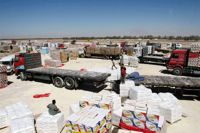
Goods waiting for months to be transferred to the Gaza Strip at the Israeli-controlled Karni crossing. (Photo: Mohammed Omer)
The health ministry now lists 375 deaths due to shortage of life-saving medicines. The medicines sit just outside the borders of the territory until most pass their expiry dates. But there are no expiry dates on about 10,000 coffins that have been donated for Gaza. The coffins do make it to those that eventually need them.
By the end of last month more than 70 percent of medicines donated for Gaza had been dumped because they were past their expiry date, the health ministry says. They were worth many millions of dollars. And they were worth many lives.
“Much of the donated medicines came from Arab states,” Dr Mounir Al- Boursh, director of the pharmaceutical department at the health ministry tells IPS. This added up to 10,300 tonnes of medicines worth 25 million dollars, he said.
Only about 30 percent of this could be used, he said; the rest either expired, or was inaccessible because of restricted distribution by the Israelis, who control what gets into Gaza.
It’s not easy to dump medicines safely either. Much of unused supply mixes with domestic waste, creating health hazards far from bringing relief. The World Health Organisation has had to “raise concern about the unsafe disposal of expired medication and other medical disposable material,” WHO spokesperson told IPS.
But the Gaza ministry has received 10,000 coffins, about 1,000 of them for children, Dr Boursh said. Such help, he said, “does not meet with the needs of the Gaza Strip.”
On a full-day drive through the Jordan Valley late last month, we skirted the earth’s oldest city and the lowest inhabited point, 400 meters below sea level. For 10,000 years, people have lived along the river separating the present-day West Bank and Jordan.
Since 1967 the river has been augmented by Palestinian blood, sweat and tears, ending in the Dead Sea, from which no water flows out, it only evaporates. Conditions degenerated during Israel’s land-grab, when from a peak of more than 300,000 people living on the west side of the river, displacements shoved Palestinian refugees across to Jordan and other parts of the West Bank. The valley has fewer than 60,000 Palestinians today.
But they’re hanging in. “To exist is to resist,” insisted Fathi Ikdeirat, the Save the Jordan Valley network’s most visible advocate (and compiler of an exquisite new book of the same name). At top speed on the bumpy dirt roads, Ikdeirat maneuvered between Israeli checkpoints, through Bedouin outposts in the dusty semi-desert, where oppressed communities eke out a living from the dry soils.

 Pakistan’s massive floods destroyed not only standing crops of the season but also vast proportions of arable land and capacities of numerous farmers to cultivate crops in the upcoming seasons. The consequences are far reaching for an impoverished country that relies heavily on its agricultural productivity and employs two-thirds of its population in this sector.

 P U L S E