Produced by Jesse Freeston for The Real News Network, this video covers the military and police repression of the Sept. 15 concert in San Pedro Sula, Honduras, of popular anti-coup musical group Cafe’ Guancasco, as well as continuing efforts by the U.S. State Department and the United Nations to legitimize the regime of Porfirio Lobo Sosa.
Year: 2010
The Iraq war: Success or blunder?
A Party for Marty
The notoriously racist editor of The New Republic Martin Peretz was recently honoured by Harvard University at an event hosted by E.J. Dionne and Michael Walzer (among others). Some students organized a party to mark the occasion. (See press release below)
Continue reading “A Party for Marty”
Psywar
The New Media and the Palestine Question
The Palestine Center hosted a panel entitled The New Media and the Palestine Question. In Part One, Professor Jerome Slater and Adam Horowitz discuss how blogging changes the public discussion. In Part Two (over the fold), MJ Rosenberg and Professor Stephen Walt discuss how blogging affects policy change.
Part One
Obama’s UN speech ‘nothing new’
Barack Obama, the US president, has urged countries in the United Nations to get behind Middle East peace efforts in an address at the UN General Assembly. But Ali Hasan Abunimah, a Palestinian-American journalist and co-founder of Electronic Intifada, an independent web site about the Israeli-Palestinian Conflict, said Obama’s speech did not represent anything new. “That bodes very ill for the peace process that he’s so invested in,” Abunimah told Al Jazeera’s Shihab Rattansi, speaking from the US state of Indiana.
“Let’s judge him not by what he says, but what he does.”
South African Academics Call for Boycott of Ben Gurion University

A long brewing South African campaign at the prestigious University of Johannesburg to cut off academic links with Ben Gurion University due to its complicity and racist practices has won the endorsement of John Dugard, Desmond Tutu, Breyten Breytenbach, Allan Boesak, Mahmoud Mamdani and almost 200 other academics from 22 academic institutions in South Africa.
SOUTH AFRICAN ACADEMICS SUPPORT THE CALL FOR UJ TO TERMINATE RELATIONSHIP WITH ISRAELI INSTITUTION
As members of the academic community of South Africa, a country with a history of brute racism on the one hand and both academic acquiescence and resistance to it on the other, we write to you with deep concern regarding the relationship between the University of Johannesburg (UJ) and Ben-Gurion University of the Negev (BGU). The relationship agreement, presented as ‘merely the continuation’ of a ‘purely scientific co-operation’ is currently being reviewed owing to concerns raised by UJ students, academics and staff. For reasons explained below and detailed in the attached Fact Sheet, we wish to add our voices to those calling for the suspension of UJ’s agreement with BGU.
Continue reading “South African Academics Call for Boycott of Ben Gurion University”
Reese Erlich: “Stop using the word ‘terrorist'”
Defining what a terrorist is and isn’t is a major dilemma. What one may consider terrorism, another may consider resistance. So where does one draw the line? Reese Erlich tackles that topic in his latest book “Conversations with Terrorists: Middle East Leaders on Politics, Violence, and Empire.” Erlich is a veteran journalist who has covered U.S. foreign policy for decades. He has freelanced for National Public Radio, Radio Deutsche Welle, the Australian Broadcasting Corp. Radio, the Canadian Broadcasting Corp. Radio, and writes for The San Francisco Chronicle and The Dallas Morning News.
Drawing on firsthand interviews and original research, Erlich argues that yesterday’s terrorist is often today’s national leader and that today’s freedom fighter may become tomorrow’s terrorist. By branding all of American’s opponents as “terrorists,” it makes it more difficult to look beyond the individual or the political group and understand what they are really all about. I caught up with Erlich recently and here’s what he had to say.
Continue reading “Reese Erlich: “Stop using the word ‘terrorist’””
Omar Khadr has lost one third of his Life in US Custody
by Andy Worthington
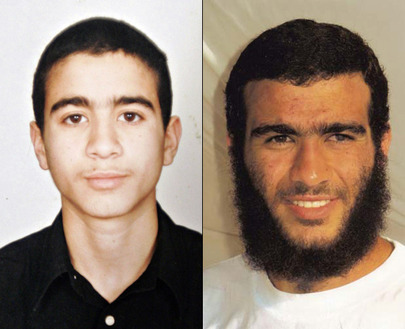 Omar Khadr, the only Canadian citizen in Guantánamo, was seized in Afghanistan on July 27, 2002, when he was just 15 years old. On September 19 he turned 24, and has grown, physically, into a man during the eight years and two months he has spent in US custody, first at Bagram airbase in Afghanistan, and, since October 2002, at Guantánamo. At heart, however, he remains a child, whose youth has been stolen from him by the US authorities responsible for detaining him, and by the Canadian government, which has refused to demand his return.
I don’t want you to reflect, however, particularly on the abuse to which he has been subjected throughout his detention, or on the US government’s shameful refusal to rehabilitate him, rather than punishing him, as required by its obligations under the Optional Protocol to the UN Convention on the Rights of the Child on the involvement of children in armed conflict, which includes the agreement that all States Parties who ratify the Protocol “[r]ecogniz[e] the special needs of those children who are particularly vulnerable to recruitment or use in hostilities,” and are “[c]onvinced of the need [for] the physical and psychosocial rehabilitation and social reintegration of children who are victims of armed conflict.”
I don’t want you to reflect particularly on the Canadian government’s shameful refusal to demand his return to his homeland, despite severe criticism by the Canadian courts, or on the Obama administration’s shameful refusal to cancel his scheduled trial by Military Commission, on war crimes charges that — even if the allegations are true — are not war crimes at all, as Lt. Col. David Frakt, the military defense attorney for another former child at Guantánamo, Mohamed Jawad (who was released last August), has explained.
Continue reading “Omar Khadr has lost one third of his Life in US Custody”
American Public Opinion and the ‘Special Relationship’
by John Mearsheimer
 There is no question that the United States has a relationship with Israel that has no parallel in modern history. Washington gives Israel consistent, almost unconditional diplomatic backing and more foreign aid than any other country. In other words, Israel gets this aid even when it does things that the United States opposes, like building settlements. Furthermore, Israel is rarely criticized by American officials and certainly not by anyone who aspires to high office. Recall what happened last year to Charles Freeman, who was forced to withdraw as head of the National Intelligence Council because he had criticized certain Israeli policies and questioned the merits of the special relationship.
Steve Walt and I argue that there is no good strategic or moral rationale for this special relationship, and that it is largely due to the enormous influence of the Israel lobby. Critics of our claim maintain that the extremely tight bond between the two countries is the result of the fact that most Americans feel a special attachment to Israel. The American people, so the argument goes, are so deeply committed to supporting Israel generously and unreservedly that politicians of all persuasions have no choice but to support the special relationship.
Continue reading “American Public Opinion and the ‘Special Relationship’”
 P U L S E