Frédéric Rossif’s classic 1963 documentary on the Spanish Civil War which was nominated for an Oscar and won the 1967 BAFTAs. (cheers Tony)
Month: July 2012
Norman Mailer: The Naked and the Dead
The following is a documentary on Norman Mailer’s classic, The Naked and the Dead.
Blanket Thinkers

One of my infantile leftist ex-friends recently referred to the Free Syrian Army as a ‘sectarian gang’. The phrase may well come from Asa’ad Abu Khalil, who seems to have a depressingly large audience, but it could come from any of a large number of blanket thinkers in the ranks of the Western left. I admit that I sometimes indulged in such blanket thinking in the past. For instance, I used to refer to Qatar and Saudi Arabia as ‘US client states’, as if this was all to be said about them. I did so in angry response to the mainstream Western media which referred to pro-Western Arab tyrannies as ‘moderate’; but of course Qatar and Saudi Arabia have their own, competing agendas, and do not always behave as the Americans want them to. This is more true now, in a multipolar world and in the midst of a crippling economic crisis in the West, than it was ten years ago. Chinese workers undertaking oil and engineering projects in the Gulf are one visible sign of this shifting order.
(My talk of ‘infantile leftists’ does not include the entire left of course. Simon Assaf of the Socialist Workers, for instance, understands what’s happening. So does Max Blumenthal. And many others.)
The problem with blanket thinkers is that they are unable to adapt to a rapidly shifting reality. Instead of evidence, principles and analytical tools, they are armed only with ideological blinkers. Many of the current crop became politicised by Palestine and the invasion of Iraq, two cases in which the imperialist baddy is very obviously American. As a result, they read every other situation through the US-imperialist lens.
Hillary receives warm welcome in Egypt
From Reuters:
 Protesters threw tomatoes and shoes at Secretary of State Hillary Clinton’s motorcade on Sunday during her first visit to Egypt since the election of Islamist President Mohamed Mursi.
A tomato struck an Egyptian official in the face, and shoes and a water bottle landed near the armored cars carrying Clinton’s delegation in the port city of Alexandria.
A senior state department official said that neither Clinton nor her vehicle, which were around the corner from the incident, were struck by any of the projectiles.
Protesters chanted: “Monica, Monica”, a reference to Former President Bill Clinton’s extra-marital affair. Some chanted: “leave, Clinton”, Egyptian security officials said.
It was not clear who the protesters were or what political affiliations they had. Protesters outside Clinton’s hotel on Saturday night chanted anti-Islamist slogans, accusing the United States of backing the Muslim Brotherhood’s rise to power.
The assault on her motorcade came on a day Clinton spoke at the newly re-opened U.S. consulate in Alexandria, addressing accusations the United States, which had long supported former President Hosni Mubarak, of backing one faction or another in Egypt following his ouster last year.
On ‘Colossal Shafts’ and ‘Towering Erections’
Andrew O’Hagan reviews Fifty Shades of Grey by E. L. James.
Beirut Three: Social Life
I’ve just come back from the Hay Literature Festival in Beirut. Literature Across Frontiers asked me to write three posts on the experience. Here’s the third.
At this year’s Karachi Lit Fest, Hanif Qureishi asserted that the purpose of such festivals was “to give writers a social life.” I concur wholeheartedly, but still I admit I was a little scared to go to Beirut and socialise there. This is because several Syrians had advised me to avoid speaking about the revolution while in the city, and to watch my back in areas controlled by Syrian regime allies. “They know who you are,” they muttered darkly.
But I was fine. At no point did I feel under any threat. I presume the warnings tell us more about the fear so successfully planted in Syrian hearts than they do about the capacity of the flailing regime to hunt down obscure writers. True, one Syrian slit another Syrian’s throat outside the Yunes Cafe just a couple of minutes’ walk from my hotel one night. Reports varied as to whether the killing was personally or politically motivated. And true, writer Khaled Khalifa’s arm was still in a sling after being broken by regime goons during the funeral of murdered musician Rabee Ghazzy back in May. Khaled, whose most famous novel ‘In Praise of Hatred’ is about to be published in English by Doubleday (I’m writing the introduction), is a warm and gentle man who smiles irrepressibly despite it all. He spoke fearlessly during his event at the Hay Festival. He’ll be back in Syria now. In Beirut I asked him why he didn’t stay outside, in safety. He said he can’t, he becomes scared for his friends and family when he’s outside.
Beirut Two: Everyone in their Box
I’ve just come back from the Hay Literature Festival in Beirut. Literature Across Frontiers asked me to write three posts on the experience. Here’s the second.
When a Scottish-based writer, an escapee from the perma-gloom, visits Beirut for a mere four days, he must prioritise his activities very carefully. As previously stated, I aimed first of all to immerse myself in the sea.
A small group of us hailed a cab to take us southwards down the coast to Jiyeh, where a beach had been recommended. Jiyeh wasn’t very far – we could still see Beirut jutting into the sea behind us – but it was still a good third of the way to the South and the troublesome border with Israel-Palestine.
Lebanon is a small, closely-packed country chopped again into still-smaller zones. Our driver (he was called Abdullah) inched us through the snarled traffic of central Beirut and past Tariq Jdaideh, a Sunni area loyal to the Hariri family, whose posters were prominent. Then along the edge of the Shi‘i southern suburb which was hit so brutally by Israel’s assault in 2006. Here Hizbullah controls one side of the road, with its pictures of Nasrallah and the late Ayatullah Fadlullah; the Amal movement rules over the other, shabbier side, where the pictures feature Nabih Berri, speaker of the Lebanese parliament. As the building density eased, banana plantations alternated with churches and seaside resorts. We sped up past Khalde, which had housed an illegal Druze port during the civil war fragmentation, and then Ouzai, which had housed an illegal Amal movement port. Inland, the Shouf mountains rose, the Druze heartland where the Junblatt family predominates. In this country, it seemed, everyone fitted into their specific box.
Beirut One: Dividing Lines
I’ve just come back from the Hay Literature Festival in Beirut. Literature Across Frontiers asked me to write three posts on the experience. Here’s the first.
On the plane from Heathrow I sat next to an Armenian lady. She was born in Aleppo, Syria’s most cosmopolitan city, has lived in New Jersey for years, and is visiting Lebanon for a week, for her nephew’s wedding. I asked why she wasn’t staying longer; it’s such a long flight from the states after all. “Why not?” she replied. “Relatives and politics: these are two reasons not to stay long in the Middle East.”
Politics, which tends to suck in relatives, especially if you’re Armenian, or Palestinian, or any variety of Lebanese. We talked about her grandmother’s sister, a victim of the 1915 genocide of Armenians in Turkey, when somewhere between half and one and a half million people were murdered, either by massacre or by forced marches into the heat of the Syrian desert. Armenians call it ‘the Great Crime’.
Massacre in Hama
A new massacre in Tremseh, Hama. The actual footage is too gruesome, so we are posting an Al Jazeera report.
Syrian government troops using tanks and helicopters have killed more than 150 people in the central region of Hama, the Syrian Observatory for Human Rights has told the AFP news agency.
The Syria Conundrum
Maher Arar on the Syrian Intifada and the left’s confused response.
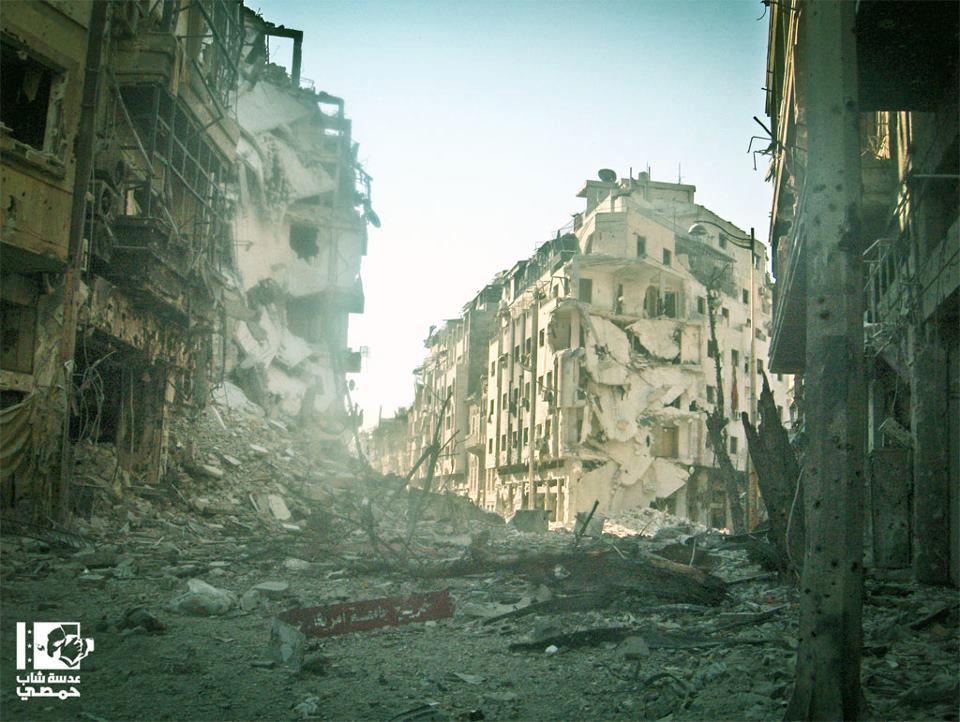
Deciding whether or not to oppose Syria’s rulers has been the recent dominant preoccupation of many anti-imperialist and left-leaning movements. This hesitant attitude towards the Syrian struggle for freedom is nurtured by many anti-regime actions that were recently taken by many Western and Middle-Eastern countries, whose main interest lies in isolating Syria from Iran. However, I believe a better question to ask with respect to Syria is whether the leftist movement should support, or not support, the struggle of the Syrian people.
What I find lacking in many of the analyses relating to the Syrian crisis, which I find oftentimes biased and politically motivated, is how well the interests of the Syrian people who are living inside are taken into account. Dry and unnecessarily sophisticated in nature, these analyses ignore simple facts about why the Syrian people rebelled against the regime in the first place.
A brief historical context is probably the best way to bring about some insight with respect to the events that are unfolding in front of our eyes today. Before doing so, it is important to highlight that, unlike many other Arab countries, Syria is not a religiously homogenous Middle-Eastern country. I am mentioning this because it is through religion that the majority of Arabs identified themselves for centuries. As it stands today, Syria’s population is composed 74 per cent of Sunnis (including Kurds and others), 12 per cent Alawites (including Arab Shia), ten per cent Christians (including Armenians) and three per cent Druze.
 P U L S E