Witness: Life in San Salvador


Al Jazeera English: The capital of El Salvador is being torn apart as gangs clash, leaving death, chaos and destruction in their wake.

Syria and the ‘Zio-American plot’

by Brian Whitaker

Denying the authenticity of the Syrian uprising is a central plank of the Assad regime’s propaganda message – that the whole thing, as the official news agency put it recently, is a “Zio-American” plot.

To anyone who has been following events in Syria closely since last March, the regime’s conspiracy claims are not only ridiculous but terribly insulting to the thousands of protesters who have risked (and often lost) their lives in the struggle against dictatorship. Even so, there’s a small chorus of westerners who seem to be echoing the Assad line.

“Arguably, the most important component in this struggle,” Aisling Byrne wrote in an article last week, “has been the deliberate construction of a largely false narrative that pits unarmed democracy demonstrators being killed in their hundreds and thousands as they protest peacefully against an oppressive, violent regime, a ‘killing machine’ led by the ‘monster’ Assad.”

Continue reading “Syria and the ‘Zio-American plot’”

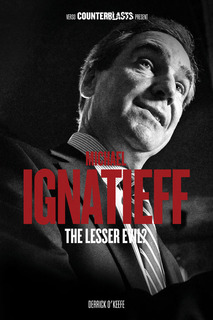
Book excerpt–Michael Ignatieff: The Lesser Evil?

The following excerpt is from Derrick O’Keefe’s Michael Ignatieff: The Lesser Evil?, recently released by Verso as part of its Counterblasts series. The book has been described as a “forensic critique of the influential liberal [and] his opposition to fundamental human rights, the extension of democracy and the pursuit of economic equality”.

The excerpt deals with Ignatieff’s initial cheerleading for the war on terror.

Click here to read a new interview with O’Keefe at the New Left Project.

It would be wrong to treat Ignatieff’s judgment on Iraq merely as “a mistake.” In fact, it flowed inexorably from his near-total identification with U.S. military power. In Empire Lite (2003), Ignatieff takes up an old family business — propagandizing for imperialism. Lamentably, the good old days of his great grandfathers Nicholas Ignatieff and George Monro Grant were long gone, but the great-grandson still came out swinging: “Imperialism used to be the white man’s burden. This gave it a bad reputation. But imperialism doesn’t stop being necessary just because it becomes politically incorrect.”

Empire Lite is heavy on these sorts of pithy, in-your-face, politically incorrect phrases. No effete, overly intellectual constructions from this teller of hard truths. Ignatieff sought to rouse the complacent American liberal conscience to its historical duty.

America’s entire war on terror is an exercise in imperialism. This may come as a shock to Americans, who don’t like to think of their country as an empire. But what else can you call America’s legions of soldiers, spooks and Special Forces straddling the globe? These garrisons are by no means temporary. Terror can’t be controlled unless order is built in the anarchic zones where terrorists find shelter.

There were plenty of new battles to be fought — weak-kneed fools be damned. And the new rationales for military intervention that Ignatieff and others had been road-testing in the 1990s were more sought-after commodities than ever before. Newly ensconced at Harvard, Ignatieff was well positioned to be in the frontline of the battle of ideas over the war on terror.

In the early days after 9/11, Ignatieff was quick to stake out a hawkish position, writing in the Guardian that the terror attacks on the United States were an act of “apocalyptic nihilism,” outside the realm of politics. Those who believed that “the terrorists’ hatreds must be understood, and that what they hate must be changed so that they will hate no more” were dismissed as naïve and foolhardy. “Since the politics of reason cannot defeat apocalyptic nihilism, we must fight,” he thundered.

Continue reading “Book excerpt–Michael Ignatieff: The Lesser Evil?”

Much to Forgive: The Story of Bibi Sadia

by Kathy Kelly and the Afghan Youth Peace Volunteers

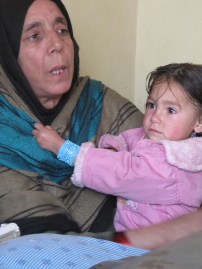
Bibi and her granddaughter.

Kabul – Bibi Sadia and her husband Baba share a humble home with their son, his wife and their two little children. An Afghan human rights advocate suggested that we listen to Bibi’s stories and learn more about how a Pashto family has tried to survive successive tragedies in Kabul.

Holding her three year old granddaughter in her arms, Bibi adjusted her hijab and launched into a narrative that began during the Soviet occupation.  The mujahideen had asked Baba to bring them medicines two or three times a week for those injured in the war. For each batch of medicines that Baba delivered, the mujahideen paid him a small sum of money. When the Russian occupiers discovered what he was doing, they beat him severely.  After that, the mujahideen accused him of spying for the Russians and they also beat him badly.

The vicious beatings gave him perforated ear drums requiring six operations and left him permanently hard of hearing.

They also left him mentally unsound, so that Bibi became the sole breadwinner for the family.  “During the time of the Taliban,” Bibi tells us with a soft smile, “I used to make bread, wash clothes and reap other people’s wheat to earn a living,” The mujahideen, having ousted Russia’s favored government and its army, were now in power and frowned on women working.  “I used to work by the moonlight, sewing clothes from animal hide”.

Continue reading “Much to Forgive: The Story of Bibi Sadia”

Ten Good Things About a (Not So) Bad Year

by Medea Benjamin

I had the privilege of starting out last year witnessing, firsthand, the unfolding of the Egyptian revolution in Tahrir Square. I saw people who had been muzzled their entire lives, especially women, suddenly discovering their collective voice. Singing, chanting, demanding, creating. And that became the hallmark of entire year–people the world over becoming empowered and emboldened simply by watching each other. Courage, we learned in 2011, is contagious!

1. The Arab Spring protests were so astounding that even Time magazine recognized “The Protester” as Person of the Year. Sparked by Tunisian vendor Mohamed Bouazizi‘sself-immolation to cry out against police corruption in December 2010, the protests swept across the Middle East and North Africa—including Egypt,Libya, Bahrain, Syria, Yemen, Algeria, Iraq, and Jordan. So far, uprisings have toppled Tunesian President Ben Ali, Egyptian President Hosni Mubarak, and Libyan leader  Muammar Gaddafi–with more shake-ups sure to come. And women have been on the front lines of these protests, highlighted recently by the incredibly brave, unprecedented demo of 10,000 Egyptian women protesting military abuse.

Continue reading “Ten Good Things About a (Not So) Bad Year”

Rumsfeld-Era Propaganda Program Whitewashed by Pentagon

by Cyril Mychalejko

This article first appeared at Toward Freedom.

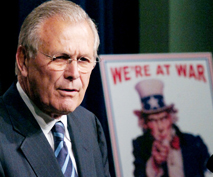
A controversial public relations program run by former Defense Secretary Donald H. Rumsfeld’s Pentagon was cleared of any wrong-doing by the agency’s inspector general in a report published last month. The program used dozens of retired military officers working as analysts on television and radio networks as “surrogates” armed by the Pentagon with “the facts” in order to educate the public about the Department of Defense’s operations and agenda.

At the same time, the report quoted participating analysts who believed that bullet points provided by Rumsfeld’s staff advanced a “political agenda,” that the program’s intent “was to move everyone’s mouth on TV as a sock puppet” and that the program was “a white-level psyop [psychological operations] program to the American people.” It also found a “preponderance of evidence” that one analyst was dismissed from the program for being critical of former Defense Secretary Rumsfeld, while another analysts said a CNN official told him he was being dropped at the request of the White House.

Nevertheless, the inspector general exonerated the Pentagon, stating that it complied with Department of Defense (DoD) policies and regulations, including not using propaganda on the US public, while also claiming that retired military analysts, many of whom were affiliated with defense contractors, gained nothing financially or personally for the businesses they were affiliated with.

The investigation was requested by Congress after the New York Times published a story revealing the Pentagon’s public relations program, “Behind TV Analysts, Pentagon’s Hidden Hand” (04/20/2008), which was subsequently awarded a Pulitzer Prize for Investigative Reporting. The article showed how these analysts, many of whom had ties to military contractors, were used to help sell the war in Iraq, to push other Bush Administration foreign policy “themes and messages” and to act as a rapid response team to counter criticisms in the media. One official Department of Defense talking points document released while the Bush Administration was still trying to sell the need for a war with Iraq to the public states, “We know that Saddam has weapons of mass destruction.”

Continue reading “Rumsfeld-Era Propaganda Program Whitewashed by Pentagon”

Robot Wars

Al Jazeera’s excellent Fault Lines return with an investigation into the use of unmanned military technologies.

Over the past decade, the US military has shifted the way it fights its wars, deploying more unmanned systems in the battlefield than ever before. Today there are more than 7,000 drones and 12,000 ground robots in use by all branches of the military.

These systems mean less American deaths. They also mean less political risk for the US when it takes acts of lethal force — often outside of official war zones.

But US lethal drone strikes in countries like Pakistan have brought up serious questions about the legal and political implications of using these systems.

Fault Lines looks at how these new weapons of choice are allowing the US to stretch the international laws of war and what it could mean when more and more autonomy is developed for these lethal machines.

Window To My City

By Feroz Rather

Illustration by Showkat, a Srinagar-based painter and artist

By the River Jhelum, my window opens into the city of Srinagar at noon. It is a trellis window. Its wooden motifs are rhomboidal, our patient improvisations of what they were, many centuries ago, in Samarkand. Over the soldiers’ sand-bagged bunker and the tangles of wire, over the roof shingles of houseboats moored in the muddy water, it overlooks a road, dusty and strewn with stones, busy with life, the leisurely passage of buses.

The window fills with the clamor of the city centre, Lal Chowk, from the rear: honking of cars, shouts of bus conductors, of vendors selling lotus stems and water nuts, the jingle of bangles on the arms of women, hobnobbing of old men, whistles of the policemen on prowl. It listens in the songs of Habeh Khuton, sad and reminiscent of the color of saffron from Pamper from the corner where you find late poems of Azad, fresh copies of Curfewed Night, fake pieces of Bombay music.

Continue reading “Window To My City”

“America’s Chickens Are Coming Home to Roost.”

An end of the year lament.

by William A. Cook

“Violence begets violence. Hatred begets hatred. And terrorism begets terrorism. A white ambassador said that y’all, not a black militant (Ambassador to Iraq, Edward Peck). Not a reverend who preaches about racism. An ambassador whose eyes are wide open and who is trying to get us to wake up and move away from this dangerous precipice upon which we are now poised…” — Jeremiah Wright, September 16, 2001.

Prophets fare poorly in their own country, yet countries would do well to hearken to their prophets. Scorn, ridicule, and innuendo attend their pronouncements as the righteous defend their actions as logical, existential and necessary. Jeremiah Wright suffered such scorn and mockery because he understood the consequences of revenge on the innocent and the defenceless, justified by whatever inane discourse. Wright spoke truth to power that Sunday after 9/11 and the righteous cried to heaven condemning him to perdition for defaming America, for even suggesting that revenge for the sake of revenge is the motivation of the arch fiend against the Almighty, the foulest, most ignorant, most amoral rational for action.

Prophets anticipate truth; they review a nation’s past history and can predict its future. Witness America’s past as the Reverend Wright did that Sunday morning, and what America is doing now repeats its ugliness. Wright said this about America’s past:
Continue reading ““America’s Chickens Are Coming Home to Roost.””

Punishing the whistleblower?

As Bradley Manning faces charges of espionage over the Wikileaks cables Inside Story Americas asks if the US government is overreacting.

Bradley Manning, a private in the US army, has been accused of perpetrating the biggest intelligence leak in US history.

Now a military judge is trying to determine whether Manning should face a court martial. He could face as many as 22 specific allegations in the charges that include aiding the enemy and espionage.
Continue reading “Punishing the whistleblower?”