The Axis of Islamophobia

Max Blumenthal discusses his must read article The Great Islamophobic Crusade. Here’s an excerpt:

Little of recent American Islamophobia (with a strong emphasis on the “phobia”) is sheer happenstance. Years before Tea Party shock troops massed for angry protests outside the proposed site of an Islamic community center in lower Manhattan, representatives of the Israel lobby and the Jewish-American establishment launched a campaign against pro-Palestinian campus activism that would prove a seedbed for everything to come. That campaign quickly — and perhaps predictably — morphed into a series of crusades against mosques and Islamic schools which, in turn, attracted an assortment of shady but exceptionally energetic militants into the network’s ranks.

Besides providing the initial energy for the Islamophobic crusade, conservative elements from within the pro-Israel lobby bankrolled the network’s apparatus, enabling it to influence the national debate. One philanthropist in particular has provided the beneficence to propel the campaign ahead. He is a little-known Los Angeles-area software security entrepreneur named Aubrey Chernick, who operates out of a security consulting firm blandly named the National Center for Crisis and Continuity Coordination. A former trustee of the Washington Institute for Near East Policy, which has served as a think tank for the American Israeli Public Affairs Committee (AIPAC), a frontline lobbying group for Israel, Chernick is said to be worth $750 million.

You can read the rest of this excellent article at Max’s website.
Frost/Assange

The WikiLeaks founder talks about secrets, leaks and why he will not go back to Sweden.

The Crisis of Islamic Civilization

Ali Allawi on his book The Crisis of Islamic Civilization. (see Robin’s review)

The Carnegie Council is the world’s leading voice promoting ethical leadership on issues of war, peace and global social justice. Its mission is to be the voice for ethics in international policy.

Transcript:

Thank you very much, Joanne, and good morning, ladies and gentlemen. I had really two choices. One was to try to summarize Islamic civilization in half an hour, or to discuss this more in a personal way and a personal capacity which I thought might be interesting at such an early hour. I’ve called my talk, “In Search of Islam’s Civilization.”

I was born into a mildly observant Muslim family in Iraq. The 1950s in the Middle East and the broader Islamic world were a time when the secular elements of society, the ruling political class, and cultural and intellectual feats had moved far from an overt identification with Islam. It appeared then to be only a matter of time before Islam would lose whatever hold it may have still had on the peoples and societies of the Muslim world.

Continue reading “The Crisis of Islamic Civilization”

The Death of the Liberal Class

Chris Hedges discusses his new book The Death of the Liberal Class. The Q&A is over the fold. Produced by The Sanctuary for Independent Media in Troy NY, this event was co-sponsored by Bethlehem Neighbors for Peace.

Continue reading “The Death of the Liberal Class”

Deck London’s Walls II

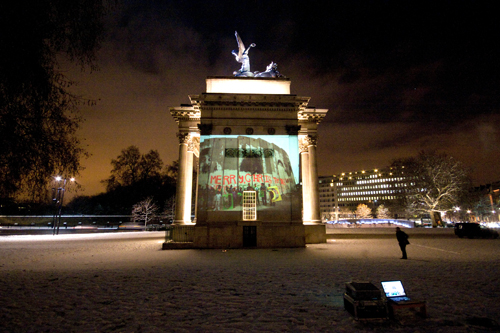
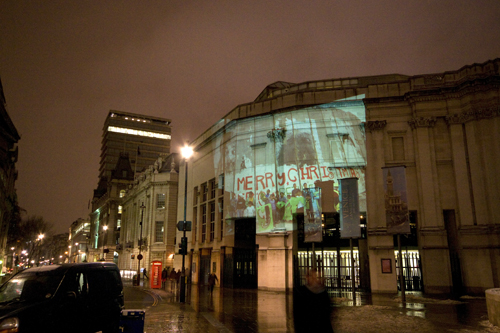
Yesterday we wrote about photojournalist William Parry’s Christmastime project in London: projecting images of Israel’s apartheid wall in Bethlehem onto monuments and buildings in the British capital.

The goal, says Parry, is to “provide a stark political backdrop to the frantic Christmas shopping rush, to remind Britain and the West that Israel’s illegal occupation and separation wall are strangling Bethlehem – and Palestine – the birthplace of Christ and Christmas.”

The images used in the projections are primarily of Palestinian children from the Aida refugee camp who have decorated a portion of the wall with a Christmas message to the world. Click here for yesterday’s overview of the project and to see the original images taken by Parry in Bethlehem.

Over the fold are pictures from last night’s projections at Marble Arch, the National Portrait Gallery, and Parliament, where Parry reports his group was nearly arrested.

Continue reading “Deck London’s Walls II”

Deck London’s Walls with Bethlehem’s Calls

Image of Israeli separation wall in Bethlehem projected onto London monument

Two dozen children, aged 5-17, from the Aida refugee camp in Bethlehem, cut out stencils of letters, stars and Christmas trees and sprayed painted ‘MERRY CHRISTMAS WORLD FROM BETHLEHEM GHETTO’ on Israel’s illegal separation wall. Photographed by UK-based photojournalist William Parry, images of the children and their message – along with powerful images of checkpoints and life under occupation – will temporarily ‘hijack’ prominent wall spaces in central London throughout the week leading up to Christmas, with the help of projection artist, Beverley Carpenter. (photographs of Bethlehem and of the projection project in London can be found over the fold!)

Says Parry:

The idea is to provide a stark political backdrop to the frantic Christmas shopping rush, to remind Britain and the West that Israel’s illegal occupation and separation wall are strangling Bethlehem – and Palestine – the birthplace of Christ and Christmas. We’re bringing the reality of Bethlehem to London this Christmas.

The children who painted the message on the wall are third and fourth generation refugees, at risk of being made refugees again because of the wall’s devastating impact. We are complicit in suspending their rights to justice and freedom through our governments’ biased support of Israel.”

Continue reading “Deck London’s Walls with Bethlehem’s Calls”

The French in Algeria

The French in Algeria pioneered many of the torture techniques that were subsequently used in Vietnam, Iraq and Afghanistan. French ‘counterinsurgency’ specialists, who had already fought the Vietnamese, trained American soldiers and interrogators throughout the 1960s.

Al Jazeera examines the bitterness still provoked by France’s colonial war in Algeria and how it fuels resentment between France and its Muslim community.

War in the Borderlands

Derek Gregory is professor of geography at the University of British Columbia, and author of excellent The Colonial Present: Afghanistan, Palestine, and Iraq. He discusses the evolving character of conflicts in the borderlands of former empires and the blurring of the conceptual borders of war itself.

Rainer Maria Rilke’s ‘Inner Sky’


Rilke's Damion Searls discusses the poetry of Rainer Maria Rilke with Christopher Lydon on Brown University’s Radio Open Source. Often bracketed with Yeats at the pinnacle of European poetry in the 20th Century, Rilke makes an even better pair with Walt Whitman as the irresistible great poet for everyone. In his essay ‘Looking for Rilke’ (in Stephen Mitchell’s Selected Poetry of Rainer Maria Rilke) Robert Hass relates:

When Rilke was dying in 1926 — of a rare and particularly agonizing blood disease — he received a letter from the young Russian poet Marina Tsvetayeva. “You are not the poet I love most,” she wrote to him. “‘Most’ already implies comparison. You are poetry itself.”

From The Inner Sky, “poems, notes, dreams” that Damion Searls has selected and translated, we are reading Rilke fragments that can make one gasp on a first hearing. I like specially, for example, these “Notes on the Melody of Things,” which snuck up on me six weeks ago and induced just the sort of trance Robert Hass recounts.