Howl

Allen Ginsberg on Pacifica Radio radio reading his banned poem “Howl” followed by a discussion with publisher Lawrence Ferlinghetti.

An interview with graphic artist Eric Drooker who has produced a graphic novel based on his friend Allen Ginsberg’s “Howl”. The full text of the poem is over the fold.

Download program audio (mp3, 47.85 Mbytes)

Few poems have been as celebrated or reviled as Allen Ginsberg’s ‘Howl,’ which was penned in Berkeley at the height of the Cold War, andwas the subject of a famous obscenity trial against publisher Lawrence Ferlinghetti. Renowned painter and graphic novelist Eric Drooker speaks about his friend Allen Ginsberg, whose poem he has animated, and discusses why ‘Howl’ still can’t be read in full on the radio today.

Allen Ginsberg and Eric Drooker, Howl: A Graphic Novel Harper Perennial, 2010
Continue reading “Howl”

Tea party, Big money, Twisted maps

Al Jazeera: Ahead of the US midterm elections, Fault Lines presenter Avi Lewis travels to Nevada and Florida — two states gripped by political division and economic uncertainty.

“War does this to your mind”

by Kathy Kelly

Editor’s Note: American peace activists Kathy Kelly, Jerica Arents and David Smith-Ferri are part of a 3 person delegation currently travelling in Afghanistan. Find more entries from their travelogues on PULSE.

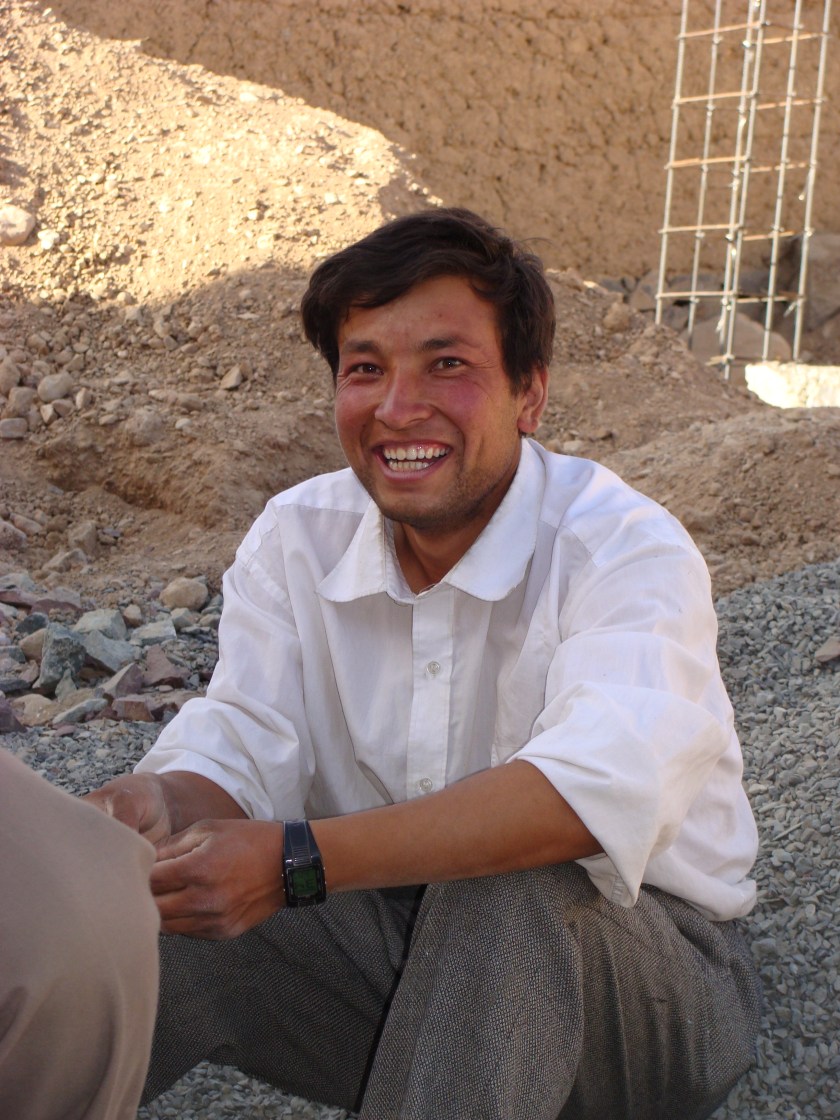
Khamad Jan at a construction site in Bamiyan, Afghanistan

Kabul– Khamad Jan, age 22, remembers that, as a youngster, he was a good student who enjoyed studying.  “Now, I can’t seem to think,” he said sadly, looking at the ground.  There was a long pause. “War does this to your mind.”

He and his family fled their village when Taliban forces began to attack the area. Bamiyan Province is home to a great number of Hazara families, and Khamad Jan’s is one of them. Traditionally, other Afghan ethnic groups have discriminated against Hazaras, regarding them as descendants of Mongolian tribes and therefore inferior.

During the Taliban attacks, Khamad Jan’s father was captured and killed.  As the eldest, Khamad Jan bore responsibility to help provide for his mother, two brothers and two sisters. But he struggled with debilitating depression, so much so that villagers, anxious to help, talked of exorcism. One day, he said he felt ready to give up on life.  Fortunately, community members and his friends in a local youth group, the “Afghan Youth Peace Volunteers,” have helped him come to terms with the pain he feels, assuring him that he can find a meaningful future.

Khamad Jan’s village is a particularly hard place in which to build houses, roads or farms. He and his family own a small plot of land which produces potatoes and wheat. The family works hard, but they only grow enough to feed themselves for seven months of the year. For a few months of every year, they must depend heavily on bread and potatoes, a carbo-diet which leads to malnutrition.  Like other women in the village, Khamad Jan’s mother and sisters are chronically anemic, suffering from headaches and leg cramps.

Continue reading ““War does this to your mind””

Bamiyan Diaries – Day Two

by David Smith-Ferri

Editor’s Note: American peace activists Kathy Kelly, Jerica Arents and David Smith-Ferri are part of a 3 person delegation currently travelling in Afghanistan. Read Smith-Ferri’s first piece on their experiences here.

Building Bamiyan Peace Park

The city of Bamiyan, with a population of roughly 60,000, has only one paved street, a wide, two-kilometer road without lanes that is a site of constant activity from 5 a.m. to curfew, at 10 p.m., and is referred to as the “Bazaar” because it is lined on both sides with shops.

In our short time here, we’ve been struck by how hard people, both in town and in the outlying villages, have to work to make a meager living. Children clearly work hard, too, seeming to participate fully in the livelihood of the family. At almost anytime of the day they can be seen at all manner of enterprise – helping set up the family street stall early in the morning, riding a donkey to fetch water in five-gallon plastic jugs, helping harvest potatoes, herding sheep or goats, collecting leaves for fuel, washing clothes in a creek, caring for younger siblings; and of course, they also attend school. Their work is as much a part of the landscape as the cottonwood trees and the red-rock cliffs which stand above the rivers.

Having had a chance to talk with members of the Afghan Youth Peace Volunteers (AYPV) and learn something about their significant commitments to home, family, and school, it was with delight and astonishment that we visited Bamiyan Peace Park today with nine proud members of the group and learned about their role in its development and use.

Continue reading “Bamiyan Diaries – Day Two”

Bamiyan Diaries – Day One

by David Smith-Ferri

Editor’s Note: American peace activists Kathy Kelly, Jerica Arents and David Smith-Ferri are part of a 3 person delegation currently travelling in Afghanistan. This is Smith-Ferri’s article written about their first day in Bamiyan province.

Bamiyan Province in Afghanistan, a stunningly beautiful mountainous region, is located in the center of the country, roughly 100 miles from Kabul. Most people here live in small, autonomous villages tucked into high mountain valleys, and work dawn to dusk just to scratch out a meager living as subsistence farmers, shepherds, or goatherds. The central government in Kabul and the regional government in Bamiyan City exercise little or no control over their lives. They govern themselves, and live for the most part in isolation.

Given this, who would imagine that Afghan youth from small villages across Bamiyan Province would come together to form a tight-knit, resilient, and effective group of peace activists, with a growing network of contacts and support that includes youth in other parts of the country and peace activists in the U.S. and in Palestine? I certainly wouldn’t have. In the United States, we may find it hard to believe that anything good can actually come out of Afghanistan, or we may have fallen into a trap of thinking that Afghans cannot accomplish anything useful without foreign aid and assistance. I confess that I struggle to live outside the shadow of this narrow-mindedness and ethno-centrism. Certainly, if the scope of our imaginations is limited by CNN and Fox News, we would not be likely to imagine an indigenous peace group forming in Bamiyan Province. But this is exactly what has happened.

Calling themselves the Afghan Youth Peace Volunteers (AYPV), they range in age from eight to twenty, and they have been active for over two years, translating their camaraderie and the horror of their families’ experience of war and displacement into a passionate and active pacifism. At an invitation from AYPV, three American peace activists from Voices for Creative Nonviolence have arrived in Bamiyan for five days to build bridges of friendship and support with these youth and their families. Over this time, we will write a daily diary of our experiences and interactions with the Afghan Youth Peace Volunteers.

Continue reading “Bamiyan Diaries – Day One”

The Elephant in the Room

by Larbi Sadiki — An Al Jazeera Excerpt

Excluding Hamas from current and future Palestinian-Israeli peace negotiations is an exercise in futility.

Sidelining Hamas in any process to craft genuine peace between Israelis and Palestinians is a glaring omission tantamount to ignoring an elephant in the room. Whether it is Obama’s or the UN’s negotiating room, pretending something of that size absent is an exercise in futility. Hamas is definitely an elephant with many tales. Telling some of these tales recounts the Islamist movement’s rise to power against all odds.

A movement under ‘siege’

Like Hezbollah in Lebanon, Hamas exists in a world that does not want it and in which it is ‘wanted’, a world some might argue it does not also want. It is lumped with the bogeymen and ‘demons’ of world politics on whom are blamed ‘terror’ and the state of ‘structured chaos’ in the Middle East, Pakistan, and Afghanistan, amongst other hotspots. Hamas is no angel and there are no angels in politics. Indeed, part of the problem lies not only in the political strategies Hamas occasionally deploys, but also in the excessive secrecy surrounding most of the movement’s activities.

Continue reading “The Elephant in the Room”

The collapse of American journalism

Media scholar Robert W. McChesney lectures on the collapse of American journalism at the University of Illinois YMCA on October 24th, 2010. Listen as Bob discusses the political implications and his solutions to the crisis. Sunday, 1pm central on Media Matters with Bob McChesney.

The lecture begins at 6:00.

Download mp3.

Susan Abulhawa v. Alan Dershowitz: Novel Approaches

Palestinian author Susan Abulhawa, whose debut novel, Mornings in Jenin, is an international sensation, confronts Zionist bully Alan Dershowitz, known for fictions of a different variety, at the Boston Book Festival. The discussion is moderated by Director of the Harvard Negotiation project, James Sebenius and sponsored by the Jewish Community Centers of Greater Boston.

Breaking the Silence

Israel’s Channel 10 shows excerpts from Hagai Levi’s documentary about the wonderful folks behind Breaking the Silence.

Pakistan’s Food Crisis Expected to Worsen

by Aun Ali

Pakistan’s massive floods destroyed not only standing crops of the season but also vast proportions of arable land and capacities of numerous farmers to cultivate crops in the upcoming seasons. The consequences are far reaching for an impoverished country that relies heavily on its agricultural productivity and employs two-thirds of its population in this sector.

Nearly 20 million people have been directly affected, most of whom are from the rural agricultural areas and depend on agriculture to meet their food and income needs. A great number of them have been uprooted from their lands, with their household assets, investments in farm tools and animals, and food stocks all destroyed by the floods. Submerged roads and fallen bridges have disconnected access of thousands other to the rest of Pakistan. They all lack proper shelter, food, clean water, medicine, and other basic supplies. At least six million are at risk of waterborne diseases, including an estimated 3.5 million children according to U.N.

However, if the situation is terribly bad now, the worst is yet to come.

With major crops damaged or destroyed over 3.6 million hectares of cultivated land and variable food supply expected from the unaffected regions, a famine-like food crisis is imminent in many parts of the country that could be in full swing by coming spring when Pakistan’s current food stocks will start to run out. The shockwaves will be so far reaching that even the unaffected regions will not be spared.

Continue reading “Pakistan’s Food Crisis Expected to Worsen”