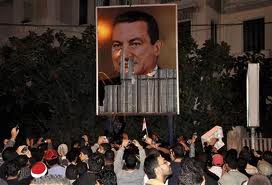
Egyptian Blogger Sandmonkey will Continue on Despite Brutality

by Dennis Bernstein

To call the ongoing people’s revolts in Tunisia and Egypt FaceBook revolutions is certainly overstating the case.

In both countries, the time was ripe for revolution and social upheaval. Poverty, repression and hopelessness were enforced by greedy U.S.-supported despots who were deaf to the needs of their people.

But there is little doubt that the recent street-protest revolts in Tunis and Cairo were assisted by new social media: Facebookers, tweeters and a new generation of Internet bloggers.

In Egypt, the blogosphere  has been on fire with young activists planning meetings, sharing information, planning actions and sending emergency messages about government attacks.

Mahmoud Salem, known in the blogosphere, as “Sandmonkey,” is among the most famous and savvy young Egyptian bloggers, now working at the edges of Liberation Square.

Sandmonkey, who describes himself as “a pro-democracy, free-speech, women’s rights activist,” has been blogging since 2004. His blog is now read around the world and has become part of an alternative information flow, carrying the message from the street to the 24-hour-a-day rush hour on the information super-highway.

What Sandmonkey’s blogging had helped bring about was brought home to him this week when he moved from the blogosphere to Liberation Square where hundreds of thousands of demonstrators have been demanding that longtime dictator Hosni Mubarak resign.

Continue reading “Egyptian Blogger Sandmonkey will Continue on Despite Brutality”
Democracy in the Arab world?

The protests that overthrew half a century of autocratic rule in Tunisia are spreading. The governments of Egypt, Algeria, and Yemen are feeling the wrath of decades of repression as people take to the streets and demand freedom.

Revolution In The Head And The Art Of Protest

A documentary about Rage Against The Machine by See of Sound.

Arguably the most provocative band of the last 20 years, Rage Against The Machine have since their explosive debut, been the group most associated with the American protest movement. This film dissects the work and career of RATM and looks at their place in this always fascinating lineage of artists and performers who have spoken out on behalf of, and drawn attention to, the world’s marginalised, downtrodden and oppressed. Picking up the flame from a linear musical tradition going back to the War Of Independence, with the best known protagonists coming up during the 1950s and 60s civil rights movement via artists such as Pete Segar and the young Bob Dylan, the anger remained as brutal as ever during the final decade of the 20th Century in Rage and contemporaries like Public Enemy. FEATURING: Brand new interviews with; renowned Rage producer and engineer, Garth Richardson; RATM Biographer, Colin Devenish; the band’s live sound engineer, Dave ‘Rat’ Levine and the man who signed them Michael Goldstone. With further contributions from folk-protest singer and author Jerry Silverman, ex-‘Rolling Stone’ editor Joe Levy, and Professor of American Studies and English at Washington State University, T.V. Reed.

Zizek and Ramadan on future of Egypt

Zizek is in fine form on the Riz Khan Show. In a recent op-ed he noted that

the most shameful and dangerously opportunistic reaction was that of Tony Blair as reported on CNN: change is necessary, but it should be a stable change. Stable change in Egypt today can mean only a compromise with the Mubarak forces by way of slightly enlarging the ruling circle. This is why to talk about peaceful transition now is an obscenity: by squashing the opposition, Mubarak himself made this impossible. After Mubarak sent the army against the protesters, the choice became clear: either a cosmetic change in which something changes so that everything stays the same, or a true break.

The revolutionary chants on the streets of Egypt have resonated around the world, but with a popular uprising without a clear direction and an unpopular leader refusing to concede, Egypt’s future hangs in the balance. Riz Khan talks to Muslim scholar Tariq Ramadan and Slovenian philosopher Slavoj Zizek about the power of popular dissent, the limits of peaceful protest and the future of Egyptian politics.

Egyptian Riot Grrls: Finding the Feminine Face of Fury

by Beenish Ahmed

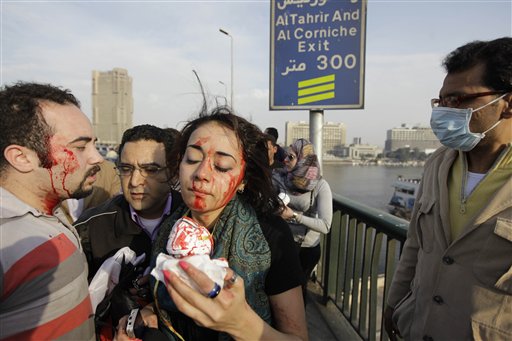
(AP Photo/Ben Curtis)

Much has been aflutter on twitter about the very visible presence of women among the protests that have taken Egypt by storm over the last few weeks, but images of them have remained sparse amid the digital slideshows strung together by major media outlets, portraying mainly dense crowds of the manly.

What falls within these frames does not necessarily paint a full picture, since as Egyptian Organization for Human Rights activist Ghada Shahbandar claims, the crowd in downtown Cairo is up to 20 percent female. Others have put the number much higher, at 50 percent.

Although they are less prevalent, some efforts have been made to depict the role of women this popular uprising. The Global Post put together a slideshow on the Women of Egypt among the March of Millions in Tahrir Square, and a compilation of photographs from various sources can be found on sawt al niswa, a self-described “feminist webspace.”

A quick look through the reels of these images reveals the feminine side of fury and eliminates any remaining shred of doubt that the issues of unemployment and corruption that are widely cited as the primary causes for this unrest effect only men.

Continue reading “Egyptian Riot Grrls: Finding the Feminine Face of Fury”

New York Times slimes on Julian Assange

Bill Keller of the New York Times accuses Wikileaks of engaging in ‘anti-war propaganda’. Of course that is something that the august ‘paper of record’ would never do. It only engages in pro-war propaganda. Check out the kind of things Keller was writing in the lead up to the Iraq war.

Phenomenons otherwise known as Julian Assange and WikiLeaks have – no doubt – turned world politics and journalism, upside-down. Maybe that’s why the New York Times was among the first US Media outlets to begin working with Assange last year, securing scoops on classified US Government documents obtained by WikiLeaks. Six months later, the relationship has soured and the Times is looking to profit from it by publishing a critical tell-all book about the source that they once relied on.

Reflections on Nuclear Power

October 1979: Riot police stand behind the blockaded front gate of Seabrook, NH nuclear plant during an anti-nuclear protest by the Coalition for Direct Action (Photo: Ken Kelley)

by Ken Kelley

It seems unimaginable, several decades after accidents at Three Mile Island and Chernobyl, to hear people like President Obama tout nuclear power as a clean source of energy. Obama announced $8 billion in taxpayer subsidies last year to build two reactors in Georgia, despite the fact that—from the mining of uranium to the unresolved issue of disposal of highly toxic radioactive waste—nuclear power is the most environmentally dangerous way of generating electricity.

While the Georgia reactors will be the first built in the U.S. since the 1970s, there are over 60 new nuclear plants under construction worldwide, mostly in Asian countries like China, India, and South Korea. Talk of a “nuclear renaissance”as if it were some kind of cultural reawakening—has brought me back to the heyday of the anti-nuclear movement in the late 1970s, when it seemed that the industry was on the ropes and that nuclear power would soon be a thing of the past, leaving only its toxic legacy for future generations to deal with.

I remember one late afternoon on a hot spring day in 1977, as I waited with other members of the Clamshell Alliance to be arrested for the third occupation of the construction site at the Seabrook nuclear power plant in New Hampshire.  At dusk, a state trooper led me on to a school bus, packed with chanting protestors.

Continue reading “Reflections on Nuclear Power”

People Power in the Middle East

M. Shahid Alam

From his weekly perch at CNN, Fareed Zakaria, speculated last Sunday (or the Sunday before) whether George Bush could take credit for the events that were unfolding in Tunisia, whether this was the late fruit of the neoconservative project to bring ‘democracy’ to the Middle East.

It is quite extraordinary watching Zakaria – a Muslim born and raised in India, and scion of a leading political family – mimic with such facility the language of America’s ruling classes, and show scarce a trace of empathy for the world’s oppressed, despite his propinquity to them by reason of history and geography. He does have a bias for India, but here too he only shows a concern for India’s strategic interests, not the interests of its subjugated classes, minorities and ethnicities. This I offer only as an aside about how easy it is for members of the upper classes in countries like India, Pakistan or Egypt to slip into an American skin whenever that dissimulation offers greater personal advantages.

As a cover for deepening US control over the Middle East – here is the latest civilizing mission for you – the neoconservatives in the Bush administration argued that the Islamic world produces ‘terrorists’ because it lives under autocracies. To solve the ‘terrorist’ problem, therefore, the US would have to bring democracy to the Middle East. This demagoguery only reveals the bankruptcy of America’s political class. It is a shame when the President of the United States and his neoconservative puppet-masters peddle such absurdities without being greeted by squeals of laughter – and shouted down as hypocritical, as farcical.

Who has been the leading ally and sponsor these past decades of nearly all the despotisms in the Middle East – those of royal pedigree and others seeking to become royalties?

Regardless, the real plan of United States failed miserably. It was dispatched to its grave by a people’s resistance in Iraq, Afghanistan and Pakistan.

Continue reading “People Power in the Middle East”

Egypt Awakes

UPDATE: See Al Jazeera’s reports below and read Ahmed Moor (who recorded the video below)’s account of today’s events at MondoWeiss.

Led by what appears to be a girl and a boy, a group of Egyptian protesters chase the riot police.

Helena Cobban of Just World News asks if the Arab world is finally waking from 40-year sleep:

In Egypt, the long-entrenched, US-backed-to-the-repressive-hilt Mubarak regime is facing one of the most serious challenges yet to its control.In Tunisia, the long-entrenched, strongly US-backed Ben Ali regime is history, and citizens on the streets and in their gathering places are right now determining how their country will governed in the future.

Continue reading “Egypt Awakes”