Two Palestinians violently arrested- one of them from his house- in a nonviolent demo in al-walaje that was met with stun and tear gas grenades and direct violence from the Israeli Army including rock throwing.
Escalating criticism of Israel led its security establishment to declare a pr war on “delegitimization” (more excellent reports by Lia Tarachansky here).
After Israel’s major attack on Gaza in December 2008, it has faced criticism around the world. This criticism escalated after the publication of the Goldstone Report in 2009 that found evidence of war crimes in the attack. This year, Israel’s security establishment declared a full out PR war on criticism that it identifies as “delegitimization” of Israel. Israel’s most influential think tank, the Reut Institute, developed the strategy for how to fight this PR war. It published a massive report in preparation for this year’s Herzeliya conference entitled “Building a political firewall: against Israel’s delegitimization” which advocated that the Israeli intelligence agencies establish special units to collect information on critics of Israel. The report also advocates the establishment of pro-Israel networks in “hubs of delegitimization” which it named as London, Paris, Madrid, Toronto, and the Bay Area. The Real News’ Lia Tarachansky spoke to Morton A. Klein, the president of the Zionist Organization of America who talks about how American lobby groups help Israel fight its PR war.
AL-ARAKIB, ISRAEL — On July 26, Israeli police demolished 45 buildings in the unrecognized Bedouin village of al-Arakib, razing the entire village to the ground to make way for a Jewish National Fund forest. The destruction was part of a larger project to force the Bedouin community of the Negev away from their ancestral lands and into seven Indian reservation-style communities the Israeli government has constructed for them. The land will then beopen for Jewish settlers, including young couples in the army and those who may someday be evacuated from the West Bank after a peace treaty is signed. For now, the Israeli government intends to uproot as many villages as possible and erase them from the map by establishing “facts on the ground” in the form of JNF forests. (See video of of al-Arakib’s demolition here).
Moments before the destruction of the Bedouin village of al-Arakib, Israeli high school age police volunteers lounge on furniture taken from a family’s home. [The following four photos are by Ata Abu Madyam of Arab Negev News.
Moments before the destruction of the Bedouin village of al-Arakib, Israeli high school age police volunteers lounge on furniture taken from a family's home. (The following four photos are by Ata Abu Madyam of Arab Negev News.)
One of the most troubling aspects of the destruction of al-Arakib was a report by CNN that the hundreds of Israeli riot police who stormed the village were accompanied by “busloads of cheering civilians.” Who were these civilians and why didn’t CNN or any outlet investigate further?
I traveled to al-Arakib yesterday with a delegation from Ta’ayush, an Israeli group that promotes a joint Arab-Jewish struggle against the occupation. The activists spent the day preparing games and activities for the village’s traumatized children, helping the villagers replace their uprooted olive groves, and assisting in the reconstruction of their demolished homes. In a massive makeshift tent where many of al-Arakib’s residents now sleep, I interviewed village leaders about the identity of the cheering civilians. Each one confirmed the presence of the civilians, describing how they celebrated the demolitions. As I compiled details, the story grew increasingly horrific. After interviewing more than a half dozen elders of the village, I was able to finally identify the civilians in question. What I discovered was more disturbing than I had imagined.
Amanda Klonsky has informed PULSE that Yonatan Shapira has sent the following account of events unfolding at the Kirresh family home in the Muslim Quarter in Jerusalem. Settlers from the fanatical group Ateret Cohanim have taken over the home of a Palestinian family of more than 50 people. The Settlers are being protected by Israeli police, who guard the door while the Kirresh family sits outside in the street with no protection.
It is close to midnight and I am standing outside on a narrow street in the Muslim Quarter, very close to Herod’s Gate. We are standing in front of a very big house on As-Sadyya Street. The Kirresh family has lived in this house for seventy-four years. Close to fifty people live in the apartments inside this two or three story house.
Last night the Kirresh family went to a cousin’s wedding in East Jerusalem. They came back from the wedding and found out that Settlers from Ateret Cohanim had come with the police and taken over their house. About thirty young male Settlers are in the house, and it is completely occupied by them, except for one apartment that is still being held by the one family member who just didn’t go to the wedding. That family member is still inside the house, in his room! The Settlers are in the other rooms– it’s a big house, maybe two or three floors, and they are just walking around inside, sitting around and singing, as if all these Palestinian people were not outside looking at them.
The whole atmosphere is like theater- it’s a beautiful street, the houses are built of stone, it’s so old and majestic. And the police are guarding the door, making sure that the Settlers can continue to stay in the house. Standing close to the door, I overheard the conversation between a police officer and Settler inside the house. I heard the police officer saying to one of the Settlers, ‘We are on your side, we are here to protect you.’
Aside from the Kirresh family, a few members of the International Solidarity Movement (ISM) and Israeli BDS activists joined in standing witness outside the house. People are sitting on chairs, leaning on the walls out in the street. A child is sleeping under a blanket here next to me, and there are women and babies. They are all waiting for a court decision. Basically, the Settlers came and literally stole the house, and now the place is being guarded by the police so the residents of the house cannot go in.
On Friday morning, we intend to return with many more activists, to support the Kirresh family in regaining their home.
We are living in Palestine. Our history, our culture, our everything is Palestinian. — Mahmoud Jreri of DAM
Photo: Marilyn Donahue
“I see myself as a fisherman,” says Suhell Nafar, a member of DAM, the leading Palestinian hip-hop group. “Today, I fished a few fish who didn’t know anything and now know a little thing. Maybe now when they see the TV news, they will think differently about it. Maybe they will go on the Internet and learn about it.”
Suhell was speaking at last weekend’s WOMAD music festival, minutes after DAM had given a passionate performance in front of a big crowd. “There were thousands of people at the concert screaming ‘Free Palestine’. Most of them have never heard about Palestine, and now they know something.”
Hip-hop has been one of the Palestinians’ most effective communication vehicles in recent years. While conventional messages are often drowned out, groups like DAM have been able to reach several new audiences at home and abroad, including the young. The group is not only popular among Palestinians on the West Bank and Gaza, but also in their native Israel, where they have a following among some Jewish-Israelis. Since forming in 1999, they’ve toured several times in Europe and the US, appeared in the Sundance-nominated film Slingshot Hip-Hop, and received exposure in US and European media, including on CNN and in Time.
On 27 July 2010, Julian Assange of WikiLeaks spoke at the Frontline Club about the impact of the documents that were released in partnership with The Guardian, the New York Times and German paper Der Spiegel which chronicle in minute detail US military operations between 2004 and late 2009. He also gave a practical demonstration of how journalists and citizens can make use of the vast amount of data available online.
For unlucky residents of the Gulf States, the BP oil-spill disaster, coming up on 100 days, could take another turn for the worst if one of the storms churning up tropical waters in the Atlantic Ocean blossoms into a full-blown hurricane and heads into the Gulf of Mexico.
For several already marginalized Native tribes living on the Louisiana Coast – many of them fishermen and shrimpers – a hurricane crashing through the oil-polluted Gulf now could destroy a way of life that has survived for centuries.
Already, the tribal land among the coastal bayous is disappearing faster than anywhere on the planet, the victim of unbridled oil exploration and dam building projects of the Army Corps of Engineers dating back to the 1930s.
“For us it’s more like a hundred years of oil disasters than a hundred days,” said Chief Charles Verdin of the Pointe au Chien tribe. “And really when you look at it … it’s business as usual. The tribes being ignored, forgotten, overlooked, and forced from their land.”
At the United National Peace Conference that took place this weekend in Albany, Ralph Poynter, the husband of imprisoned activist lawyer Lynne Stewart and coordinator of her defense committee, was invited to read his own statement and a letter from his wife about her incarceration, the prison industrial complex, the state of the antiwar movement, and the importance of resisting state oppression.
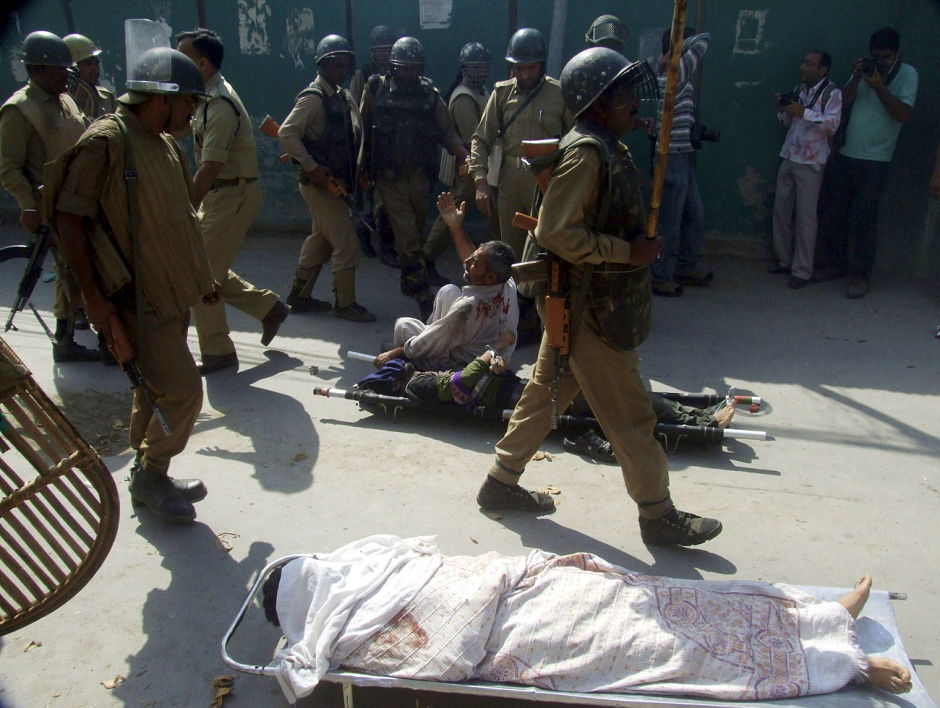
Indian policemen walk past the bodies of Muzaffar Ahmad Bhat and Fayaz Ahmad Wani (front) as they lie on the road after police stopped the funeral procession of the two in Srinagar July 6, 2010. India placed restrictions in parts of its controlled Kashmir on Tuesday and deployed thousands of troops to stop anti-India demonstrations after the death of two youths. Protesters said Fayaz Ahmad Wani and Muzaffar Ahmad Bhat were killed when police took action to stop anti-India demonstrations. (Photo: Umar Ganie/Reuters)
A Kashmiri lawyer rang me last week in an agitated state. Had I heard about the latest tragedies in Kashmir? I had not. He was stunned. So was I when he told me in detail what had been taking place there over the last three weeks. As far as I could see, none of the British daily papers or TV news bulletins had covered the story; after I met him I rescued two emails from Kashmir informing me of the horrors from my spam box. I was truly shamed. The next day I scoured the press again. Nothing. The only story in the Guardian from the paper’s Delhi correspondent – a full half-page – was headlined: ‘Model’s death brings new claims of dark side to India’s fashion industry’. Accompanying the story was a fetching photograph of the ill-fated woman. The deaths of (at that point) 11 young men between the ages of 15 and 27, shot by Indian security forces in Kashmir, weren’t mentioned. Later I discovered that a short report had appeared in the New York Times on 28 June and one the day after in the Guardian; there has been no substantial follow-up. When it comes to reporting crimes committed by states considered friendly to the West, atrocity fatigue rapidly kicks in. A few facts have begun to percolate through, but they are likely to be read in Europe and the US as just another example of Muslims causing trouble, with the Indian security forces merely doing their duty, if in a high-handed fashion. The failure to report on the deaths in Kashmir contrasts strangely with the overheated coverage of even the most minor unrest in Tibet, leave alone Tehran.
On 11 June this year, the Indian paramilitaries known as the Central Reserve Police Force fired tear-gas canisters at demonstrators, who were themselves protesting about earlier killings. One of the canisters hit 17-year-old Tufail Ahmad Mattoo on the head. It blew out his brains. After a photograph was published in the Kashmiri press, thousands defied the police and joined his funeral procession the next day, chanting angry slogans and pledging revenge. The photograph was ignored by the mainstream Indian press and the country’s celebrity-trivia-obsessed TV channels. As I write, the Kashmiri capital, Srinagar, and several other towns are under strict military curfew. Whenever it is lifted, however briefly, young men pour out onto the streets to protest and are greeted with tear gas. In most of the province there has been an effective general strike for more than three weeks. All shops are closed.
Can I tell how much I love peaches?
Not ordinary ones
But those plucked from
The orchards along Jhelum
The ones in the basket before me
Are nebrim for sure
But they blush like a home-grown innocence
And hold as many juicy promises
I wonder what tree bore them
I wonder if it’s wise to ignore them
The tree of life
Has many buried roots
It is said that my only son
Was killed under the canopy
Of the branches of one such tree
By the army
Also known as the security forces
An old joke
What do they secure
These so-called security forces?
Not the people, not our lives, not our liberty
Not our sentiments, nor our emotions, not our sanity
Not our sons who are shot
Nor our daughters who are raped
Not the truth, not the facts, not humanity


 P U L S E