Will the Afghan Surge Succeed?

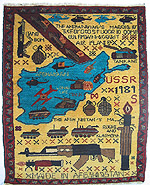
Soviet Exodus War Rug

M. Shahid Alam

More than eight years after dismantling the Taliban, the United States is still mired in Afghanistan. Indeed, last October it launched a much-hyped ‘surge’ to prevent a second Taliban takeover of Afghanistan, not imminent yet, but eminently possible.

The first dismantling of the Taliban was a cakewalk.

In 2001, the United States quickly and decisively defeated the Taliban, killed, captured or scattered their fighters, and handed over the running of Afghanistan to their rivals, mostly Uzbeks and Tajiks from the Northern Alliance.

Unaware of Pashtoon history, American commentators were pleased at the smashing victory of their military, convinced that they had consigned the Taliban to history’s graveyard.

Instead, the Taliban came back from the dead. Within months of their near-total destruction, they had regained morale, regrouped, organized, trained, and returned to fight what they saw as a foreign occupation of their country. Slowly, tenaciously they continued to build on their gains, and by 2008 they were dreaming of taking back the country they had lost in 2001.

Could this really happen? That only time will tell, but prospects for the Taliban today look better than at any time since November 2001.


Continue reading “Will the Afghan Surge Succeed?”

Defamation and Binary Idiocy

by Ali Farzat

To summarise: I have been smeared by a Scottish newspaper. Most of the words they attribute to me I did indeed say, but they have decontextualised and selected to such an extent that they make me say things I do not believe – for instance that September 11th was a good thing, or that the Taliban should take over Afghanistan. What follows is a rather long description of meeting the man from the gutter press, which I hope will set the record a little straighter. Yesterday, meanwhile, 33 civilians were killed by NATO bombs in Afghanistan.

I was doorstepped the other morning. A young man wearing a suit and an apologetic manner wanted to ask some questions on behalf of the Scottish Mail on Sunday.

What? Stumbling down the stairs in my thermal underwear, wild-haired and bestubbled, I dream for a passing moment that I’ve become as important to the world as Tiger Woods or Amy Winehouse. Perhaps even now press vermin are going through my rubbish bin. Perhaps paparazzi are crowding the front garden.

Alas, our aspiring hack, young Oliver Tree (for so he called himself), hasn’t yet graduated to the tabloid heights, and neither have I. It soon becomes clear that his mission is much more mundane, is indeed the everyday grind of papers like the Mail: to create outrage where there was none before, to smear, misrepresent and decontextualise, in order to strangle the possibility of real debate.

Continue reading “Defamation and Binary Idiocy”

Rahimullah Yusufzai on the Taliban, Al-Qaida and the ‘Af-Pak’ theatre

Kudos to The Real News for giving its viewers an opportunity to listen to Rahimullah Yusufzai, the most respected authority on the politics of the Afghanistan-Pakistan frontier. Yusufzai was also among our 20 Top Global Media Figures of 2009.

Capture of leader will not weaken Taliban: Taliban is so strong now they have probably already replaced Baradar


Continue reading “Rahimullah Yusufzai on the Taliban, Al-Qaida and the ‘Af-Pak’ theatre”

Offensive in Marja directed at US public opinion

The reported arrest of Mullah Abdul Ghani Baradar by US forces in cooperation with Pakistan is significant. He was a key member of the Quetta Shura, the central command of the Afghan Taliban. Pakistan sees the Afghan Taliban as a strategic asset in its struggle against regional rivals. It would be odd therefore to hand over such a key figure to US forces. I therefore suspect three possible scenarios: 1) The reported negotiations that Baradar had been conducting with  coalition forces were unauthorized by the shura, and therefore they chose to throw him under the bus with Pakistani cooperation to preempt any possible betrayal; 2) Baradar has already cut a deal and the ‘arrest’ is staged to make his coming in from the cold appear more respectable; 3) Pakistan is trying to signal its indispensability to the Taliban who in recent months had been growing increasingly recalcitrant. Either way, it is unlikely that Baradar’s arrest will do much to diminish the gains that the Taliban have been making in recent year. Here I would also like to recommend one of the best, most comprehensive, books on the Afghan Taliban: Antonio Guistozzi’s Koran, Kalashnikov, and Laptop: The Neo-Taliban Insurgency in Afghanistan 2002-2007.

In related news, one of the world’s finest investigative reporters, Gareth Porter of the Inter Press Service is just back from Afghanistan. He notes that the attack on Marja is meant to prepare Americans to accept negotiations with Taliban.

USA and USSR: Accidental Parallels?

M. Shahid Alam

Cover Image GIFIs the question of parallels between the USA and the USSR idle, even mischievous? Perhaps, it is neither, but, on the contrary, deserves our serious consideration.

During the Cold War, the USA and USSR were arch rivals, each the antipodes of the other. For some four decades, they battled each other for ‘survival’ and global hegemony, staring down at each other with nuclear tipped missiles, ready at the push of a button to consummate mutually assured destruction. What parallels could there possibly exist between such irreconcilable antagonists?

Dismissively, the skeptic might retort that their similarities start and end with the first two letters in their names. The USA won and the USSR lost the Cold War. With all four of the letters in its name, the USSR is dead and gone. Its successor state, Russia, now ranks a distant second behind the USA in military power, a position it retains only by virtue of its nuclear arsenal. Measured in international dollars, the Russian economy ranked eighth in the world in 2009, trailing behind its former client, India.

On the other hand, the USA still believes it can ride roughshod over much of the world like a Colossus. It came close to doing this for a few years after the collapse of communism. In the years since its occupation of Iraq, that image has been deflated quite a bit. Haven’t the events of the last decade – the growing challenge to its hegemony in Latin America, the economic rise of India and China, and the recovery of Russia from its collapse of the previous decade – downsized the Colossus of the 1990s? Indeed, the near collapse of its economy in 2008 appears to have brought the Colossus down on its knees.

Continue reading “USA and USSR: Accidental Parallels?”

The Power and Necessity of Dissent

On Jan 21st, a group of student activists at Georgetown University provided guest speaker, General Patraeus, with an unexpected welcome, successfully interrupting his address by reading out the names and ages of those killed in the wars in Iraq and Afghanistan. In the process, they’ve reminded us of the power and necessity of dissent, which, in this case, was effectively achieved by less than a dozen remarkable students.

Continue reading “The Power and Necessity of Dissent”

Brzezinski on the Soviet occupation of Afghanistan

Zbigniew Brzezinski has always ranked high in leftist demonology for allegedly luring the Soviets into Afghanistan and ‘creating’ the Mujahideen thereby destroying a government which was bringing womens’ rights and education to the benighted, medieval people. Typically, this analysis accords no agency to the Afghans themselves: the natives can only be manipulated, they have no will of their own. It is always the outsider that knows what’s best for the native: for the neoconservatives it is Uncle Sam, for leftists it as Kremlin. As Brzezinski correctly notes here, however, the Soviets were already deeply engaged in Afghanistan long before the invasion. The arms supplies only started after the invasion, and escalated around 1982. The war was a popular liberation struggle. The US support only hastened the Soviet exit, it wasn’t indispensable to it. The Afghans would have fought anyway.

Leaving aside his dubious views in other areas, on Afghanistan Brzezinski is right. And the interviewer’s attempt to impose a teleological narrative on developments in Afghanistan is rather frivolous. There was no inevitability to all that has happened in Afghanistan. Much like the neoconservatives, leftists seem predisposed to accept the Enlightnement belief in the linear progress of history. They fail to appreciate the  contingency of it all.

(The first part of this interview is here)

Afghanistan: The Kashmir Connection

It is a mark of how far right things have moved in the past 30 years that even a Cold War hawk such as Zbigniew Brzezinski can come across sounding more reasonable than the putatively ‘liberal’ US president. The following is an interesting interview in which Brzezinski explicates his oft-misrepresented position on Central Asia. It also marks the clear split between the realist and neoconservative worldviews. Though both are marinated in American exceptionalism, unlike the neoconservatives, the realists have a sense of the limits of US power. That’s the main reason why all of them opposed the Iraq war. Brezinski’s comments about Afghanistan toward the end of the interview are notable: as he points out, the US cannot resolve the conflict unless it addresses the issue of Kashmir first. This same opinion was forwarded by Graham Usher earlier in the London Review of Books, and most recently by Pankaj Mishra in the New York Review of Books. I have excerpted at length Mishra’s must-read article below.

Obama’s long speech on Afghanistan on December 1 did not refer even once to India or Kashmir. Yet India has a large and growing presence in Afghanistan, and impoverished young Pakistanis, such as those who led the terrorist attack against Mumbai last November, continue to be indoctrinated by watching videos of Indian atrocities against Muslims in Kashmir. (Not much exaggeration is needed here: in late November an Indian hu-man rights group offered evidence of mass graves of nearly three thousand Muslims allegedly executed over the last decade by Indian security forces near the border with Pakistan.) Another terrorist assault on India is very likely; it will further stoke tensions between India and Pakistan, enfeebling America’s already faltering campaign against the Taliban and al-Qaeda.

Continue reading “Afghanistan: The Kashmir Connection”

Speaking Truth to Power

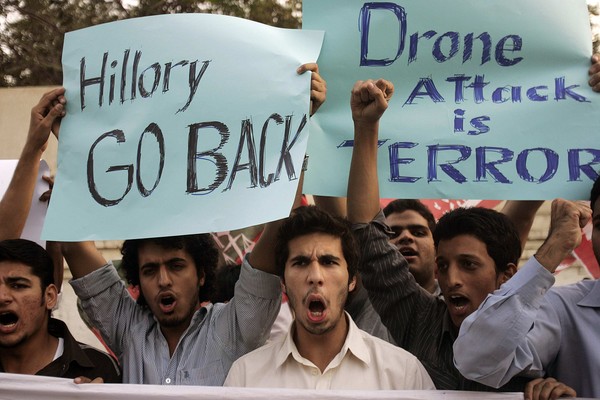
Students in Lahore, Pakistan, protest against the visit of U.S. Secretary of State Hillary Clinton. (K.M. Chaudary/AP Photo/October 29, 2009)

by Kathy Kelly

There’s a phrase originating with the peace activism of the American Quaker movement: “Speak Truth to Power.”  One can hardly speak more directly to power than addressing the Presidential Administration of the United States. This past October, students at Islamabad’s Islamic International University had a message for Secretary of State Hillary Clinton.  One student summed up many of her colleagues’ frustration. “We don’t need America,” she said. “Things were better before they came here.”

The students were mourning loss of life at their University where, a week earlier, two suicide bombers walked onto the campus wearing explosive devices and left seven students dead and dozens of others seriously injured. Since the spring of 2009, under pressure from U.S. leaders to “do more” to dislodge militant Taliban groups, the Pakistani government has been waging military offensives throughout the northwest of the country.  These bombing attacks have displaced millions and the Pakistani government has apparently given open permission for similar attacks by unmanned U.S. aerial drones.   Every week, Pakistani militant groups have launched a new retaliatory atrocity in Pakistan, killing hundreds more civilians in markets, schools, government buildings, mosques and sports facilities.  Who can blame the student who believed that her family and friends were better off before the U.S. began insisting that Pakistan cooperate with U.S. military goals in the region?

Continue reading “Speaking Truth to Power”

Demolishing Bagram to Destroy Evidence?

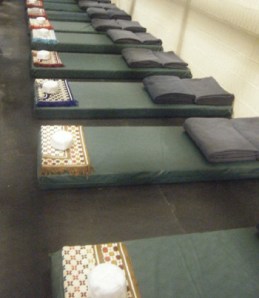
In a notification filed on December 30th in a U.S. District Court for the District of Columbia, the Justice Department has announced that in addition to shifting prisoners from Bagram to a newly built facility nearby, the Pentagon also intends to demolish the original facility at Bagram.  According to the notification, the Department of Defense will shift prisoners to the new facility by January 19th.  Shortly thereafter, plans to demolish the Bagram facility will be put into effect.

According to an article in the Huffington Post on December 31st, Ramzi Kassem – a lawyer serving as counsel for several Guantanamo and Bagram detainees – has stated that the plan to demolish Bagram “amounts to destroying evidence in the cases of detainees who say they were tortured there.”

Kassem, also a law professor at City University of New York, maintains that Bagram ought to be preserved as evidence and as a crime scene. In Kassem’s view, the administration’s decision to demolish the facility  can be read as an  “underhanded attempt” on the part of a government concerned with “covering its own tracks.”

Continue reading “Demolishing Bagram to Destroy Evidence?”