The Times reports that a team of US-Nato special forces descended on a village in Kunar and apprehended 10 Afghans, including 8 schoolchildren — grades six, nine and ten — and executed them in cold blood. Seven of the children belonged to a single family, and many were handcuffed before being shot. Following is the lament of an Afghan poet who has endured enough of the freedom brought him by the so-called Operation Enduring Freedom.
(I am unable to translate this right now, maybe later. But the pictures speak for themselves).
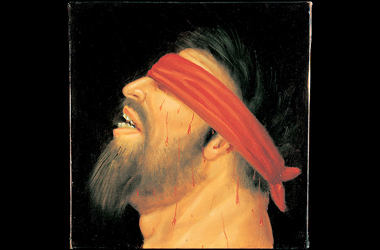
Abu Ghraib painting by Fernando BoteroBy Aisha Ghani
On Monday, November 30th the Supreme Court overturned a Second Circuit Court of Appeals order to release photographs of U.S. soldier abuse of prisoners in Afghanistan and Iraq. According to a statement by Solicitor General Elena Kagan, disclosing these photographs “would pose a clear and grave risk of inciting violence and riots against American troops and coalition forces.”
The contestation over the release of these photographs began four years ago, when a trials court judge claimed that the Bush administration was evading obligations imposed on it by the Freedom of Information Act in withholding the images. Although earlier this year the Obama administration argued in favor of releasing the photographs in an effort to encourage ‘transparency’, the decision was later reversed. While the Supreme Court has historically challenged the state’s assertions in cases concerning the rights of detainees, this time they sided with the Obama Administration, permitting the Pentagon to block the release of these photographs and others like them.
Are we to believe that concern for the safety of U.S. soldiers and civilians lies at the heart of this decision, or can we sense a certain disingenuity when we think about how the state endangers both soldiers and civilians everyday by subjecting them to war? Insincerity, as George Orwell tells us, is “the gap between one’s real and declared aims.”
What is it about the nature of the image in general and, more specifically, about the ‘possible’ content of these images in particular that is creating a palpable gap between the state and judiciary’s real and declared aims?
Mara Ahmed and I were given the opportunity to interview Tariq Ali when he spoke at Hamilton College in Upstate New York on November 11, 2009, during his recent speaking tour of the United States. Tariq, a native of Pakistan who lives in England, is a well known writer, intellectual and activist. He has traveled all over Southwest Asia and the Middle East while researching his books. Mara, who is working on a film highlighting the opinions of the Pakistani people regarding the current situation in Pakistan and the Western initiated ‘Global War on Terror’, had a lot of questions for Tariq about the internal state of Pakistan. I wanted to ask Tariq for his opinion about the effects of American foreign policy in Afghanistan and Pakistan, and what alternatives he thought might be available.
Mara: What is the role of Islamophobia in the Global War on Terror? Many American war veterans have described the wars in Iraq and Afghanistan as imperialistic, racist and genocidal. Your comments?
Tariq: Well, I think Islamophobia plays an important part in things, because it creates an atmosphere in which people feel, “Oh, we’re just killing Muslims, so that’s alright.” And this situation is becoming quite serious in the United States and in large parts of Europe, where people feel that the fact that a million Iraqis have died is fine because they’re not like us, they’re Muslims. So, Islamophobia is becoming a very poisonous and dangerous ideological construct which has to be fought against.
From The Nation’s press release (You can watch Democracy Now’s interview with Jeremy Scahill here):
In a stunning investigation just posted at TheNation.com, Jeremy Scahill reveals a covert military operation being run almost entirely by Blackwater, USA, a military contractor embroiled in controversy for their actions in Iraq and the Middle East. Key points from the piece:
An elite division of Blackwater, USA is running a covert, US Military operation that includes planning targeted assassinations, “snatch and grabs” and other sensitive actions inside and outside Pakistan. This is a program that not even some Senior Level Obama Administration and Pentagon officials are aware of.
Blackwater operatives are assisting in gathering intelligence to help run a secret, second and heretofore unreported, US military drone bombing campaign that runs parallel to the well-documented CIA predator strikes.
Sources for The Nation report that some non-military Blackwater employees, outside of the US Military chain of command, have obtained rolling security clearances above their approved clearances, and higher than even members of the US Congress.
Fault Lines brings together a panel of guests and a studio audience to discuss Obama’s war in Afghanistan. Hosted by Avi Lewis. Excellent interventions from Jeremy Scahill and Matthew Hoh.
The wonderful Kathy Kelly gives an excellent, compelling presentation on the costs, monstrosities and sorrows of war at the First Presbyterian Church in Binghamton, NY. She importantly provides the view on the ground from the perspective of Pakistani, Afghani and Palestinian villagers at the receiving end of hellish drones and shares her experiences in Gaza and Pakistan.
Two highly recommended clips — and if you have any “progressive” friends who breezily defend Obama’s being awarded the Nobel Peace Prize, please draw their attention to these videos and to an example of a two-time NPP nominee whose work would actually merit such recognition.
Kathy Kelly co-coordinates Voices for Creative Nonviolence, a campaign to end U.S. military and economic warfare, and co-founded Voices in the Wilderness, a group which had openly defied economic sanctions from 1996-2003 by bringing medicines to children and families in Iraq.
“It is forbidden to kill; therefore all murderers are punished unless they kill in large numbers and to the sound of trumpets.” — Voltaire
Question: How many countries do you have to be at war with to be disqualified from receiving the Nobel Peace Prize?
Answer: Five. Barack Obama has waged war against only Pakistan, Afghanistan, Iraq and Somalia. He’s holding off on Iran until he actually gets the prize.
Somalian civil society and court system are so devastated from decades of war that one wouldn’t expect its citizens to have the means to raise serious legal challenges to Washington’s apparent belief that it can drop bombs on that sad land whenever it appears to serve the empire’s needs. But a group of Pakistanis, calling themselves “Lawyers Front for Defense of the Constitution”, and remembering just enough of their country’s more civilized past, has filed suit before the nation’s High Court to make the federal government stop American drone attacks on countless innocent civilians. The group declared that a Pakistan Army spokesman claimed to have the capability to shoot down the drones, but the government had made a policy decision not to. (1)
On the day I arrived in Peshawar mid-September, the evening stillness was broken by nine loud explosions, each preceded by the sucking sound of a projectile as it arced into Hayatabad, the suburban sprawl west of the city. Their target was a Frontier Constabulary post guarding the fence that separates the city from the tribal region of Khyber.
When I lived here seven years ago, Hayatabad hosted many Afghan refugees; those with fewer resources lived in the slums of Kacha Garhi, along the Jamrud Road to the Khyber Pass. Many established businesses here and dominated commerce and transportation in parts of the city. Some would temporarily migrate to Afghanistan in summer where it was cooler. But Peshawar was a sanctuary, as Afghanistan was perpetually at war. Now the remaining Afghans are leaving because Afghanistan feels safer. There are checkpoints all over the city, many kidnappings, and during my visit, there were at least three suicide bombings and four rocket attacks, many of them targeting Hayatabad.


 P U L S E