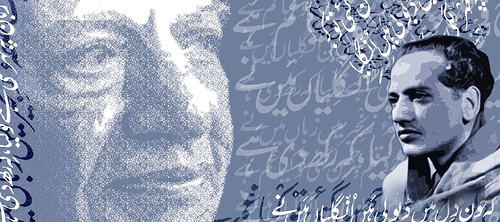
Thus Alone, and Always, Have People Resisted Tyranny: Remembering Faiz on his Birth Centenary

Today is the first birth centenary of Faiz Ahmed Faiz: one of South Asia’s most beloved radical Urdu poets. Today is also, just two days after Mubarak’s resignation as a result of the inspiring revolution in Umm al-Duniya, Mother of the World, Egypt; and almost a month after Tunisia’s courageous revolution. How ecstatic would Faiz have been today?!

by Huma Dar

Today is the first birth centenary of Faiz Ahmed Faiz: one of South Asia’s most beloved radical Urdu poets.  Today is also, just two days after Mubarak’s resignation as a result of the inspiring revolution in Umm al-Duniya, Mother of the World, Egypt; and almost a month after Tunisia’s courageous revolution.  How ecstatic would Faiz have been today?!  Faiz, who had lived in Beirut, in exile from Pakistan — when ruled by the US-bolstered military dictator, General Zia-ul Haq.  Faiz, who wrote a beautiful lullaby for a Palestinian child, and a poem for those who were martyred outside their beloved Palestine.  Faiz, whose poem commonly mis-titled, “Ham Dekhenge,” is a battle-song for people fighting for social justice from Sindh, Pakistan to Kashmir to Chhattisgarh, India.

The title of this particular poem of Faiz is in Arabic: “Wa Yabqaa Wajhu Rabbika.”  It is most often brushed aside as it does not fit the simplistic profile of the “avowed atheist” assigned to Faiz.  Being a socialist does not preclude belief in Islam, but this nuance is lost on many who cannot easily imagine Faiz being a Muslim, leave alone leading a prayer in the mosque of his ancestral village, especially given the subtle Islamophobia that pervades élite political and literary discourses, both within and without South Asia.  For some, even more difficult “to reconcile [is] the glowing tribute [that Faiz wrote] to Muhammad Ali Jinnah,” but this has to do with the rigorous demonology of Jinnah, the founder of Pakistan, in Indian historiography, and the hegemonic status of India and Indian academics, even those who vigorously critique nationalisms of all kinds, within South Asian Studies.
Continue reading “Thus Alone, and Always, Have People Resisted Tyranny: Remembering Faiz on his Birth Centenary”

Standoff on the Nile

After seven days of mass protests in Egypt, a people’s movement has taken hold throughout the country, demanding the end of Hosni Mubarak’s 30 years in power. A day-by-day account of how Egypt has been set alight by a mass revolt against President Hosni Mubarak.

Celebrations across the Arab world

Mosaic’s round-up of the celebrations across the Middle East on Egypt’s people power toppling of Mubarak.

Vodpod videos no longer available.

Egypt: Seeds of Change

Revolutions do not come about from determination and desire for change alone, they need organization and planning. If you are one of those who believes that the Egyptian revolution was the consequence of a spontaneous outpouring of discontent, the following episode from AJE’s People and Power, which is a unique study in the art of revolution, should help disabuse you. Western activists in particular — whose failures were noted by Antonio Gramsci in the early decades of the century, and who have maintained an unbroken record of defeat since — will find a lot to learn from this.

Arab Earthquake

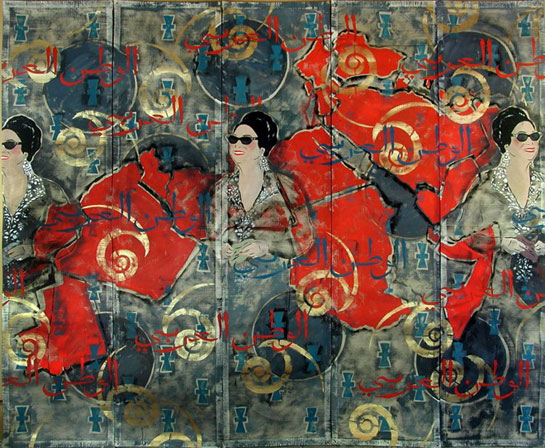
'al-Watan al-Arabi' by Chant Avedissian

Throughout yesterday messages were sent out from within the Egyptian regime to the effect that Husni Mubarak was about to resign. Millions went onto the night streets to celebrate the victory. Then, incredibly, Mubarak repeated his intention to stay. He lied about his contributions to Egyptian sovereignty and addressed the Egyptians as his children, to screams of derision. Despicable as he is, there was something of the tragic hero about him, tragic in the Greek or Shakespearean sense. The very traits which had thrust him to greatness – stubborness, brutishness, contempt for the people – were condemning him, with every word, to the most ignominious humiliation. He spoke from the gravel of his octogenarian throat, a man of the past adrift in a strange new world.

Tragic or not, it was certainly theatre – directed by the military. Communique Number One had already been delivered. Then this evening Omar Suleiman made a curt admission of defeat, for he too has been deposed (although he announced only Mubarak’s fall). The military’s Supreme Council is in charge.

Continue reading “Arab Earthquake”

“Egypt is free” and “We won!”

by Tariq Ali

Egyptian anti government protesters shout slogans as they continue their presence in Tahrir square

A joyous night in Cairo. What bliss to be alive, to be an Egyptian and an Arab. In Tahrir Square they’re chanting, “Egypt is free” and “We won!”

The removal of Mubarak alone (and getting the bulk of his $40bn loot back for the national treasury), without any other reforms, would itself be experienced in the region and in Egypt as a huge political triumph. It will set new forces into motion. A nation that has witnessed miracles of mass mobilisations and a huge rise in popular political consciousness will not be easy to crush, as Tunisia demonstrates.

Arab history, despite appearances, is not static. Soon after the Israeli victory of 1967 that marked the defeat of secular Arab nationalism, one of the great Arab poets, Nizar Qabbani wrote:

Arab children,
Corn ears of the future,
You will break our chains.
Kill the opium in our heads,
Kill the illusions.
Arab children,
Don’t read about our suffocated generation,
We are a hopeless case,
As worthless as a water-melon rind.
Don’t read about us,
Don’t ape us,
Don’t accept us,
Don’t accept our ideas,
We are a nation of crooks and jugglers.
Arab children,
Spring rain,
Corn ears of the future,
You are the generation that will overcome defeat.

How happy he would have been to seen his prophecy being fulfilled.

Continue reading ““Egypt is free” and “We won!””

The Brief Reign of a Boy King: The Obama Legacy Unearthed

by Jennifer Matsui and Stella La Chance

The revolutions in Tunisia and Egypt have forced Obama into an uncomfortable but familar posture: On the one hand, in order to preserve at least the appearance of credibility, the candidate of hope and change has to feign solidarity with the people who expressed their hope by flooding into the streets of Tunisia and Cairo demanding change in leadership of their US-sponsored tyrannies. On the other, as the man charged with the responsibility of prolonging the death-gasp of a doomed Empire, Obama had to work overtime behind the scenes to make sure that any political changes forced upon America’s satraps in the Middle East remain cosmetic and trivial. This dilemma accounts for the mixed messages being issued from the White House throughout the crisis as each mangled response contradicts an earlier stance.

More recent developments on Mubarak’s “dignified” exit reveal even more cynical contempt for Egypt’s long suffering people on the part of the Obama administration as Egypt’s recently appointed VP Omar Suleiman, the CIA’s ‘go to guy’ for its offshore torture enterprises has reportedly been installed as Mubarak’s puppet successor.

What better illustrates Obama’s flailing and ineffectual leadership style than a comparison of his rhetoric in Cairo shortly after taking office with his current posture regarding developments in Egypt? In his 2009 Cairo speech, Obama affirmed his “unyielding belief” in the universality of democratic struggle, and the “yearning” of all people to live “under the rule of law and the equal administration of justice, towards government that is transparent and doesn’t steal from the people”. Words that in retrospect reveal the insincerity behind them as his administration attempts to downplay the “government by the people, of the people . . . ” stuff as it applies to the Arab world, and push forward a more moderate and “realistic” solution to what they consider an unfolding ”crisis” in Egypt and beyond: Millions of people peacefully united in a struggle to break free from a brutal, authoritarian regime headed by a corrupt tyrant.

Continue reading “The Brief Reign of a Boy King: The Obama Legacy Unearthed”

The Imitator

picture by Ali Farzat

He copies phrases from foreign newspapers into a notebook. Then he copies his notes into a larger notebook with a flag and a band of gold on the front.

His mouth imitates the words of the state TV channel, and the words of undead clerics, and the words of puff-eyed men who sit in cafés.

He curses his country’s backwardness. At the same time he proclaims that the world was brighter when his grandfather was still a rheum-eyed boy.

At school he wrote poems praising his teacher. At work he writes letters praising his boss. When the time is right he writes reports denouncing his colleagues.

He is embarrassed by his social station. In the presence of his inferiors he imitates his superiors. He swings his belly like a wealthy businessman, preens his moustache like a tribal chief, avoids eye contact like a distracted poet or professor, or establishes it, beneath beetling brows, like a policeman. He aims to provoke fear. He is scared of everything.

Continue reading “The Imitator”

Regaining Momentum

8th February. AP photo.

Until today the earthshaking Egyptian revolution appeared to be losing momentum. Regime propaganda, repeated on state TV and in Saudi-owned regional media, appeared to be convincing significant sections of the population that the protests were responsible for diminished security (although it was the regime that freed violent criminals and pulled police off the streets) and economic destabilisation (although it was the regime again which closed the internet, halted the trains, and dealt perhaps a long-term blow to tourism by encouraging mobs to attack foreigners). As 40% of Egyptians rely on daily wages for survival, success of regime propaganda in this area could fatally undermine the revolution.

The United States clearly believed that Mubarak, Suleiman and the military, having weathered the initial shock, were slowly but surely regaining control. After meeting the ruling clique, Obama’s envoy and Mubarak-business partner Frank Wisner praised Mubarak and insisted that he “must stay in office to steer” a process of achieving “national consensus around the preconditions” for the future. The White House said Wisner was speaking in a personal capacity, but didn’t contradict him. Hillary Clinton, meanwhile, expressed support for Vice President Omar Suleiman’s transitional leadership. Suleiman’s credentials for midwifing democracy include personal supervision of execution by torture, a rock solid reputation with Israeli intelligence, and his oft-stated belief that Egyptians are not yet ready for democracy.

Even as the regime and its American sponsor speak of dialogue, reform and transition, arrests of opposition activists and harrassment of journalists continue, as does the decades-old state of emergency. In one hand the stick, and in the other the carrot: state salaries and pensions have been increased by 15%, and the public sector has announced it will employ the unemployed. The regime has had neither the time nor the inclination to reorder the economy to benefit the working class, so it’s most probable that Egyptians are about to benefit from a temporary cash injection from Saudi Arabia and other terrified Gulf states.

Continue reading “Regaining Momentum”