Israel’s Channel 10 shows excerpts from Hagai Levi’s documentary about the wonderful folks behind Breaking the Silence.
Category: Gaza
Playing with Water

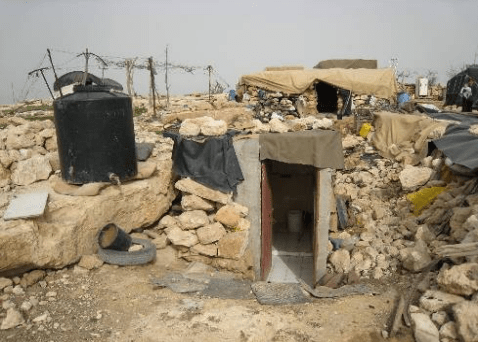
Water in Israel is probably one of the most blatant faces of apartheid. As reports like the Amnesty International report of 2009, “Troubled Waters” and the B’tselem website coverage of the issue, “The Water Crisis” show us, Israel’s resources are invested in water theft/access denial from Palestinians. But water in Israel is not just a substance of life, for those who can’t have it, it’s a tradable commodity, for those who’ll never miss it.
Like a Fish in National Waters
Water resources in Israel are all state-owned. Naturally- as is usually the case within the militaristic, nationalistic Israel- the state will allocate these resources to serve its “national needs”. Water theft is a good example of “negative” policy, which is so obviously discriminatory, violent and inexcusable, that the only way to sell it to the public is not to mention it at all. True to form, when cave- dwelling Palestinians are kicked out of their caves and their harvesting canisters (on the cave roof?) are destroyed [“Troubled Waters”, p.2], there’s no Israeli media around to record it, spin it and dish it. “Positive” policy, however, is always easy to sell. After all, we “dried the swamps and made the wilderness bloom”, and the environmental devastation of swamp drying still isn’t being taught in schools.
But the Coffins Do Come In
by Mohammed Omer
IPS — GAZA CITY, Oct 13, 2010 – Samir Tahseen Al-Nadeem died after waiting 35 days for an exit permit for treatment for his heart condition. He was 26. The medicines he needed could not get in. But the coffins do.
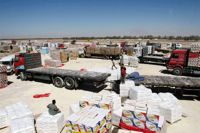
The health ministry now lists 375 deaths due to shortage of life-saving medicines. The medicines sit just outside the borders of the territory until most pass their expiry dates. But there are no expiry dates on about 10,000 coffins that have been donated for Gaza. The coffins do make it to those that eventually need them.
By the end of last month more than 70 percent of medicines donated for Gaza had been dumped because they were past their expiry date, the health ministry says. They were worth many millions of dollars. And they were worth many lives.
“Much of the donated medicines came from Arab states,” Dr Mounir Al- Boursh, director of the pharmaceutical department at the health ministry tells IPS. This added up to 10,300 tonnes of medicines worth 25 million dollars, he said.
Only about 30 percent of this could be used, he said; the rest either expired, or was inaccessible because of restricted distribution by the Israelis, who control what gets into Gaza.
It’s not easy to dump medicines safely either. Much of unused supply mixes with domestic waste, creating health hazards far from bringing relief. The World Health Organisation has had to “raise concern about the unsafe disposal of expired medication and other medical disposable material,” WHO spokesperson told IPS.
But the Gaza ministry has received 10,000 coffins, about 1,000 of them for children, Dr Boursh said. Such help, he said, “does not meet with the needs of the Gaza Strip.”
Reese Erlich: “Stop using the word ‘terrorist'”
Defining what a terrorist is and isn’t is a major dilemma. What one may consider terrorism, another may consider resistance. So where does one draw the line? Reese Erlich tackles that topic in his latest book “Conversations with Terrorists: Middle East Leaders on Politics, Violence, and Empire.” Erlich is a veteran journalist who has covered U.S. foreign policy for decades. He has freelanced for National Public Radio, Radio Deutsche Welle, the Australian Broadcasting Corp. Radio, the Canadian Broadcasting Corp. Radio, and writes for The San Francisco Chronicle and The Dallas Morning News.
Drawing on firsthand interviews and original research, Erlich argues that yesterday’s terrorist is often today’s national leader and that today’s freedom fighter may become tomorrow’s terrorist. By branding all of American’s opponents as “terrorists,” it makes it more difficult to look beyond the individual or the political group and understand what they are really all about. I caught up with Erlich recently and here’s what he had to say.
Continue reading “Reese Erlich: “Stop using the word ‘terrorist’””
Zionist Dialectics: Past and Future
Excerpted from 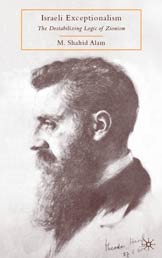 Israeli Exceptionalism (Palgrave: 2009).
by M. Shahid Alam
“My God! Is this the end? Is this the goal for which our fathers
have striven and for whose sake all generations have suffered?
Is this the dream of a return to Zion which our people have
dreamt for centuries: that we now come to Zion to stain its soil
with innocent blood?”
Ahad Ha’am, 1921
This study has employed a dialectical framework for analyzing the destabilizing logic of Zionism. We have examined this logic as it has unfolded through time, driven by the vision of an exclusionary colonialism, drawing into its circuit – aligned with it and against it – nations, peoples, forces, and civilizations whose actions and interactions impinge on the trajectory of Zionism, and, in turn, who are changed by this trajectory.
It would be a bit simplistic to examine the field of interactions among the different actors in this historic drama on the essentialist assumption that these actors and their interests are unchanging. Instead, we need to explore the complex ways in which the Zionists have worked – and, often have succeeded – to alter the behavior of the other political actors in this drama: and, how, in turn, the Zionists respond to these changes. Most importantly, we need to explore all the ways in which the Zionists have succeeded in mobilizing the resources of the United States and other Western powers to serve their specific objectives.
Resistance threads
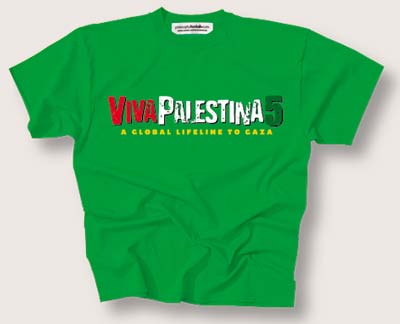
On Saturday 18 September, the fifth, and most ambitious convoy leaves for Gaza. From London, Casablanca and Doha three simultaneous routes consisting of hundreds of vehicles to break the siege. Three times in the last eighteen months Viva Palestina has broken Israel’s siege, each time successfully delivering their aid, despite Israel’s murderous assault on the Freedom Flotilla , they fully intend to deliver this time too. Our VIVA PALESTINA 5 T-shirt will be worn by all drivers and crew. Sales of the shirt help fund the convoy. We can’t all be on this incredible journey to bring vital material aid and international solidarity to Gaza but by wearing this shirt we are all convoy members.
Courtesy of the team at Philosophy Football.
On Gaza, Artists Speak Out
Terry Jones, Annie Lennox, Thandie Newton, Alexei Sayle, Mike Figgis, Katharine Hamnett and Jason Flemyng, voice their support for Amnesty International’s ongoing efforts to secure justice for both Palestinians and Israelis and make an impassioned plea for Israel to cease its illegal siege of Gaza. Find out more here.
BBC Bias: Panorama Programme Exposed
From Pete Charles, by way of YouTuber wotdoesitmatter:
Chris Hedges lends support to USToGaza.org
Chris Hedges speaking at the Tabernacle Church fundraiser for www.ustogaza.org in Philadelphia on September 10, 2010.
Continue reading “Chris Hedges lends support to USToGaza.org”
Lauren Booth’s Open Letter To Israel
Free Gaza’s Lauren Booth has an open video letter to the people of Israel.
 P U L S E