The courage of these protesters is admirable even if some of their politics (their positions on the Palestinians and on Lebanon) is less than savoury. (Remember that Iran executed many who protested back in 2009)
Category: Iran
People Power in the Middle East
M. Shahid Alam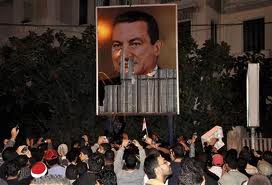
From his weekly perch at CNN, Fareed Zakaria, speculated last Sunday (or the Sunday before) whether George Bush could take credit for the events that were unfolding in Tunisia, whether this was the late fruit of the neoconservative project to bring ‘democracy’ to the Middle East.
It is quite extraordinary watching Zakaria – a Muslim born and raised in India, and scion of a leading political family – mimic with such facility the language of America’s ruling classes, and show scarce a trace of empathy for the world’s oppressed, despite his propinquity to them by reason of history and geography. He does have a bias for India, but here too he only shows a concern for India’s strategic interests, not the interests of its subjugated classes, minorities and ethnicities. This I offer only as an aside about how easy it is for members of the upper classes in countries like India, Pakistan or Egypt to slip into an American skin whenever that dissimulation offers greater personal advantages.
As a cover for deepening US control over the Middle East – here is the latest civilizing mission for you – the neoconservatives in the Bush administration argued that the Islamic world produces ‘terrorists’ because it lives under autocracies. To solve the ‘terrorist’ problem, therefore, the US would have to bring democracy to the Middle East. This demagoguery only reveals the bankruptcy of America’s political class. It is a shame when the President of the United States and his neoconservative puppet-masters peddle such absurdities without being greeted by squeals of laughter – and shouted down as hypocritical, as farcical.
Who has been the leading ally and sponsor these past decades of nearly all the despotisms in the Middle East – those of royal pedigree and others seeking to become royalties?
Regardless, the real plan of United States failed miserably. It was dispatched to its grave by a people’s resistance in Iraq, Afghanistan and Pakistan.
The Net Delusion
In this brilliant lecture Evgeny Morozov asks if free information means free people? The event was recorded on 19 January 2011 in LSE’s Sheikh Zayed Theatre. It was moderated by Alison Powell.
Available as: mp3 (38 MB; approx 82 minutes)
 At the start of the twenty-first century we were promised that the internet would liberate the world. We could come together as never before, and from Iran’s ‘twitter revolution’ to Facebook ‘activism’, technological innovation would spread democracy to oppressed peoples everywhere. We couldn’t have been more wrong. Morozov destroys this myth, arguing that ‘internet freedom’ is an illusion, and that technology has failed to help protect people’s rights. Not only that – in many cases the internet is actually helping authoritarian regimes. From China to Russia to Iran, oppressive governments are using cyberspace to stifle dissent: planting clandestine propaganda, employing sophisticated digital censorship and using online surveillance. We are all being manipulated in more subtle ways too – becoming pacified by the net, instead of truly engaging. This event marks the publication of Evgeny Morozov’s new book The Net Delusion: How Not to Liberate The World.
Continue reading “The Net Delusion”
Some Unvarnished Truths About the US and Israel
by M. Shahid Alam
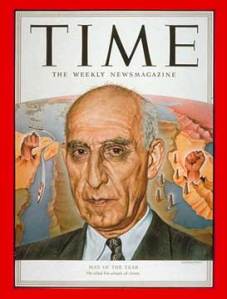 Was there ever a time when a leading organ of the US media could speak the unvarnished truth about the links between the United States and Israel?
Consider this quote from Time magazine of January 1952, embedded in an article that explained its choice of Mohammed Mossadegh as its Person of the Year for 1951. It had no compliments for Mossadegh, the man who was spearheading his country’s bid to take back its oil resources from the British-owned Anglo-Iranian Oil Company. No surprise there.
Surprising, however, is Time’s candor on Israel. It minces no words. US support for the creation of Israel had alienated the Middle East: it had been a costly error, motivated not by national interest but petty considerations of presidential politics. Truman had supported the creation of Israel in order to court American Jewish votes. This was the plain truth: a US President had placed his electoral chances ahead of a vital national interest. Apparently, in those days, Time could write the plain truth without worrying about the tide of flak from the American Jewish community.
Continue reading “Some Unvarnished Truths About the US and Israel”
New York Times Beats Drums for War
Ray McGovern: NYT ignores intelligence there is no evidence of Iran nuclear weapons program program. He also has some interesting observations about Alan Dershowtiz’s fantasies.
Why a Saudi King Might Want the US to Attack Iran
Some insights, some zany speculation. (for smarter, informed commentary see this CBC interview with Glenn Greenwald)
Lawrence Wilkerson: The Wikileaks cable isn’t about Iran being a threat to security, it’s about rival elites defending oil wealth and power
Wilkerson on the significance of Wikileaks and Israeli Apartheid
Colonel Lawrence Wilkerson on Countdown with Keith Olbermann to discuss Wikileaks.
Vodpod videos no longer available.
Wilkerson on the significance of Wikileaks and …, posted with vodpod
Nato: Going Global
From Al Jazeera’s excellent Empire with Marwan Bishara.
The North Atlantic Treaty Organisation is the largest military force ever assembled, with a potential armed force of more than seven million. But as its original enemies, communism and the Soviet Union, were defeated two decades ago, what is the alliance’s new identity or new role?
Tariq Ali assesses Obama’s record
Our dear and respected friend Tariq Ali on the Riz Khan Show.
Iran’s “Soft Power” Increasingly Checks US Power
by Flynt Leverett and Hillary Mann Leverett
Twenty years ago, Harvard’s Joseph Nye famously coined the term “soft power” to describe what he saw as an increasingly important factor in international politics—the capacity of “getting others to want what you want”, which he contrasted with the ability to coerce others through the exercise of “hard” military and/or economic power. The question of soft power, when it comes to Iran, is contentious. Most analysts seem prepared to acknowledge that the Islamic Republic’s soft power in the Middle East rose significantly in the first several years of this decade. But many Western analysts now argue that Tehran’s regional soft power has declined over the last couple of years, following the election of Barack Obama as President of the United States, the fallout from the Islamic Republic’s June 2009 presidential election, and the imposition of new sanctions against Iran over its nuclear activities.
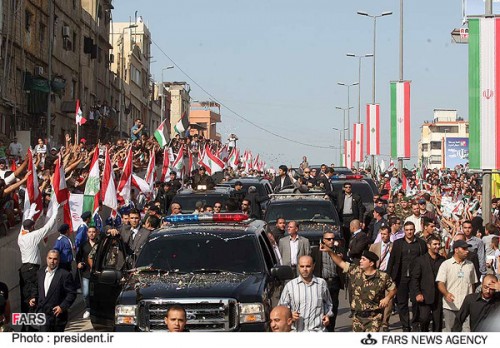
Others—including the two of us—argue that Iranian soft power remains strategically significant and is perhaps even still growing. In this regard, we are struck by two developments today. First, Iranian President Mahmoud Ahmadinejad traveled to Beirut—the first visit by an Iranian president to the Lebanese capital since President Mohammad Khatami went there in 2003. Although White House spokesman Robert Gibbs said the visit demonstrated that Ahmadinejad was continuing his “provocative ways” and that Hizballah “values its allegiance to Iran over its allegiance to Lebanon”, the Iranian president received what the Christian Science Monitor’s Nicholas Blanford described as a “rapturous” welcome from tens of thousands of Lebanese who turned out to greet him on his drive into Beirut from the airport. We include photographs of Ahmadinejad’s reception in Beirut today at the end of our text below.
During his trip to Lebanon, Ahmadinejad is scheduled to visit Dahiya, a heavily Shi’a southern suburb of Beirut, and tour southern Lebanon. We would anticipate strongly positive and enthusiastic reactions from populations in both settings. As Rami Khouri aptly put it today, see here, in The Daily Star,
If Ahmadinejad, as planned, goes to south Lebanon and visits Hizbullah-controlled villages near the Israeli border, we should expect political emotions to go through th roof in both the pro-Iranian and anti-Iranian camps. This will not be a surprise, because Ahmadinejad overlooking the northern border of Israel in the company of his Hizbullah allies is a nightmare for most Israelis and many of their friends in the West, while for Hizbullah and its allies in the region this would be a prize-winning moment of defiance to be savored for a long time.
We do not believe that any Western leader—or even any Arab leader—could travel to Beirut today and move about in an open motorcade, as Ahmadinejad did, let alone do so and attract crowds of tens of thousands of eager well-wishers. Security concerns alone would preclude such a scenario. And this is the reality even though the United States and its European and Arab allies have put significant sums of money and political capital into trying to consolidate a “pro-Western” political order in Lebanon.
Continue reading “Iran’s “Soft Power” Increasingly Checks US Power”
 P U L S E