An important interview with Scott Ritter, the former UN chief weapons inspector in Iraq, on Democracy Now!, debunking some of the myths spun around Iran’s nuclear programme.
In a frightening replay of its pathological gullibility for state propaganda, the mainstream press (with honourable exceptions, as ever) has once again adopted the dominant narrative set by Western governmental officials, with journalists and other members of the intelligentsia dutifully performing their role as Gramsci’s “experts in legitimation”.
Human beings are members of a whole,
In creation of one essence and soul.
If one member is afflicted with pain,
Other members uneasy will remain.
If you have no sympathy for human pain,
The name of human you cannot retain.
— A poem by the Persian poet Sa’adi (1210 – 1290)
gracing the entrance of the Hall of Nations of the
United Nations building in New York City
If we speak out against the threat of force against Iran (regarding the nuclear conflict) and warn against a military strike, we cannot be silent on the use of force in Iran itself against its own civil society. For solidarity with the civil society and a peaceful order in the region constitute the primary concern of our efforts. If we condemn foreign sanctions against the Iranian people, we deplore all the more domestic sanctions directed at peaceful demonstrators, journalists, trade unionists, professors, students and others. Thereby the government deprives itself from the domestic basis needed against foreign threats.
Not only as individuals but also conjointly as a group of engaged scholars, we want to announce our resolute protest against the brutal clampdown of demonstrators and against the mass arrests, and strongly advise a peaceful dialogue with the civil society. We call upon the government to release all political prisoners of the last few weeks – amongst them many professors – and to seek dialogue with precisely those persons as moderators of the civil society. Freedom of opinion and the right to demonstrate – cornerstones of the UN Charter of Human Rights to which Iran is a signatory – are being massively violated in today’s Iran.
We strongly remind that the state of siege and the continuing threat of force that have emanated from foreign governments once again fatally demonstrate how thereby the space for a democratic development in Iran are being reduced.
The Independent has offered Darius Guppy the opportunity to write back against the dominant ‘Iran narrative’ in the Western media. Guppy argues that there is no hard evidence for rigging in the recent Iranian presidential elections (an argument made here and here too), and criticises the easy assumption that Ahmadinejad’s victory was fraudulent, as well as, more generally, the West’s usual double standards when it comes to the Muslim world. He questions the complacent expectation that most young Iranians wish to emulate our ‘free’ society, and contrasts the UK unfavourably with Iran in terms of authoritarian surveillance, public ethics, and culture. “Visit Iran and you will see a people polite, hospitable, cultured, noble and brave,” he writes. “Look at Britain’s urban hell and you will see young girls and boys armed with knives, swearing, half naked, vomiting the previous night’s attempt to stifle their pain and their emptiness.” Guppy here is employing the rant genre, as I often do myself. Like all op-ed journalism, his piece is necessarily partial and incomplete. He generalises, and fails to mention, for example, Iran’s galloping heroin problem. But he surely makes some very good points, and makes them very eloquently. The Independent is to be congratulated for giving him the space.
Or is it? Two paragraphs into the online piece, the reader is directed to another article which mocks the author. This framing piece doesn’t engage Guppy’s arguments but simply launches ad hominem attacks against him. It turns out that Guppy was imprisoned for insurance fraud in 1993. This is relevant information, but not so relevant that we need to be informed even before we’ve finished Guppy’s piece. Then the Independent’s omniscient voice implies Guppy is not a genuine enough native informant because he’s only half Iranian. (Guppy does use the rhetorical ‘we’ in his piece, but also describes himself as an old Etonian. He isn’t pretending to be anything he isn’t.) The framing article also subtly distorts Guppy’s perspective, for instance by claiming that he mocks the idea that Iranians long for democracy. In Guppy’s article, democracy is written inside inverted commas – ‘democracy’. In other words, Guppy is not writing against democracy, but against the propagandist use of the word in the West.
I find the use of someone’s alleged hard line past to dismiss their significance to a present political movement unpersuasive. Nevertheless, amidst all the hype it is always useful to get a different perspective.
Following the results of a disputed presidential election Iranians poured onto the streets in their tens of thousands to protest the re-election of incumbent Mahmoud Ahmadinejad.
The demonstrations were unprecedented both in their scale and nature and the largest of their kind since the Islamic revolution in 1979.
Recent weeks have seen an explosion of interest in Twitter, a social networking application which has been used by thousands of internet users to pass on news, views and rumours about the situation unfolding in Iran in the wake of the disputed presidential election.
The Iranian struggle is not however, the first conflict in which emerging ‘Web 2.0’ social media technologies have played a significant role. Israel’s offensive in Gaza in December 2008 – January 2009 provides an important precedent which shows that, despite its undoubted potential for empowering new forms of bottom-up organisation, the social web is not immune from very traditional propaganda techniques.
Operation Cast Lead – The First Social Media War
The roots of Israel’s media strategy in Gaza emerged in the aftermath of the 2006 Lebanon War. The Winograd Commission appointed by the Israeli Government to look into the conflict criticised a lack of co-ordination in the country’s media effort. This led to the creation of the National Information Directorate in the Prime Minister’s Office to co-ordinate efforts across government departments.[1][2]
Bolton at the Hay Festival last year before his attempted arrest for war crimes
John Bolton, with his characterisic contempt for international law, writes in today’s Washington Post that ‘with no other timely option, the already compelling logic for an Israeli strike [on Iran] is nearly inexorable’. The article is reproduced in full below. It should, I suggest, be read whilst mindful of Article 2 of the UN Charter by which it was agreed that: ‘All Members shall refrain in their international relations from the threat or use of force against the territorial integrity or political independence of any state, or in any other manner inconsistent with the Purposes of the United Nations.’
Last year, you may recall, the Guardian columnist George Monbiot attempted a citizens arrest on Bolton. It was a futile but symbolic act; and a rare acknowledgment that this man is a war criminal by any decent standard – and an unrepentant one at that.
With Iran’s hard-line mullahs and the Islamic Revolutionary Guard Corps unmistakably back in control, Israel’s decision of whether to use military force against Tehran’s nuclear weapons program is more urgent than ever.
Iran’s nuclear threat was never in doubt during its presidential campaign, but the post-election resistance raised the possibility of some sort of regime change. That prospect seems lost for the near future or for at least as long as it will take Iran to finalize a deliverable nuclear weapons capability.
From the Electronic Intifada, political officer for the Ireland Palestine Solidarity Campaign David Morrison writes:
(Nidal El Khairy)
At a White House press conference on 18 May 2009, US President Barack Obama expressed “deepening concern” about “the potential pursuit of a nuclear weapon by Iran.” He continued:
Needless to say, the US/EU have ignored this proposal, which would have put Iran’s uranium enrichment facilities under a degree of international control. Perhaps, President Obama’s staff should draw this proposal to his attention.
“Iran obtaining a nuclear weapon would not only be a threat to Israel and a threat to the United States, but would be profoundly destabilizing in the international community as a whole and could set off a nuclear arms race in the Middle East.”
By his side was Israeli Prime Minister Benjamin Netanyahu. In the room with them, there was an elephant, a large and formidably destructive elephant, which they and the assembled press pretended not to see. Continue reading “The elephant in the room: Israel’s nuclear weapons”
The mainstream media narrative of events unfolding in Iran has been set out for us as clear as fairytale: an evil dictatorship has rigged elections and now violently suppresses its country’s democrats, hysterically blaming foreign saboteurs the while. But the Twitter generation is on the right side of history (in Obama’s words), and could bring Iran back within the regional circle of moderation. If only Iran becomes moderate, a whole set of regional conflicts will be solved.
I don’t mean to minimise the importance of the Iranian protests or the brutality of their suppression, but I take issue with the West’s selective blindness when it gazes at the Middle East. The ‘Iran narrative’ contains a dangerous set of simplicities which bode ill for Obama’s promised engagement, and which will be recognised beyond the West as rotten with hypocrisy.
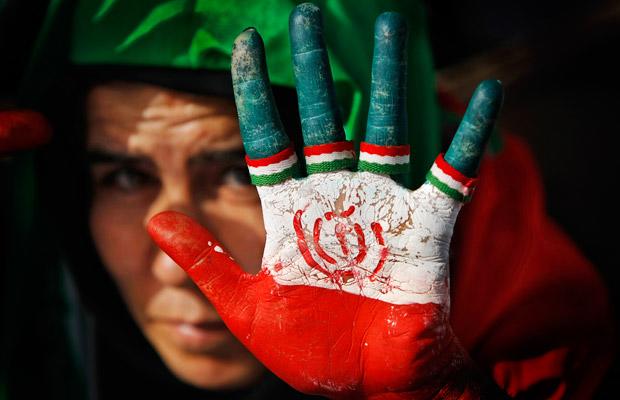
A female supporter of Iranian President Mahmoud Ahmadinejad displays her hand painted with the Iranian flag, also used as a sign for his party (Photo: AP)
Media fantasies in Iran – Abbas Barzegar
It was only a matter of time before revolution in Iran, believed dissidents and media in the west. They were wrong
It’s not about the election, Ahmadinejad, or the even the protesters. The world has been captivated by the events in Iran because for many, Iran is to Islamism what the Soviet Union was to communism and presumably today we are somewhere near the fall of the Berlin Wall.
Al Jazeera’s Empire, with Marwan Bishara. The first short documentary is so bad that it could have been made by the BBC or CNN. Flynt Leverett is insightful as usual, but as much as I love and respect Hamid Dabashi, I think he adds little of value to the discussion.


 P U L S E