Aftermath

The first issue of Critical Muslim, a quarterly magazine in book form co-edited by Ziauddin Sardar and me, will be in the shops in January. More on that at a later date. Today I’m finishing off a long essay on Syria, Iraq and sectarian hatred for Critical Muslim’s third issue. Amongst the books I review in the essay are Fanar Haddad’s indispensable “Sectarianism in Iraq” and Nir Rosen’s “Aftermath: Following the Bloodshed of America’s Wars in the Muslim World,” which is also indispensable, in a different way. As a taster, here’s the section on “Aftermath.”

For a mix of contextual analysis and gripping reportage, the reader will find no better book than Nir Rosen’s magisterial “Aftermath: Following the Bloodshed of America’s wars in the Muslim World”.

Most Western correspondents were flown into Iraq unable to speak Arabic, largely ignorant of the context, to pass their time attending coalition press briefings or embedded with the US military. Their reports were heavy with simplistic labels (‘the Sunni triangle’, for instance) and ignored non-sectarian nationalism and class issues. Rosen’s writing on Iraq is the polar opposite of such parachute journalism. He speaks Arabic for a start, and blends in physically as a result of the “melanin advantage” bequeathed by his Iranian father. More to the point, he is courageous and energetic, going where few outsiders would dare, whatever their skin tone. He’s a reporter of the best kind, capable of locating pattern behind the copious detail. So he doesn’t merely report the mosque sermons he attended, or his encounters with militiamen and their victims, but accurately interprets and reads between the lines. His descriptions of time, place and personality are vivid, with not an ounce of orientalism added. His lack of sentimentality combined with his obvious sympathy for the people of the region make him the perfect candidate to voyage into the sectarian heart of darkness.

Continue reading “Aftermath”

Part II of NYTimes eXaminer interview with Belén Fernández

The following is a the second half of an interview conducted by the new NYTimes eXaminer with PULSE co-editor Belén Fernández about her book The Imperial Messenger: Thomas Friedman at Work. Read the first half here.

Q: Did you come away with a lower opinion of Friedman or of the people and institutions that continually give him platforms to spew his idiotic, loathsome views?  I find it so telling that, when Friedman did his “suck on this” performance on Charlie Rose, Rose just nods and leans in for the next question instead of calling Friedman out for saying one of the most offensive things ever said on television.  Or to put it another way:  Do you think the New York Times would allow one of their columnists to consistently dehumanize entire groups of people – to the point of openly calling for civilian deaths in Gaza, Afghanistan and Iraq – if those people weren’t Arab/Muslim?

Unfortunately, Orientalist dehumanization is institutionalized in US media discourse, the result being that there is no overwhelming public concern when over a million Iraq lives are lost thanks to America’s bellicose projects or when 1400 Palestinians perish in a matter of 22 days at the hands of the Israel Defense Forces.

It is utterly appalling that neither Charlie Rose nor anyone else in the US establishment media took issue with Friedman’s obscene proclamation, and that he was never required by his employer to apologize for it in the interest of maintaining a pretense of objectivity. One can imagine the uproar that would have ensued—and over which Friedman himself would have presided—had, for example, Yasser Arafat instructed Israelis to suck on things, or had Osama bin Laden justified 9/11 with similar terminology. Friedman, on the other hand, is permitted to continue blissfully peddling his contemptuous analyses of the Arab/Muslim world, such as his 2007 assessment—with regard to the US military—that Iraqis “don’t deserve such good people… if they continue to hate each other more than they love their own kids.”

Of course, it is safe to assume that most Iraqis exhibit normal human affection for their offspring, including for those millions of offspring that have been killed, maimed, displaced or otherwise made to suffer as a result of a US military-inflicted sucking, and that the half a million Iraqi children previously killed by US-championed sanctions were probably also loved by their parents.

Even if Charlie Rose et al. fail to comprehend that sucking orders do not qualify as proper journalistic etiquette, they should at least be able to comprehend that Friedman’s argument for why the sucking should occur is in complete defiance of logic. According to Friedman, Iraqis must be made to suck so that the US can effectively combat the “terrorism bubble” that has developed in “that part of the world” and that poses a “fundamental threat to our open society,” something Americans discovered on 9/11. However, this very same Friedman also explains that the real threat to “open, Western, liberal societies today” consists not of “the deterrables, like Saddam, but the undeterrables – the boys who did 9/11.” The resulting argument—made by someone who himself criticizes the Bush administration for implying a link between bin Laden and Saddam Hussein—is that war against deterrables whose weapons are not the problem will solve the problem of undeterrables who are the weapons and who by definition cannot be deterred anyway.

Continue reading “Part II of NYTimes eXaminer interview with Belén Fernández”

NYTimes eXaminer interviews Belén Fernández

The following is a the first half of an interview conducted by the new NYTimes eXaminer with PULSE co-editor Belén Fernández about her book The Imperial Messenger: Thomas Friedman at Work.

Billed as “an antidote to the ‘paper of record'”, the NYTimes eXaminer‘s Advisory Council is composed of such distinguished figures as Richard Falk, Phyllis Bennis, and Edward Herman.

See Phil Weiss’ comment on the interview at Mondoweiss.

Q: Why Tom Friedman? And can you talk a little about how the book is organized? 

A: My decision to write the book was not the product of any sort of long-standing obsession with Thomas Friedman, whose journalistic exploits I remained mercifully immune to for most of my existence up until 2009.

Then, about midway through that year, the idea came to me suddenly when I noticed the $125 “Russian breakfast” option on the room-service menu at my five-star Havana hotel.

Kidding. In 2009 I watched with simultaneous fascination and horror as Friedman flitted on pedagogical missions from Lebanon to Iraq to Afghanistan to Palestine to Africa, where he discovered the root cause of oppression in Zimbabwe by going on safari in Botswana.

Later that same year, Friedman’s decades-long lecture to the Arab/Muslim world on how to behave reached new levels of absurdity with his pronouncement according to which:

A corrosive mind-set has taken hold since 9/11. It says that Arabs and Muslims are only objects, never responsible for anything in their world, and we are the only subjects, responsible for everything that happens in their world. We infantilize them.

Arab and Muslims are not just objects. They are subjects. They aspire to, are able to and must be challenged to take responsibility for their world.

Arab/Muslim subjectivity was of course called into question not only by the fact that Friedman in this very same article instructed the Islamic world to engage in a civil war equal in ferocity to the US civil war, but also by the fact that—approximately 10 days prior to criticizing the infantilizing of Arabs and Muslims—he had remarked to an amused Fareed Zakaria of CNN that Afghanistan was like a “special needs baby” adopted by the US. (Friedman had refrained in this case from throwing in his regular complaint that the US was “baby-sitting a civil war” in Iraq—a complaint he apparently felt was not irreconcilable with his own declaration of the need for an Iraqi civil war.)

Continue reading “NYTimes eXaminer interviews Belén Fernández”

Why I “Assaulted” Defense Chief Leon Panetta

by 
Alli McCracken 

Alli McCracken being arrested by the police for protesting at the Congressional hearing

“Assault? Who — or what — did I assault?” I asked the police officer incredulously as I sat in his office at the police station, handcuffed to the wall. “Well, looks like it was Leon Panetta himself,” the officer responded as he flipped through a pile of paperwork.

Me? A 22-year-old mild-mannered peace activist, assaulted the Secretary of Defense? I had simply tried to tell him how I felt about the wars. 

On the morning of October 13th about 25 activists who are occupying Washington DC, as part of the nationwide occupations, went on a field trip to Congress. We wanted to attend the House Armed Services Committee hearing where Leon Panetta, the Secretary of Defense, and Martin Dempsy, Chairman of the Joint Chiefs of Staff, were testifying about “lessons learned by the Department of Defense over the preceding decade” and “how those lessons might be applied in the future in light of anticipated reductions in defense spending.” After all, these hearings are open to the public. And shouldn’t we have a say in where our money is being spent?

As a peace activist with the group CODEPINK for the past 10 months, I have done my fair share of sending letters and emails and delivering petitions to our government representatives, asking them to stop pouring trillions of our taxpayer dollars into the endless cycle of death, destruction and reconstruction halfway across the world. There are so many critical things that we could spend that money on here in America, such as education, healthcare, helping the homeless, the elderly, the disabled, the veterans.

Continue reading “Why I “Assaulted” Defense Chief Leon Panetta”

Foreshadowing Iraq: The War on “Life Itself”

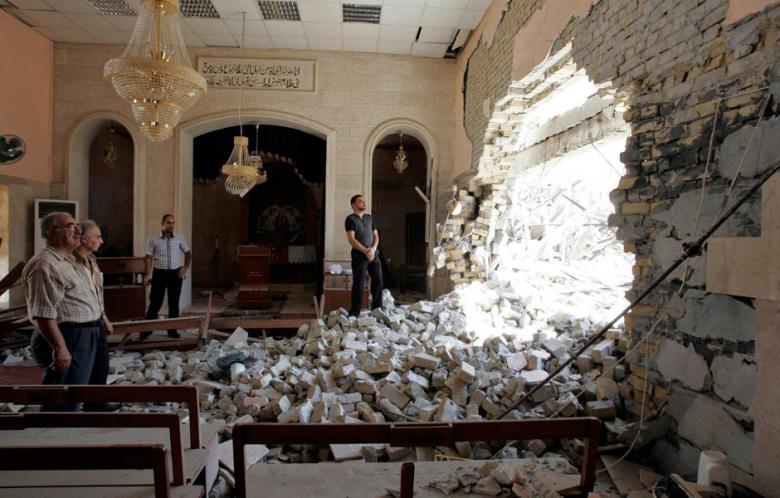
Residents inspect a damaged church after a bomb attack in central Kirkuk, Iraq (Photo: Reuters -- Ako Rasheed)

American University of Beirut professor Omar Dewachi writes at Al Akhbar English:

Washington’s planned withdrawal of troops from Iraq next December is hailed as a turning point for the country. But the war on Iraq was much more than a military battle under the banner of regime change. It was an attack on the social body of a people that predated the 2003 invasion and will outlast a nominal troop withdrawal. As the world marks the ten years anniversary of 9/11 used as a pretext to invade Iraq, reflecting on the burdens of this war is a reminder that 20 years of violent US intervention will take decades to erase.

George Bush’s declaration of ‘war on terror’ in the wake of 9/11 took place one month after I arrived in the US to embark on my doctoral studies in anthropology. An unending war was unleashed with dramatic consequences on the lives of millions of people in the Middle East and the US. After 2003, members of my own family fell victim to the occupation and the sectarian violence, while others were completely uprooted from the city of Baghdad. The war was being felt in the US, as men and women of Middle Eastern and South Asian descent were subjected to physical, symbolic, and bureaucratic violence through torture, surveillance systems, and the new cultural economy of blame and accusation.

In 2003, I began my research on the effects of years of warfare in Iraq by mainly looking at the exodus of Iraqi doctors and the ‘un-doing’ of the Iraqi health system during the 1990s. I was already familiar with the topic. I had trained and worked as a medical doctor in Iraq during the 1990s, where I lived through the collapse of one of the region’s most developed health systems. As a doctor working under sanctions, I struggled in my everyday with the rapid deterioration of the whole country’s infrastructure, the lack of medical supplies, the migration of the medical staff, the dismantling of the service infrastructure, and the mounting of the regime’s coercive violence. We wrestled daily to stock low supplies of saline solutions, cannulas, disposable gloves, and antibiotics. Hospital structures began failing with the absence of maintenance and supplies, as many were on the UN sanctioned list of ‘dual use.’ This was not merely a war on a rogue political regime; it was a war on the social body in Iraq.

Continue reading “Foreshadowing Iraq: The War on “Life Itself””

What we are Forgetting to Remember: The Social Context of 9/11

by Mike King

September 11, 2001 is a world historic moment, a historical signpost – “9/11” – marking more than a deadly attack, but a moment that truly changed history, one that can help us understand both the past and the present.  This week marks the tenth anniversary of the 9/11 attacks.  Of the memorials given, documentaries aired and news stories published this week, few will address the causes and effects of 9/11 in a way that gives a sense of the root causes, social context and contradictions that surround that moment and continue to define our present.
9/11 grew out of everything from Cold War contradictions to longstanding political grievances and anti-imperialism in the Muslim world.  9/11 propelled two unending wars, Afghanistan being the longest in US history, bankrupting both State finances and global moral legitimacy.  Despite the killing of Osama bin Laden, and his mysterious burial at sea, and despite the fact that there have been no successful terror attacks in the US since 9/11, the US has lost the “War on Terror” in every other conceivable way.  Whether in terms of lost economic hegemony or in terms Federal budget deficits (and their social effects), largely caused by the costs of wars, or in terms of a loss of geopolitical control over much of the Western hemisphere or North Africa, the US leveraged its Empire to fund a new Crusades which has them clutching to their global thrown with one hand, munitions with the other, as the other world powers and financiers wait for the right moment to pull the rug out from under them, as multiple occupations meet persistent resistance.

Continue reading “What we are Forgetting to Remember: The Social Context of 9/11”

The Terrorism Issue that Wasn’t Discussed

by Gareth Porter

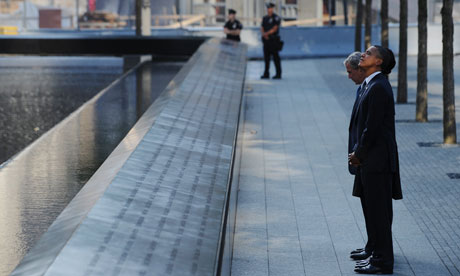
George W. Bush and President Barack Obama visit the 9/11 memorial (Mandel Ngan/AFP/Getty Images

In the commentary on the tenth anniversary of 9/11, the news and infotainment media have predictably framed the discussion by the question of how successful the CIA and the military have been in destroying al Qaeda. Absent from the torrent of opinion and analysis was any mention of how the U.S. military occupation of Muslim lands and wars that continue to kill Muslim civilians fuel jihadist sentiment that will keep the threat of terrorism high for many years to come.

The failure to have that discussion is not an accident. In December 2007, at a conference in Washington, D.C. on al Qaeda, former State Department Coordinator for Counterterrorism Daniel Benjamin offered a laundry list of things the United States could do to reduce the threat from al Qaeda. But he said nothing about the most important thing to be done: pledging to the Islamic world that the United States would pull its military forces out of Afghanistan and Iraq and end its warfare against those in Islamic countries resisting U.S. military presence.

During the coffee break, I asked him whether that item should have been on his list. “You’re right,” he answered.  And then he added, “But we can’t do that.”

“Why not,” I asked.

“Because,” he said, “we would have to tell the families of the soldiers who have died in those wars that their loved ones died in vain.”

His explanation was obviously bogus. But in agreeing that America’s continuing wars actually increase the risk of terrorism against the United States, Benjamin was merely reflecting the conclusions that the intelligence and counter-terrorism communities had already reached.

Continue reading “The Terrorism Issue that Wasn’t Discussed”

The Nisoor Square Shootings: an interactive comic by Dan Archer

Following the 2009 coup in Honduras, comics journalist Dan Archer embarked on a three-part graphic history of the event, which we posted at PULSE.

Archer has recently put together an interactive comic on the subject of the 2007 Nisoor Square Shootings in Baghdad, for which he provides the following background:

“In late 2007, 17 Iraqi civilians were killed and at least 24 wounded after a convoy of Blackwater (the US military contractor) vehicles opened fire in Nisoor square, claiming their convoy had come under attack.

Charges were brought against the men, but subsequently—and controversially—dismissed. The case was re-opened in January 2011.”

Visit the Cartoon Movement website to view more background in comic form and for simple instructions on participating in Archer’s interactive timeline of the event—an innovative creation that incorporates various eyewitness testimony as well as other reports.

Click here to visit Archer’s website.

Paying the Price: Killing the Children of Iraq

John Pilger’s 2000 documentary on the effects of economic sanctions on Iraq remains an important testament to the pre-Iraq war history of international crimes against the Iraqi people.

Following footage of George H.W. Bush’s convincing announcement that “You, the people of Iraq, are not our enemy. We do not seek your destruction,” Pilger narrates from Iraq:

What happens when modern civilized life is taken away? Imagine all the things we take for granted are suddenly not available, or severely limited: clean water, fresh food, soap, paper, pencils, books, light bulbs, life-saving drugs. Telephone calls to the outside world are extremely difficult, computers no longer work, when you fall ill you must sell your furniture to buy medicine, when you have a tooth out there’s no anesthetic. No country will trade with yours, and your money is almost worthless. Soon your children become beggars. It’s as if the world has condemned your whole society to a slow death, and all because of a dispute between governments over which you have no control. That’s what has happened here in Iraq, where almost 10 years of extraordinary isolation, imposed by the U.N. and enforced by America and Britain, have killed more people than the two atomic bombs dropped on Japan, including half a million young children.”

Pilger’s latest documentary, “The War You Don’t See”—an investigation into the media’s role in war—can be viewed online (outside of Australia) for $4.99.

Absolute Power

Part of Al Jazeera’s The Arab Awakening series.

As revolution shakes the Arab world, a series of films explore the roots of the uprisings and ask ‘what next’? Those in a position to know reveal the ‘tricks of the trade’ of Arab dictatorship.