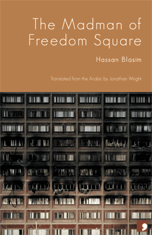
The Madman of Freedom Square

I see no need to swear an oath in order for you to believe in the strangeness of this world.”

How can imagination respond to a situation like Iraq’s, in which truth is so blatantly stranger and more horrifying than the darkest fiction? Perhaps by simply recording real stories, then sometimes allowing reality to slip a little further in the direction it’s already chosen.

Hassan Blasim, film maker, refugee, and author of the astounding short-story collection “The Madman of Freedom Square,” has a more precise formulation:

The important thing is to observe at length, like someone contemplating committing suicide from a balcony. The other important thing is to have an imagination which is not melodramatic but malicious and extremely serious, and to have an ascetic spirit that is close to death.

Except this isn’t a formulation but a voice within a story. In another story there is a man who throws himself from a balcony – a man who clears blood and debris in the aftermath of explosions, then migrates to Holland, renames himself Carlos Fuentes, becomes a Hirsi Ali figure, more Dutch than the Dutch, and suffers nightmares. There’s a man who dreams a number which foretells not a lottery ticket but .. something else. I give away too much.

Continue reading “The Madman of Freedom Square”

Zionists Against Zion?

By M. Shahid Alam

Zionists have worked hard and cleverly for their successes, but their cause has been greatly advanced at each stage by the logic of their colonial project aimed at the creation of a Jewish settler state at the very center of the Islamicate.

Most importantly, Zionism created a geopolitical realignment of great importance. It brought together two strands of the Western world, previously at odds – Christians and Jews – to join their forces against the Islamicate.

At every stage in its history, Israel has ratcheted its power by unleashing forces, even negative forces, that it has then turned to its advantage. Power, intelligence and luck have played into this.

Continue reading “Zionists Against Zion?”

Leaving al-Tanf

When hundreds of Palestinians fled Iraq in 2006, no country in the Middle East would accept them.  The UN eventually set up tent camps in ‘no man’s land’ between the Iraq-Syria border. While the camps were supposed to be a ‘temporary’ solution, it was not until the end of 2009 that a small number of refugees were finally granted permission to move to Italy, while others were told they would be transferred to refugee camps in the region. Edith Champagn’s Leaving Al Tanf documents the stories of  several Palestinian refugees as they prepare to uproot their lives yet again, compelling us to think about how the idea of home, and of time and waiting is experienced by those whose lives have overwhelmingly been marked by uncertainty, liminality, and loss.

A Process of Change – Nasrallah to Petraeus

It’s important to remember that Hizbullah leader Hassan Nasrallah’s speeches consist of more than mere rhetoric. One of the reasons for Nasrallah’s enormous popularity in the Arab and Muslim worlds is that, unlike other Arab leaders, he says what he means and means what he says. Hizbullah is the only force to have defeated Israel – once in 2000, when the brutal occupation of south Lebanon was brought to an end, and once in 2006, when Israeli troops attempted to reinvade in order to dismantle the resistance, but bled on the border for five weeks instead. During the 2006 war Israel bombed every TV mast it could find, but failed to put Hizbullah’s al-Manar off the air. Nasrallah spoke on al-Manar of “the Israeli warship that attacked our infrastructure, people’s homes and civilians. Look at it burn!” As Nasrallah uttered these words, a Hizbullah missile did indeed disable an Israeli warship, forcing Israel to move its fleet away from the Lebanese coast.

In mid-February 2010, Shaikh Nasrallah made a speech which may well mark a fundamental change in the Middle Eastern balance of power. The speech, quoted below, should not be read as a string of empty threats, but a signal of new weaponry and fighting capabilities.

Continue reading “A Process of Change – Nasrallah to Petraeus”

Seven Years in Iraq and Counting

by Ahmed Habib

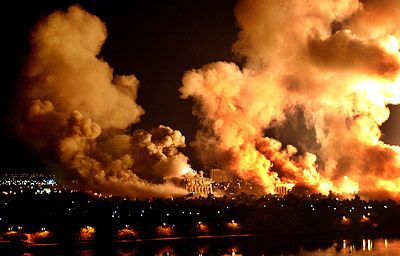
On March 20, 2003, at approximately 5:30 in the early hours of the morning, just at that time where the sun settles into its daytime position over the skies of Baghdad, American jet fighters unleashed indiscriminate firepower over the beautiful city.

Amidst a house filled with resilient spirits, Laila cowered for cover with her neighbours and family. As a twenty year old university student, the Baghdad native had already been through two wars, and a genocidal sanctions regime that limited her childhood to an existence of deprivation and fear.

“This time, it was different, the explosions were so big, we all thought we were going to die,” Laila, a pseudonym used out of fear for her safety, says over a tired phone connection seven years later.

Tens of thousands of kilometres away, activists huddled around a television set, with their heads in their hands, and watched a glorified play by play of death narrated by indifferent talking heads.

“Those are people dying under those bombs, and we couldn’t do anything to stop them,” said Firas from a Toronto apartment, to the backdrop of free flowing tears.

In the lead up to that day, millions of people took to the streets to oppose the impending war, to no avail. Since then, over a million Iraqis have lost their lives, more than five million have been displaced, and countless lives have been destroyed.

Continue reading “Seven Years in Iraq and Counting”

Falluja’s birth defects

Our good friend Dahr Jamail on the Riz Khan show to discuss the dramatic rise in birth defects in Falluja following the two brutal sieges of 2004.

On this episode of the Riz Khan show we ask if US weapons are behind the sharp rise in birth defects in Falluja. Residents of the Iraqi city blame the surge in chronic deformities on controversial weapons used by US forces against Sunni fighters in 2004. But the US military has dismissed those allegations.

Will the Afghan Surge Succeed?

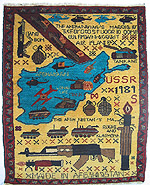
Soviet Exodus War Rug

M. Shahid Alam

More than eight years after dismantling the Taliban, the United States is still mired in Afghanistan. Indeed, last October it launched a much-hyped ‘surge’ to prevent a second Taliban takeover of Afghanistan, not imminent yet, but eminently possible.

The first dismantling of the Taliban was a cakewalk.

In 2001, the United States quickly and decisively defeated the Taliban, killed, captured or scattered their fighters, and handed over the running of Afghanistan to their rivals, mostly Uzbeks and Tajiks from the Northern Alliance.

Unaware of Pashtoon history, American commentators were pleased at the smashing victory of their military, convinced that they had consigned the Taliban to history’s graveyard.

Instead, the Taliban came back from the dead. Within months of their near-total destruction, they had regained morale, regrouped, organized, trained, and returned to fight what they saw as a foreign occupation of their country. Slowly, tenaciously they continued to build on their gains, and by 2008 they were dreaming of taking back the country they had lost in 2001.

Could this really happen? That only time will tell, but prospects for the Taliban today look better than at any time since November 2001.

Continue reading “Will the Afghan Surge Succeed?”

USA and USSR: Accidental Parallels?

M. Shahid Alam

Cover Image GIFIs the question of parallels between the USA and the USSR idle, even mischievous? Perhaps, it is neither, but, on the contrary, deserves our serious consideration.

During the Cold War, the USA and USSR were arch rivals, each the antipodes of the other. For some four decades, they battled each other for ‘survival’ and global hegemony, staring down at each other with nuclear tipped missiles, ready at the push of a button to consummate mutually assured destruction. What parallels could there possibly exist between such irreconcilable antagonists?

Dismissively, the skeptic might retort that their similarities start and end with the first two letters in their names. The USA won and the USSR lost the Cold War. With all four of the letters in its name, the USSR is dead and gone. Its successor state, Russia, now ranks a distant second behind the USA in military power, a position it retains only by virtue of its nuclear arsenal. Measured in international dollars, the Russian economy ranked eighth in the world in 2009, trailing behind its former client, India.

On the other hand, the USA still believes it can ride roughshod over much of the world like a Colossus. It came close to doing this for a few years after the collapse of communism. In the years since its occupation of Iraq, that image has been deflated quite a bit. Haven’t the events of the last decade – the growing challenge to its hegemony in Latin America, the economic rise of India and China, and the recovery of Russia from its collapse of the previous decade – downsized the Colossus of the 1990s? Indeed, the near collapse of its economy in 2008 appears to have brought the Colossus down on its knees.

Continue reading “USA and USSR: Accidental Parallels?”

Myth-Making

We often project our current political concerns backwards in time in order to justify ourselves. I say ‘we’ because everyone does it. Nazi Germany invented a mythical blonde Aryan people who had always been kept down by lesser breeds. The Hindu nationalists in India imagine that Hinduism has always been a centralised doctrine rather than a conglomerate of texts and local traditions, and describe Muslim, Buddhist, Christian, Sikh, Jain and animist influences on Indian history as foreign intrusions. Black nationalists in the Americas depict ancient Africa as a continent not of hunter-gatherers and subsistence farmers but as a wonderland of kings and queens, gold and silk, science and monumental architecture. To our current cost, Zionists and the neo-cons have been able to reactivate old Orientalist myths in the West, myths in which the entirety of Arab and Islamic history has involved the slaughter and oppression of Christians, Jews, Hindus, women, gays, intellectuals .. and so on.

Such retrospective mythmaking frequently goes to the most absurd extremes in young nations conscious of their weakness or of a need for redefinition (America may be one of these). Probably for that reason it is particularly evident in the Middle East.

Many Muslims go beyond adherence to those concepts and taboos that are necessary for religious belief and idolise or demonise historical figures who have nothing to do with the divine revelation. For many Sunnis, the first caliphs were ‘rightly guided’ saints who could do no wrong. During their reign there was no crime, poverty or injustice in the realm of Islam. For many Shia, the same men (apart from Ali) were decadent criminals. These secular figures were not deities or prophets but human beings working in specific contexts, with all the good and bad and moral ambiguity that implies, but Muslims frequently hold religious positions on their worth. The same applies even to later worldly figures like Haroon ar-Rasheed (saint or criminal) and Salahuddeen al-Ayubbi (likewise; as well as Kurdish traitor and hero of Arabism).

Continue reading “Myth-Making”

The Zanj Revolt

Working in intolerably humid conditions clearing the salt marshes of southern Mesopotamia, fed on a poor diet of dates and semolina, frequently racially abused, the ‘Zanj’ – east African slaves in 9th Century Iraq – rose in their hundreds of thousands in a revolt which lasted for 15 years. They conquered large parts of Iraq, Iran and Bahrain, held the city of Basra for a decade, established their own capital, and even minted their own currency.

As labour intensive activities such as mining and plantation agriculture had expanded in the Muslim empires, so the slave trade had developed, especially the commerce in African slaves. Simultaneously, cultural justifications for the enslavement of Africans multiplied, with many classical writers depicting blacks as slow-witted and bestial. One writer who did not rehearse the stereotype was Jahiz of Basra, himself perhaps of African origin, who wrote:

Everybody agrees that there is no people on earth in whom generosity is as universally well developed as the Zanj. These people have a natural talent for dancing to the rhythm of the tambourine, without needing to learn it. There are no better singers anywhere in the world, no people more polished and eloquent, and no people less given to insulting language. No other nation can surpass them in bodily strength and physical toughness. They are courageous, energetic, and generous, which are the virtues of nobility, and also good-tempered and with little propensity to evil. They are always cheerful, smiling, and devoid of malice, which is a sign of noble character.”

Continue reading “The Zanj Revolt”