The Making of a Virtual Palestinian State

Mosaic Intelligence Report: October 1, 2010 — Direct talks between the Palestinians and Israel might collapse. Will Netanyahu agree to extend the settlement freeze? And, does the prospect for a Palestinian Sate remain viable?

The letter Dajani talks about was actually Dennis Ross’s initiative, who was once described by his own subordinate as ‘Israel’s lawyer’. MJ Rosenberg’s blistering take on Ross’s treacheries is a must read.

Continue reading “The Making of a Virtual Palestinian State”

Infamous Israeli Interrogator becomes police chief in Israel

RussiaToday – The appointment of an infamous Israeli interrogator to a high-ranking police post has sent shockwaves among human rights groups. Known among inmates as Captain George, he’s accused of numerous cases of torture and abuse of Arabs. Now that he’s in charge of Arab affairs, many Palestinians fear for their lives. RT’s Paula Slier reports from Israel.

The Criminalization of BDS in France

by Najate Zouggari

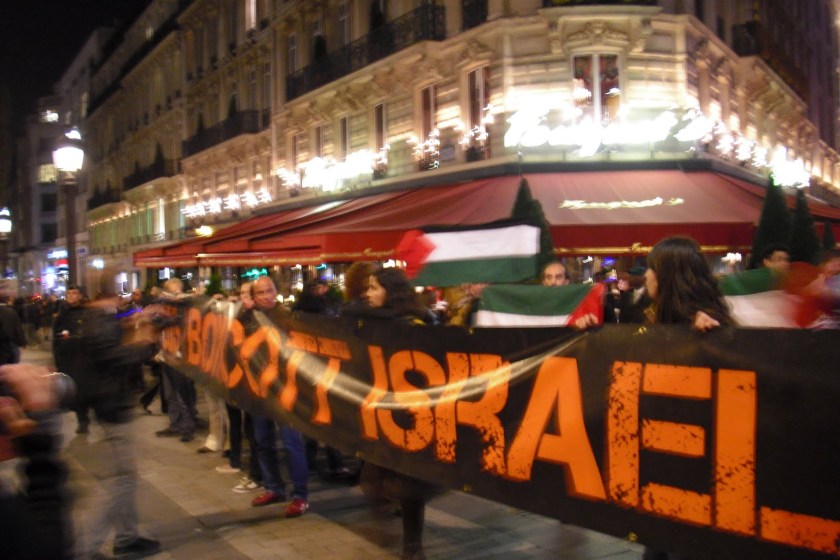
BDS activists in Paris. (Photo: Campagne BDS France)

French authorities received the request of pro-Israeli plaintiffs who finally managed to turn the international solidarity movement – and its non-violent expression of resistance against the colonial state of Israel – into a potentially punishable action.

Before reaching the tribunals and the symbolic weight of a juridical expression, this criminalizing discourse was previously set as a clear position on the opinion battlefield: many journalists and commentators harshly criticized the BDS campaign, some of them even smart enough to admit that even if the IDF — “the most moral army in the world” of “the only democracy of the Middle-East” — was perhaps not perfect, Israeli artists should still be encouraged to meet up and present their work in French festivals, universities. Apart from the fact that with such a specious reasoning racial segregation would still exist in South Africa, this discourse is omitting – either by dangerous naïveté or immoral bad faith – that culture is strictly related to the state’s apparatus: materially, through the reception of grants-in-aid, and ideologically, as an instance of reciprocity with the rest of the society. Israeli artists based in Israel are not floating in the air of abstraction: whether some complacently idealist French commentators like it or not, artists are legitimate and recognized members of the society they live in — the margin is still inside the sheet. The fact Israeli artists pay taxes to the Israeli state and serve in the Israeli military while their army bombs Palestinian civilians (with even white phosphorus as some allege) makes them indirectly but firmly responsible of the ongoing colonization, ethnic-cleansing and racist policies promoted by their government. Exempting Israeli artists and intellectuals of their moral responsibility is subsequently a poisoned gift in the long-term, and an easy way to criminalize the BDS movement in the short-term.

Continue reading “The Criminalization of BDS in France”

Zionists: terrorist pioneers

Via Stuart Littlewood:

Here’s the roll-call [from delphiforums] on who introduced terrorism (along with biological, chemical and nuclear weapons) to the Middle East:

  • Bombs in cafés: first used by Zionists in Palestine on 17 March 1937 in Jaffa (they were grenades)
  • Bombs on buses: first used by Zionists in Palestine on 20 August- 26 September 1937
  • Drive-by shootings with automatic weapons: IZL and LHI in 1937-38 and 1947-48 (Morris, Righteous Victims, p681.)
  • Bombs in market places: first used by Zionists on 6 July 1938 in Haifa. (delayed-action, electrically detonated)
  • Bombing of a passenger ship: first used by the Zionists in Haifa on 25 November 1940, killing over 200 of their own fellows.
  • Bombing of hotels: first used by Zionists on 22 July 1946 in Jerusalem (Menachem Begin went on to become prime minister of Israel).
  • Suitcase bombing: first used by Zionists on 1 October 1946 against British embassy in Rome.
  • Mining of ambulances: first used by Zionists on 31 October 1946 in Petah Tikvah
  • Car-bomb: first used by Zionists against the British near Jaffa on 5 December 1946.
  • Letter bombs: first used by Zionists in June 1947 against members of the British government, 20 of them.
  • Parcel bomb: first used by Zionists against the British in London on 3 September 1947.
  • Reprisal murder of hostages: first used by Zionists against the British in Netanya area on 29 July 1947.
  • Truck-bombs: first used by Zionists on January 1948 in the centre of Jaffa, killing 26.
  • Aircraft hijacking: world-first by Israeli jets December 1954 on a Syrian civilian airliner (random seizure of hostages to recover five spies) – 14 years before any Palestinian hijacking.

Continue reading “Zionists: terrorist pioneers”

Obama’s UN speech ‘nothing new’

Barack Obama, the US president, has urged countries in the United Nations to get behind Middle East peace efforts in an address at the UN General Assembly. But Ali Hasan Abunimah, a Palestinian-American journalist and co-founder of Electronic Intifada, an independent web site about the Israeli-Palestinian Conflict, said Obama’s speech did not represent anything new. “That bodes very ill for the peace process that he’s so invested in,” Abunimah told Al Jazeera’s Shihab Rattansi, speaking from the US state of Indiana.

“Let’s judge him not by what he says, but what he does.”

South African Academics Call for Boycott of Ben Gurion University

A long brewing South African campaign at the prestigious University of Johannesburg to cut off academic links with Ben Gurion University due to its complicity and racist practices has won the endorsement of John Dugard, Desmond Tutu, Breyten Breytenbach, Allan Boesak, Mahmoud Mamdani and almost 200 other academics from 22 academic institutions in South Africa.

SOUTH AFRICAN ACADEMICS SUPPORT THE CALL FOR UJ TO TERMINATE RELATIONSHIP WITH ISRAELI INSTITUTION

As members of the academic community of South Africa, a country with a history of brute racism on the one hand and both academic acquiescence and resistance to it on the other, we write to you with deep concern regarding the relationship between the University of Johannesburg (UJ) and Ben-Gurion University of the Negev (BGU). The relationship agreement, presented as ‘merely the continuation’ of a ‘purely scientific co-operation’ is currently being reviewed owing to concerns raised by UJ students, academics and staff. For reasons explained below and detailed in the attached Fact Sheet, we wish to add our voices to those calling for the suspension of UJ’s agreement with BGU.

Continue reading “South African Academics Call for Boycott of Ben Gurion University”

Reese Erlich: “Stop using the word ‘terrorist'”

Defining what a terrorist is and isn’t is a major dilemma. What one may consider terrorism, another may consider resistance. So where does one draw the line? Reese Erlich tackles that topic in his latest book “Conversations with Terrorists: Middle East Leaders on Politics, Violence, and Empire.” Erlich is a veteran journalist who has covered U.S. foreign policy for decades. He has freelanced for National Public Radio, Radio Deutsche Welle, the Australian Broadcasting Corp. Radio, the Canadian Broadcasting Corp. Radio, and writes for The San Francisco Chronicle and The Dallas Morning News.

Drawing on firsthand interviews and original research, Erlich argues that yesterday’s terrorist is often today’s national leader and that today’s freedom fighter may become tomorrow’s terrorist. By branding all of American’s opponents as “terrorists,” it makes it more difficult to look beyond the individual or the political group and understand what they are really all about. I caught up with Erlich recently and here’s what he had to say.

Continue reading “Reese Erlich: “Stop using the word ‘terrorist’””

American Public Opinion and the ‘Special Relationship’

by John Mearsheimer

There is no question that the United States has a relationship with Israel that has no parallel in modern history. Washington gives Israel consistent, almost unconditional diplomatic backing and more foreign aid than any other country. In other words, Israel gets this aid even when it does things that the United States opposes, like building settlements. Furthermore, Israel is rarely criticized by American officials and certainly not by anyone who aspires to high office. Recall what happened last year to Charles Freeman, who was forced to withdraw as head of the National Intelligence Council because he had criticized certain Israeli policies and questioned the merits of the special relationship.

Steve Walt and I argue that there is no good strategic or moral rationale for this special relationship, and that it is largely due to the enormous influence of the Israel lobby. Critics of our claim maintain that the extremely tight bond between the two countries is the result of the fact that most Americans feel a special attachment to Israel. The American people, so the argument goes, are so deeply committed to supporting Israel generously and unreservedly that politicians of all persuasions have no choice but to support the special relationship.

Continue reading “American Public Opinion and the ‘Special Relationship’”

Zionist Dialectics: Past and Future

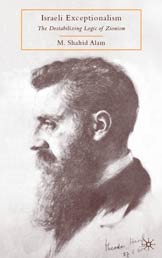
Excerpted from Israeli Exceptionalism (Palgrave: 2009).

by M. Shahid Alam

My God! Is this the end? Is this the goal for which our fathers
have striven and for whose sake all generations have suffered?
Is this the dream of a return to Zion which our people have
dreamt for centuries: that we now come to Zion to stain its soil
with innocent blood?”

Ahad Ha’am, 1921

This study has employed a dialectical framework for analyzing the destabilizing logic of Zionism. We have examined this logic as it has unfolded through time, driven by the vision of an exclusionary colonialism, drawing into its circuit – aligned with it and against it – nations, peoples, forces, and civilizations whose actions and interactions impinge on the trajectory of Zionism, and, in turn, who are changed by this trajectory.

It would be a bit simplistic to examine the field of interactions among the different actors in this historic drama on the essentialist assumption that these actors and their interests are unchanging. Instead, we need to explore the complex ways in which the Zionists have worked – and, often have succeeded – to alter the behavior of the other political actors in this drama: and, how, in turn, the Zionists respond to these changes. Most importantly, we need to explore all the ways in which the Zionists have succeeded in mobilizing the resources of the United States and other Western powers to serve their specific objectives.

Continue reading “Zionist Dialectics: Past and Future”
Nablus Limited

A soap factory and an olive oil business in Nablus deal with the harsh realities of the Israeli occupation and its impact on the economy.

Continue reading “Nablus Limited”