From the Electronic Intifada, political officer for the Ireland Palestine Solidarity Campaign David Morrison writes:
(Nidal El Khairy)
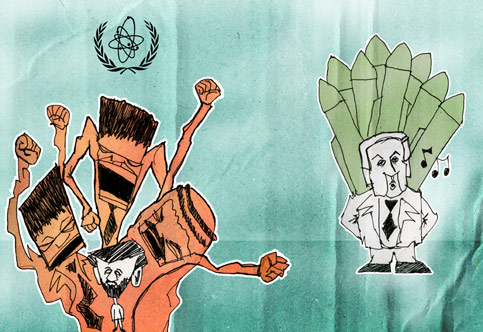
At a White House press conference on 18 May 2009, US President Barack Obama expressed “deepening concern” about “the potential pursuit of a nuclear weapon by Iran.” He continued:
Needless to say, the US/EU have ignored this proposal, which would have put Iran’s uranium enrichment facilities under a degree of international control. Perhaps, President Obama’s staff should draw this proposal to his attention.
“Iran obtaining a nuclear weapon would not only be a threat to Israel and a threat to the United States, but would be profoundly destabilizing in the international community as a whole and could set off a nuclear arms race in the Middle East.”
By his side was Israeli Prime Minister Benjamin Netanyahu. In the room with them, there was an elephant, a large and formidably destructive elephant, which they and the assembled press pretended not to see. Continue reading “The elephant in the room: Israel’s nuclear weapons”
AFP — Bestselling author Naomi Klein on Friday took her call for a boycott of Israel to the occupied West Bank village of Bilin, where she witnessed Israeli forces clashing with protesters.
“It’s a boycott of Israeli institutions, it’s a boycott of the Israeli economy,” the Canadian writer told journalists as she joined a weekly demonstration against Israel’s controversial separation wall.
“Boycott is a tactic … we’re trying to create a dynamic which was the dynamic that ultimately ended apartheid in South Africa,” said Klein, the author of “The Shock Doctrine: The Rise of Disaster Capitalism.”
“It’s an extraordinarily important part of Israel’s identity to be able to have the illusion of Western normalcy,” the Canadian writer and activist said.
“When that is threatened, when the rock concerts don’t come, when the symphonies don’t come, when a film you really want to see doesn’t play at the Jerusalem film festival… then it starts to threaten the very idea of what the Israeli state is.”
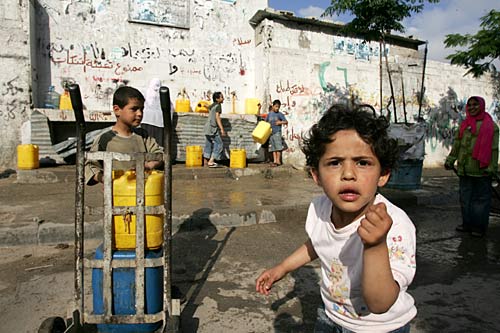
Khan Younis. Public taps for drinking water, May 2009.
Today the International Red Cross released a report detailing the catastrophic results of Israel’s brutal war on Gaza. As the siege which has crippled Gazans for the past two years continues, the Red Cross found seriously ill patients facing difficulty obtaining the treatment they needed; children suffering from deep psychological problems and people whose homes and belongings were destroyed during the conflict unable to recover.
The report in full reads:
During the 22 days of the Israeli military operation, nowhere in Gaza was safe for civilians. Hospitals were overwhelmed with casualties, including small children, women and elderly people. Medical personnel showed incredible courage and determination, working around the clock to save lives in extremely difficult circumstances. Meanwhile, daily rocket attacks launched from Gaza put thousands of residents at risk in southern Israel. Medical workers in Israel provided care for the traumatized population and treated and evacuated casualties.
Many people in Gaza lost a child, a parent, another relative or a friend. Israel’s military operation left thousands of homes partly or totally destroyed. Whole neighbourhoods were turned into rubble. Schools, kindergartens, hospitals and fire and ambulance stations were damaged by shelling and have to broker deals with financiers for support.
This small coastal strip is cut off from the outside world. Even before the latest hostilities, drastic restrictions on the movement of people and goods imposed by the Israeli authorities, particularly since October 2007, had led to worsening poverty, rising unemployment and deteriorating public services such as health care, water and sanitation. Insufficient cooperation between the Palestinian Authority in Ramallah and the Hamas administration in Gaza had also hit the provision of essential services. As a result, the people of Gaza were already experiencing a major crisis affecting all aspects of daily life when hostilities intensified in late December. Continue reading “Gaza: 1.5 million people trapped in despair”
Palestinian-American law professor and commentator George Bisharat.
In April George Bisharat wrote an article for the San Francisco Chronicle titled Changing the Rules of War giving a legal perspective on Israeli conduct in Gaza. He stated that “what is less appreciated is how Israel is … brutalizing international law, in ways that may long outlast the demolition of Gaza.” I’m sure if you read it in April, you’d remember it, and if you haven’t read it, I can’t recommend it more highly.
Maximizing Rights is a previous work of his, published 2008 in the Berkley journal Global Jurist. In it he states that it’s time to face the painful truth: the two-state solution has failed. He argues for a new paradigm, with a rights-based approach, that favours a one-state solution as it provides “the widest array of rights to the greatest number of Palestinians and Israelis.” Simply put: the one-state solution is the most just solution and is most likely to bring lasting peace.
Michael Palin, Robin Yassin-Kassab and Jeremy Harding in a 'qasr' near Ain Qenya, Ramallah
Another fine LRB diary piece by Palfest participant Jeremy Harding. A visit to the al-Khalidi library leads Jeremy to consider “the war for control of East Jerusalem that Israel has been waging, slowly but surely, by non-military means.” More pieces by Jeremy are here , here, here, and here.
Haifa al-Khalidi says that she’s not a librarian. Fine. But the al-Khalidi collection on 116 Bab al-Silsilah Street in the old city of Jerusalem doesn’t pretend to be anything other than a library so maybe Haifa simply means she’s not a scholar, even if she’s now acquainted with a thousand rare manuscripts and many more works in print that are housed here. One of the first she shows us is a beautifully decorated Arabic translation of a work on poisons and remedies by a 12th-century Indian physician. (Later I learn it contains a tale about metabolic resistance and how it’s possible, carefully and slowly, to administer a poison to a subject whose antibodies enable him to survive, even though someone else who touches him will die. Actually, that ‘he’ in the story is a her, tanked up to become a poison pie and set before a king.)
Mohammed Omer, the great Palestinian journalist and recipient of the Martha Gelhorn prize, sets the record straight about the torture ordeal he suffered at the hands of the Israeli Shin Beth torturers.
June 26, 2008 is a day I will never forget. For the events of that day irrevocably changed my life. That day I was detained, interrogated, strip searched, and tortured while attempting to return home from a European speaking tour, which culminated in independent American journalist Dahr Jamil and I sharing the Martha Gellhorn Journalism Prize in London — an award given to journalists who expose propaganda which often masks egregious human rights abuses.
Mohammed Omer receiving the Martha Gelhorn Prize together with Dahr Jamail
I want to address the denials from Israel and the inaccurate reporting by a few journalists in addition to requesting state of Israel to acknowledge what it did to me, prosecute the members of the Shin Bet responsible for it and put in place procedures that protect other journalists from such treatment.
Since 2003, I’ve been the voice to the voiceless in the besieged Gaza Strip for a number of publications and news programs ranging from The Washington Report on Middle East Affairs to the BBC and, Morgenbladet in Norway as well as Democracy Now! These stories exposed a carefully-crafted fiction continuing control and exploitation of five-million people. Their impact, coupled with the reporting of others served to change public opinion in the United States and Europe concerning the dynamics of Israel and its occupation of Palestine .
After receiving the Martha Gellhorn prize I returned home through the Allenby Bridge Crossing in the Occupied West Bank between Jordan and Israel. It was here I was detained, interrogated, and tortured for several hours by Shin Bet and border officers. When it appeared I may be close to death an ambulance was called to transport me to a hospital. From that day my life has been a year of continued medical treatments, pain — and a search for justice.
How can the supposed liberalism of Tel Aviv coexist with apartheid and occupation? In this excellent essay Yonatan Mendel considers the Israeli “fantasising project.” “It is the “positive, ‘normal’ and likeable characteristics of Tel Aviv,” Mendel argues, “that make it a paradigm of the moral and political blindness of Israeli society.”
At this very moment, long queues are probably forming outside Tel Aviv’s latest culinary thing: the yoghurterias. Even in the middle of the night you have to wait in line to get a cold and refreshing ice-cream yoghurt from the busy shop on Rothschild Boulevard. Springing up like mushrooms after the rain, the ice-cream parlours have allowed the ‘white city’ of Tel Aviv to experience the white revolution of the yoghurt. It is sweet and sour, made of natural ingredients, both healthy and tasty, with only 1.6 per cent fat, and topped with pieces of fresh fruit freshly cut up. Mangoes and pineapples, kiwis, strawberries, pomegranates, dates, melons and watermelons, red, yellow and green, are generously placed on top of the thick white yoghurt. A small cup of the local delicacy costs 18 shekels (about £3), a medium-size cup is 21 shekels, and a huge cup is 27 shekels. This is the best gastronomic response to the humidity that prevails in Israel’s ‘first Hebrew city’.
Al Jazeera’s Empire, with Marwan Bishara. The first short documentary is so bad that it could have been made by the BBC or CNN. Flynt Leverett is insightful as usual, but as much as I love and respect Hamid Dabashi, I think he adds little of value to the discussion.
Today marks the second anniversary of the criminal siege of Gaza. Here is a statement signed by over 40 NGOs, humanitarian and UN organizations denouncing Israel’s blockade:
We, United Nations and non-governmental humanitarian organisations, express deepening concern over Israel’s continued blockade of the Gaza Strip which has now been in force for two years.
These indiscriminate sanctions are affecting the entire 1.5 million population of Gaza and ordinary women, children and the elderly are the first victims.
The amount of goods allowed into Gaza under the blockade is one quarter of the pre- blockade flow. Eight out of every ten truckloads contains food but even that is restricted to a mere 18 food items. Seedlings and calves are not allowed so Gaza’s farmers cannot make up the nutritional shortfall. Even clothes and shoes, toys and school books are routinely prohibited.
The Dutch crypto-fascist MP Geert Wilders, who has been recently banned from the UK with the Home Office viewing his presence as a “threat to one of the fundamental interests of society“, says that the sequel to his first movie Fitna will focus on “how the forces of Islamization are specifically targeting Israel in a fight against all free societies.” In an interview with Haaretz, he not only commended Avigdor Liberman for his electoral succes and said he is “proud” of the similarities between his own Party for Freedom and Yisrael Beiteinu but calls the “two-state solution is an internal Israeli matter“. His “personal belief is that there is a two state solution for the Palestinians. One of those states is called Jordan.” Whilst such statements are nothing new from Wilders, the fact that he seized 15% (2nd place) of the vote in the Dutch European Parliament elections means that he’s becoming a political force to be reckoned with.
Israel will be a major part of Geert Wilders’ next film on Islam, the rightist Dutch legislator said last week in an interview for Haaretz. He praised Avigdor Lieberman, observing “similarities” between Yisrael Beiteinu and the Party for Freedom – a small movement which has grown to become Holland’s second most popular.
Wilders, a controversial anti-immigration politician, rose to international fame last year when he released a 14-minute film entitled Fitna, which attempts to portray what he considers as Islam’s “violent nature.” The film, which has been viewed by millions online, provoked mass protests throughout the Muslim world.


 P U L S E